
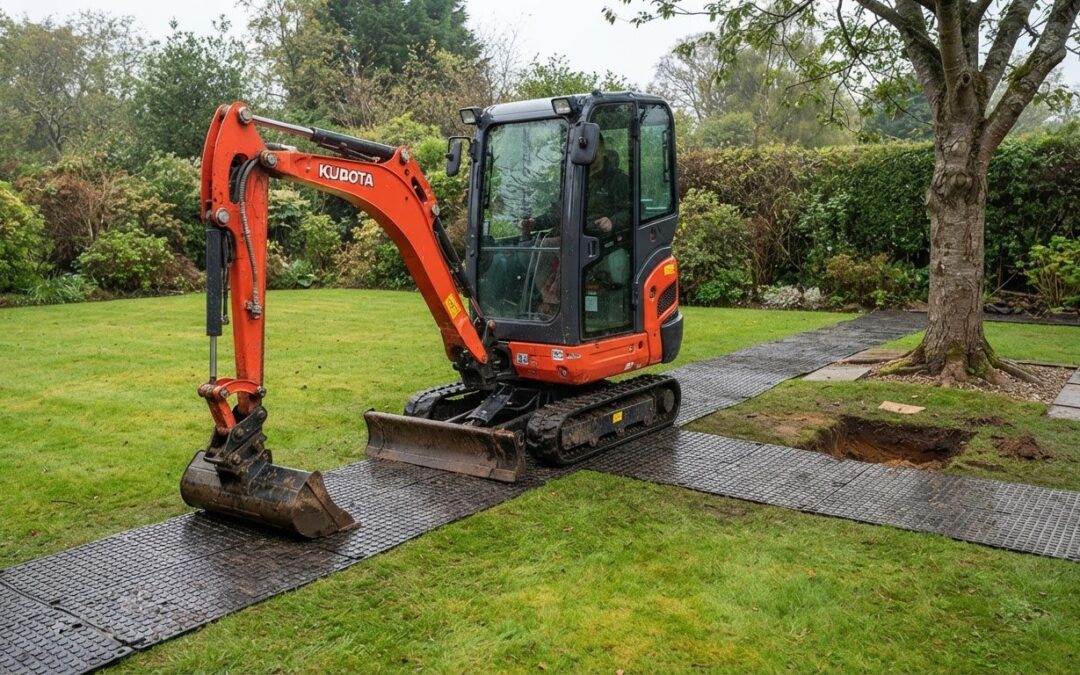
The route can do as much damage as the digger. Protecting a lawn from a mini digger starts with firm ground, a direct route and suitable ground protection where the machine will travel and turn. Avoid turning on the spot, which can tear turf and mark paving.
It’s reasonable to want the work done without leaving ruts or damaged surfaces. Careful planning can reduce avoidable wear, although soft ground and tight turning spaces make protection more difficult.
This guide explains how to plan a route with fewer repeated passes, choose between ground protection mats, boards and plywood, and protect existing lawns, paving and protected trees. You’ll also find practical points to consider before the machine arrives, including access, turning areas and what to do if the lawn needs attention after the work.
Key Takeaways
- Plan a direct route before work begins, with turning areas that limit repeated tracking across vulnerable ground.
- Choose ground coverings to suit the surface and machine movement, paying particular attention to turning points.
- Consider ground firmness, access and protected trees when deciding where machinery can travel.
- Prepare for lawn recovery as well as prevention, since ground conditions and the length of the work can affect the result.
1. Ground protection around protected trees
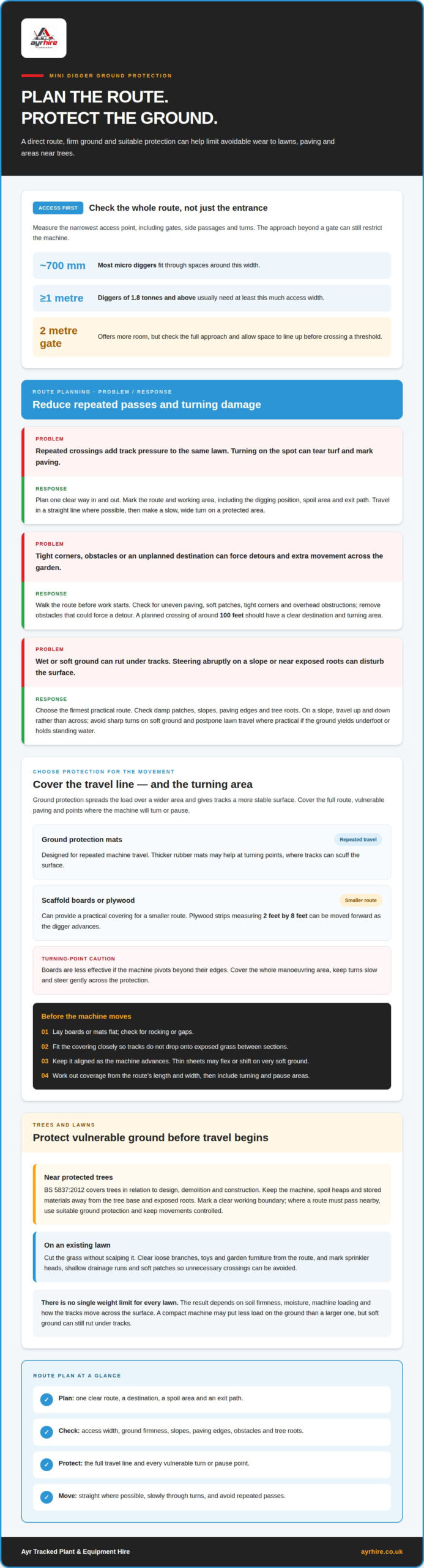
Plan the route before excavation, especially where a lawn meets a protected tree. BS 5837:2012 covers trees in relation to design, demolition and construction, according to the British Standards Institution. Keep the machine, spoil heaps and stored materials away from the tree base and exposed roots. Mark a clear working boundary before moving machinery onto the ground. Where the route must pass near a tree, use suitable ground protection and keep movements controlled.
How much weight can a lawn support before a mini digger causes damage? There’s no single weight limit for every lawn. The result depends on soil firmness, moisture, machine loading and how its tracks move across the surface. A compact machine may put less load on the ground than a larger one, but soft ground can still rut under tracks. Check the ground first: if it yields underfoot or holds standing water, postpone travel across the lawn where practical.
Mini diggers can tear turf, leave ruts and compact soil beneath their tracks. Compaction can restrict water movement through the soil and affect drainage around the worked area. Turning on soft ground adds sideways force, which can shear grass and leave track marks. Avoid sharp turns near trees or across wet turf. Instead, travel in a straight line, then make a slow, wide turn on a protected area where space allows.
Firm ground reduces the chance of rutting compared with wet, soft ground. Before work starts, walk the planned route and identify damp patches, slopes, paving edges and tree roots. Choose the firmest practical route and protect vulnerable turning points with boards or mats. On a slope, travel up and down rather than across. Wet soil can reduce traction, while abrupt steering may disturb turf even when the machine is moving forward. Avoiding repeated passes helps limit pressure on lawns and around trees.
2. Planning routes to prevent repeated passes and turning damage
Map the machine’s route before delivery. Choose one clear way in and out rather than repeatedly crossing the same lawn. Mark the route and working area to prevent people, materials and machinery from creating extra crossings. Include the digging position, spoil area and exit path in the plan. A straight route reduces steering movements and helps keep track pressure off the surrounding turf.
Measure the narrowest access point, including gates, side passages and turns. Most micro diggers fit through spaces around 700 mm wide, while diggers of 1.8 tonnes and above usually need at least 1 metre. A 2 m gate offers more room, but the approach beyond it may still restrict the machine. Check the full route, not just the entrance, and allow space to line up before crossing a threshold.
Turning is often harder on grass than travelling straight. Turning a tracked machine on the spot can tear turf and press track teeth into the surface. Plan a wide turn where space allows. Move slowly and steer gently, avoiding abrupt changes in direction. If the route ends in a confined area, place suitable ground protection at the turning point before manoeuvring.
For a route that crosses a lawn before reaching another work area, keep travel in one direction where possible. For example, a planned crossing of around 100 feet should have a clear destination and turning area, rather than repeated journeys to fetch materials. Where a turn is unavoidable, use formply beneath the turning point and steer across it gently. This gives the tracks a more stable surface than unprotected turf.
Before work starts, walk the route and remove obstacles that could force a detour. Check for tight corners, uneven paving, soft patches and overhead obstructions. A simple route plan helps coordinate tracked equipment hire with available access, reducing unnecessary movement across the garden.
3. Using ground protection mats, scaffold boards or plywood
Lay ground protection along the machine’s full route, including vulnerable paving and turning points. Mats and boards spread the load over a wider area, reducing pressure on individual patches of lawn. They also provide a more stable surface for the tracks. Fit the covering closely so the machine doesn’t drop onto exposed grass between sections. Protect paving before tracking across it, especially where joints or edges could be affected.
Choose a material that suits the job. Ground protection mats are designed for repeated machine travel, while scaffold boards or plywood can provide a practical covering for a smaller route. Plywood strips measuring 2 feet by 8 feet can be moved forward as the digger advances. Thicker rubber mats may help at turning points, where tracks can scuff the surface. Boards are less effective if the machine pivots beyond their edges, so cover the whole manoeuvring area.
How much does it cost to hire ground protection mats in the UK? The price depends on the job and is provided after a quote request. Key factors include mat type, quantity, hire duration and delivery requirements.
How many ground protection mats are needed for a mini digger route? Work it out from the route’s length and width, then include areas where the machine will turn or pause. For a straight path, calculate how many mats cover the travel line, allowing for each mat’s dimensions and any overlap needed. Include turning points rather than estimating from the route alone.
Before the machine moves, lay the boards or mats flat and check for rocking or gaps. Keep the covering aligned as the machine advances. If the ground is very soft, a thin sheet may flex or shift under track pressure. Use substantial covering along the route and keep turns slow, with the tracks supported throughout the manoeuvre.
4. Protecting an existing lawn during mini digger work
Prepare the lawn before the machine arrives. Cut the grass without scalping it, and clear loose branches, toys and garden furniture from the route. Mark sprinkler heads, shallow drainage runs and soft patches so the operator can avoid unnecessary crossings. Lay protection over the planned track line and check that the boards stay flat as the machine travels.
During the work, lift boards occasionally to inspect the grass beneath them. This can reveal trapped moisture or flattened areas before the covering is moved elsewhere. Keep to the planned route and avoid parking the machine on unprotected turf. If the job extends beyond two weeks, the lawn may be harder to preserve, so include recovery in the plan.
If turf must be lifted, store it in a shaded place and water it as needed to keep the grass growing. Reuse it when the work is complete, provided it remains in suitable condition. Before relaying, loosen the soil to around 10-15 cm. Remove rubble and contamination, then level the surface so water can drain and roots can establish.
For a private garden, arrange the property owner’s permission before machinery crosses the lawn. Insurance requirements depend on the contract and who is carrying out the work. Agree responsibility for accidental damage before starting, including who will handle repairs if tracks leave ruts or compacted patches.
After the machine leaves, assess the whole route rather than repairing only the most visible marks. Rake out shallow impressions, loosen compacted soil and replace damaged turf. If a larger area needs renewing, prepare the ground evenly before laying new turf. This gives roots a consistent surface and helps prevent dips as the lawn settles.
Planning a garden excavation? Arrange mini digger hire with the route and lawn protection in mind.
Ayr Tracked Plant & Equipment Hire: KUBOTA Mini Excavator / Digger
Ayr Tracked Plant & Equipment Hire offers a KUBOTA Mini Excavator / Digger for garden excavation and other projects that need a mini digger. It can be a practical option once you’ve planned the work area, route and surface protection and need tracked equipment for protecting lawn from mini digger damage during the job.
Before arranging hire, have the key site details ready: access width, ground conditions, excavation area and any lawn or paving the machine must cross. This helps match the equipment to the site and plan its route. Position boards or mats along the route and at turning points to help protect vulnerable surfaces.
For work involving more than excavation, Ayr Tracked Plant & Equipment Hire also offers a FORST TR8 8" Tracked Wood Chipper, an ALMA Crawler Multi-Loader and Vacuum Lifter Hire. Contact Ayr Tracked Plant & Equipment Hire to discuss your mini digger requirements.
Set the site up for a smoother start
Before work begins, turn the route plan into a simple site brief. Mark the access, excavation area and any surfaces that should remain clear. Note who will move stored materials or reposition protection if the work area changes. These decisions give the operator a clear starting point and help avoid hurried changes once the machine is on site.
Also agree how the garden will be left after excavation. Decide whether the priority is preserving every section of turf or keeping access open for the work, then plan the finish accordingly. Protecting a lawn from a mini digger is easier when acceptable trade-offs are clear before work starts.
If a KUBOTA Mini Excavator / Digger suits your project, contact Ayr Tracked Plant & Equipment Hire to discuss the equipment needed. A clear site plan is a practical first step towards getting the work underway with confidence.
Frequently Asked Questions
How do I protect my lawn or paving?
Cover the machine’s route with ground protection boards or mats, including the transition between lawn and paving. Keep the covering aligned so tracks don’t catch exposed edges. Avoid using paving as a turning point if possible. Before work begins, clear loose gravel and garden debris from the route, as these can be pressed into grass or dragged across paving.
How can I protect a lawn from mini digger damage?
Protecting a lawn from mini digger damage starts with matching the machine to the access and excavation task. A micro digger may put less pressure on turf than a heavier machine. Keep travel to the planned work area and avoid driving over the same strip for separate tasks. If the lawn is soft underfoot, use a protected route or delay crossing it.
What ground protection mats are suitable for a mini digger on grass?
Choose mats designed to support plant movement, with a surface that stays stable beneath the tracks. Cover the whole route, including places where the machine needs to pause or change direction. Thick rubber mats can be useful at turning points, while boards can cover a straight access route. The right choice depends on ground firmness, the machine and how it will manoeuvre.
Are plywood sheets safe for protecting a lawn from a mini digger?
Plywood can provide a protective trackway, but it needs to lie flat and remain supported as the machine crosses it. Eighteen-millimetre plywood has been recommended for mini diggers and dumpers. Cover the full track path, not just the centre line, and reposition sheets carefully as work progresses. If a sheet shifts, flexes or leaves gaps, stop and adjust the covering before continuing.
How should I prepare and mark a route across a lawn for a mini digger?
Walk the proposed route before machinery arrives and mark its edges with visible markers. Show the entry point, destination, working area and any section that must stay clear. Include turning space rather than marking only a narrow, straight line. Remove obstacles that could force a detour, then explain the route and any fragile surfaces to the operator before the first pass.