A single hairline fracture on a high-value glass panel in Glasgow city centre doesn’t just stall your timeline; it erases your project profit. You already know that managing heavy glazing in tight urban spaces like Sauchiehall Street requires absolute precision. Relying on outdated equipment or inconsistent suppliers is a risk your budget simply cannot afford. This guide helps you master vacuum lifter hire Glasgow by aligning the latest 2026 LOLER safety standards with the practical demands of local construction sites. We provide the technical clarity needed to eliminate material breakage and ensure full regulatory compliance. You’ll learn how to select the correct lifting capacity for your specific load, handle the logistical hurdles of narrow access, and maintain a seamless workflow from delivery to installation. Whether you’re working on the Shawlands Regeneration or high-end office fit-outs, these insights secure your site and protect your bottom line. Precise suction. Heavy-duty reliability. Professional results. We’ve stripped away the jargon to focus on the high-performance tools that get the job done safely.
Key Takeaways
- Master the technical selection process by understanding Safe Working Load (SWL) requirements and the safety advantages of dual-circuit vacuum systems.
- Secure cost-effective vacuum lifter hire Glasgow by leveraging local expertise to navigate the logistical challenges of city centre sites.
- Stay fully compliant with 2026 LOLER regulations by learning which specific safety documentation is mandatory for every lift.
- Match your equipment to the environment, from compact lifters for residential window replacements to high-capacity units for commercial shopfronts.
- Increase on-site efficiency by integrating vacuum lifters with mini spider cranes for precision handling in narrow or difficult-to-reach areas.
Navigating Glass Handling Challenges on Glasgow Construction Sites
Modern structural glazing requires more than just muscle. Large-format glass units are heavier and more expensive than ever. Manual handling poses an unacceptable risk to both workers and the project budget. In 2026, professional contractors rely on vacuum lifting technology to bridge the gap between safety and efficiency. Using mechanical aid is no longer a luxury; it’s a site requirement for commercial projects across the city.
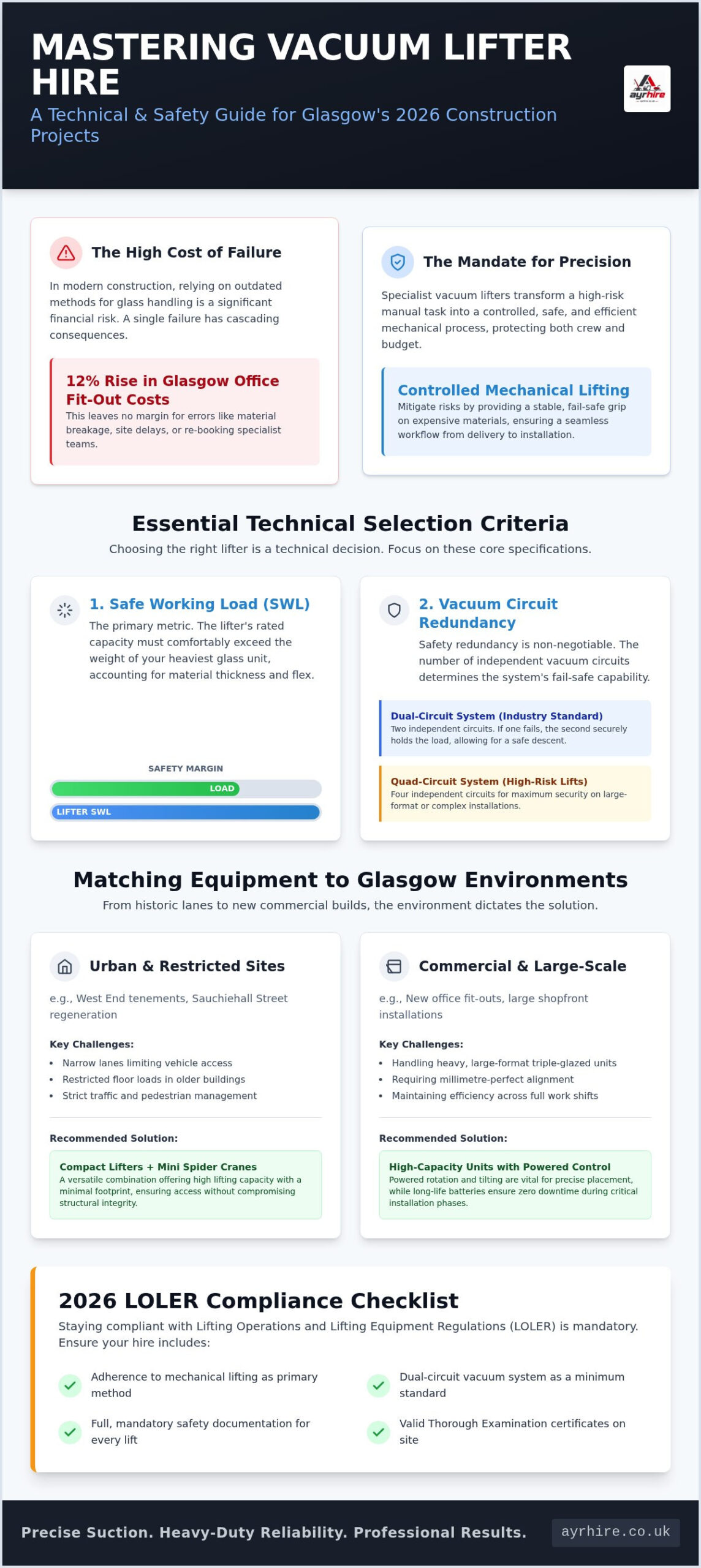
The financial impact of material breakage is severe. Glasgow office fit-out costs rose by 12% in early 2026, leaving little room for error. A shattered unit doesn’t just mean a replacement cost. It means site delays, re-booking specialist teams, and potential liquidated damages. Specialist vacuum lifter hire Glasgow mitigates these risks by providing a stable, fail-safe grip on expensive materials. It transforms a high-risk manual task into a controlled mechanical process. Reliability is the priority.
The Shift Towards Mechanical Precision in 2026
Building standards in 2026 prioritise mechanical lifting to eliminate musculoskeletal injuries. Manual labour is now viewed as the last resort for heavy glazing. Suction technology has evolved, allowing for the safe handling of non-porous materials with varying textures and weights. Fundamentally, a vacuum lifter is a primary safety device for structural glass. It ensures the load remains secure even during complex rotations or tilts. This evolution in site safety reflects a broader industry commitment to zero-harm environments. We provide the tools to meet those standards.
Glasgow-Specific Site Constraints
Glasgow presents unique logistical hurdles. In the West End, narrow lanes and traditional sandstone tenements limit the use of heavy plant. Our vacuum lifter hire Glasgow service focuses on compact, high-performance equipment that fits where others can’t. City centre projects, such as the regeneration work on Sauchiehall Street, require precise delivery timing to manage traffic permits and pedestrian safety. We understand the local geography and the permits required for smooth operation.
Older buildings often have restricted floor loads. You can’t always roll in heavy machinery. Compact vacuum lifters solve this problem. They offer high lifting capacities without the massive footprint of traditional cranes. When paired with mini spider cranes, they provide a versatile solution for restricted spaces. This combination ensures you can complete structural glazing in historical or congested areas without compromising the building’s integrity. It’s a practical approach to Glasgow’s most challenging sites. Simple. Efficient. Safe.
Essential Technical Specifications for Vacuum Lifter Selection
Choosing the right equipment for vacuum lifter hire Glasgow requires a deep dive into technical data. You can’t rely on guesswork when handling structural glass. The primary metric is the Safe Working Load (SWL). This figure must account for the weight of the glass and the specific thickness of the unit. Thinner glass may flex under suction, whereas triple-glazed units demand high-capacity frames. Always ensure your chosen lifter has a rated capacity that exceeds your heaviest load by a comfortable margin.
Safety redundancy is managed through vacuum circuits. Dual-circuit systems are the industry standard for most Glasgow sites. They use two independent vacuum paths. If one fails, the second holds the load long enough to lower it safely. For extremely large-format glazing or high-risk lifts, quad-circuit systems offer even greater security. Adhering to Safety Standards and LOLER Compliance is essential when deciding which circuit configuration matches your risk assessment. Higher redundancy reduces site stress and protects your insurance standing.
Movement control is another critical factor. Manual rotation and tilting are suitable for smaller domestic units. However, for commercial shopfronts, powered rotation is vital. It allows for millimetre-perfect alignment without manual manhandling. Modern lifters for 2026 also feature improved battery technology. You need a machine capable of a full eight-hour shift. Check the charging requirements before delivery. Most professional units now utilise fast-charge lithium systems to prevent downtime during busy glazing schedules. If you’re unsure which specification fits your project, you can view our specialised vacuum lifter fleet to compare technical data sheets.
Suction Pad Configuration and Load Capacity
The number of pads determines how the weight is distributed. Oversized units require a wider pad spread to prevent the glass from bowing. This spread is also vital for stability during lifts in high-wind conditions, which are common on exposed Glasgow sites. Generally, the lifting capacity of a system increases proportionally with the total surface area and diameter of the suction pads. Larger pads provide a more aggressive grip on heavy, non-porous surfaces.
Control Systems and Safety Indicators
Visual and audible low-vacuum warnings are non-negotiable. These systems alert the operator immediately if pressure drops below safe levels. Vacuum reserve tanks provide a secondary layer of protection, acting as a buffer to prevent sudden load drops. In 2026, intelligent grip technology is becoming more common. These sensors monitor the seal quality in real-time. It provides the operator with instant feedback on the security of the lift. This data-driven approach to lifting ensures a superior safety record on every Glasgow project. It removes the “human error” element from the suction process.
Matching Equipment to Glasgow Project Environments
Glasgow’s architectural landscape is a mix of Victorian tenements and modern steel-frame offices. Each environment dictates your equipment choice. For residential window replacements in the West End, compact lifters are essential. They allow for safe handling in tight gardens or narrow alleys without blocking entire streets. These smaller units provide the necessary suction without the bulk of industrial frames. Reliability in restricted spaces is key.
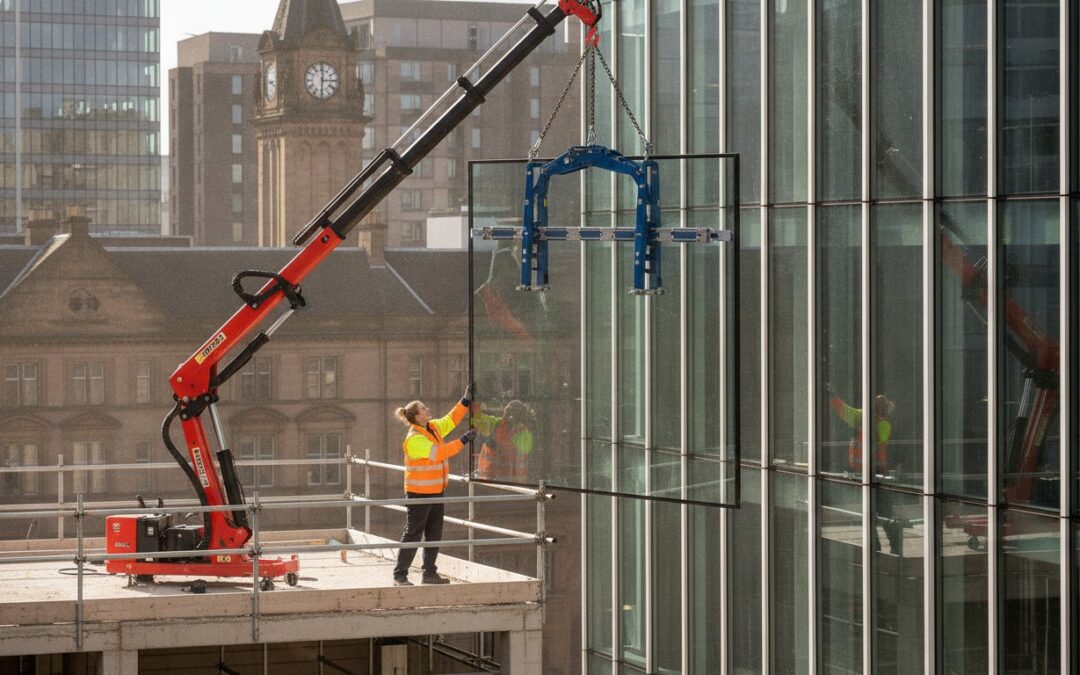
Commercial shopfronts in high-traffic areas require a different approach. Here, you’re dealing with large-format glass units that weigh hundreds of kilogrammes. You need vacuum lifter hire Glasgow that offers high-capacity suction and precise control. Internal fit-outs often present height restrictions where traditional cranes cannot operate. Using a lifter in conjunction with a floor crane allows for glass installation in basement levels or mezzanine floors. For more complex curtain walling projects, integrating your lifter with mini spider cranes is the industry standard. This synergy provides the reach and stability required for multi-storey glazing. It’s about having the right tool for the specific site footprint.
The Right Tool for Retail and Office Glazing
Retail glazing demands millimetre precision. Selecting a lifter with 360-degree rotation and 90-degree tilting is critical for positioning glass into recessed frames. Slimline models are particularly effective when working between scaffolding and the building envelope. Consider a recent shopfront installation on Buchanan Street. The restricted space and constant pedestrian flow meant manual handling was impossible. A slimline vacuum lifter allowed the team to install 400kg panels through a narrow scaffold gap with zero damage. Adhering to Essential Technical Specifications during these high-profile lifts ensures site safety remains the top priority. It protects the glass and the public.
Difficult Access and Rural Glasgow Sites
Projects on the outskirts of Glasgow or in rural Ayrshire present different logistical challenges. Transporting heavy equipment to remote sites requires careful planning. For these scenarios, pairing vacuum lifters with ALMA multi-loaders simplifies material transport across uneven terrain. Managing the initial lift phase on soft or unlevel ground is a common hurdle. Tracked loaders provide a stable platform for the glass before the vacuum lifter takes over for the final install. This setup reduces the manual effort of moving heavy units from the delivery vehicle to the installation point. It’s a robust solution for the “last mile” of site logistics. Efficient. Dependable. Built for the task.
Safety Standards and LOLER Compliance for 2026
Safety is the foundation of every successful glazing project. In 2026, staying compliant with the Lifting Operations and Lifting Equipment Regulations (LOLER) is more critical than ever following recent HSE regulatory reviews. When you arrange vacuum lifter hire Glasgow, the legal responsibility for the safe execution of the lift sits with you. This begins with appointing an Appointed Person (AP) who possesses the technical knowledge to plan the operation effectively. The AP must produce a comprehensive lift plan and risk assessment that accounts for every variable on your Glasgow site, including the high-value materials discussed in previous chapters.
A current Report of Thorough Examination (RoTE) is your proof of equipment safety. Never allow a lifter onto your site without verifying this document. It’s a legal requirement that protects your team and your business from liability. Beyond the official paperwork, daily pre-use checks are mandatory. Operators must inspect suction pads for tears, check battery levels, and test the audible warning systems before the first lift of the day. These small steps prevent major incidents. If you need equipment that arrives with all certification ready for inspection, you can book your LOLER-compliant vacuum lifter hire with a partner that prioritises technical readiness.
The 2026 LOLER Inspection Landscape
HSE inspectors in 2026 are looking for clear evidence of proactive maintenance rather than just reactive repairs. At Ayr Tracked Plant & Equipment Hire, we prioritise rigorous maintenance schedules to ensure every fleet item exceeds industry standards. Reliability is built into our process. Under current regulations, lifting accessories such as vacuum lifters must undergo a thorough examination by a competent person at least every six months. This frequency ensures that the high-stress components of the vacuum system remain functional and safe under load. It’s a non-negotiable standard that we uphold for every piece of machinery we supply.
Site Preparation and Risk Assessment
Glasgow’s urban environment demands specific site preparation. For major projects like the £150m Shawlands Regeneration, ground stability is a primary concern. You must ensure the surface can support the combined weight of the glass, the lifter, and the primary lifting machine, such as a mini spider crane. Wind speed monitoring is equally vital. Glass acts like a sail in high winds. Most lift plans specify a maximum wind speed, often around 18 to 20mph, beyond which the operation must be postponed. Ignoring these limits is a recipe for disaster. We provide the technical data you need to set these safety parameters accurately. It’s a no-nonsense approach to site safety that protects your project and your reputation.
Securing Reliable Vacuum Lifter Hire with Ayr Tracked Plant & Equipment Hire
Local expertise is the final piece of the structural glazing puzzle. When you choose vacuum lifter hire Glasgow from a regional specialist, you eliminate the logistical friction often found with national supply chains. We understand the specific challenges of Scottish site conditions. Whether it’s the coastal winds of Ayrshire or the narrow lanes of the Glasgow West End, our team has supported projects in these environments for years. Ayr Tracked Plant & Equipment Hire maintains our fleet to the highest professional standards. This ensures that when the equipment arrives on your site, it’s fully certified and ready for immediate operation.
Flexibility is built into our service model. We offer daily, weekly, and project-based hire terms to suit your specific timeline. This prevents you from paying for idle machinery during unavoidable site delays or inclement weather. Beyond the hardware, we provide expert consultation as standard. We match your glass specifications, including weight, dimensions, and thickness, to the most efficient lifting solution in our fleet. For comprehensive site requirements, we offer seamless integration with other specialist plant hire. This allows you to source mini spider cranes, multi-loaders, and vacuum lifters from a single, dependable point of contact. It simplifies your procurement process and ensures all equipment on-site works in perfect synergy.
Why a Local Partner Matters for Glasgow Projects
A local partner provides more than just machinery. We offer a personalised service rooted in regional accountability. If you encounter a technical hurdle or need an urgent equipment swap due to a change in site conditions, our proximity allows for a rapid response. National suppliers often struggle with the specific logistics of the Glasgow central belt and the surrounding Ayrshire towns. We don’t. We keep your project moving without the need for long-distance transport delays. Choosing Ayr Tracked Plant & Equipment Hire also supports the Glasgow and Ayrshire economy. It fosters long-term professional relationships built on trust and consistent performance. We’re a steady hand for your most demanding projects.
Booking Your Hire: Next Steps
Securing your equipment is a straightforward, transparent process. You can request a quote by providing your specific load requirements and your site location. Our team reviews the technical data to confirm the best machine for your specific glazing task. We handle all delivery logistics across Glasgow, Ayr, and the surrounding regions. This ensures the lifter arrives exactly when your glazing team is ready to begin installation. No delays. No unnecessary filler. Just professional tools for professional results. Enquire about vacuum lifter hire for your Glasgow site today and secure your project timeline with a reliable local partner.
Securing Success for Your Next Glasgow Glazing Project
The transition from manual handling to mechanical precision is the defining shift for Glasgow glazing projects in 2026. As we’ve detailed, success depends on more than just equipment; it requires the correct technical alignment between load specifications and site-specific constraints. By integrating the technical insights on SWL and LOLER compliance covered in this guide, you can eliminate the risk of material damage whilst maintaining a safe, efficient site. Professional vacuum lifter hire Glasgow provides the stability needed for complex structural glass installations, ensuring your project remains on schedule and within budget.
Ayr Tracked Plant & Equipment Hire is your local specialist for these demanding tasks. We provide the compact, high-performance tools necessary for narrow access and high-traffic Glasgow environments. Our flexible daily and weekly hire terms, combined with a fleet that meets the most rigorous 2026 safety standards, make us the dependable choice for Scottish contractors. Contact Ayr Tracked Plant & Equipment Hire for Expert Vacuum Lifter Hire in Glasgow to secure your project’s success. Let’s get the job done with professional precision.
Frequently Asked Questions
What is the maximum weight a glass vacuum lifter can handle?
Maximum lifting capacity depends entirely on the specific model and pad configuration. Our fleet includes compact units with a 320kg capacity for domestic tasks and heavy-duty machines capable of handling up to 1200kg for commercial glazing. Always verify the Safe Working Load (SWL) on the machine’s data plate to ensure it exceeds the weight of your heaviest glass unit.
Do I need a special licence to operate a vacuum lifter in Glasgow?
There isn’t a specific “vacuum lifter licence,” but operators must be competent under LOLER 1998 regulations. Most commercial sites in Glasgow require proof of formal training, such as a CPCS or NPORS category for specialist lifting. It’s the responsibility of the site’s Appointed Person to ensure the operator has the necessary skills to manage the equipment safely.
Can vacuum lifters be used in the rain on Scottish sites?
You can use vacuum lifters in the rain, provided the suction pads and the glass surface are kept free of contaminants. Whilst moisture is manageable, you must ensure a clean seal to maintain the required vacuum pressure. In Scotland, wind speed is usually a more critical factor; lifts should be postponed if gusts exceed the limits specified in your lift plan.
What happens if the power fails whilst a load is being lifted?
If a power failure occurs, the machine’s vacuum reserve tanks and dual-circuit systems are designed to hold the load securely. Audible and visual low-vacuum alarms will trigger immediately to alert the site team. This safety redundancy provides a vital window of time to lower the glass safely to the ground before the pressure drops below a critical level.
Are your vacuum lifters LOLER compliant for 2026?
Yes, every machine in our fleet is fully compliant with 2026 safety standards. We provide a current Report of Thorough Examination (RoTE) with every vacuum lifter hire Glasgow. This documentation is essential for your health and safety records and confirms the equipment has undergone a rigorous inspection by a competent person within the last six months.
Can I hire a vacuum lifter for a single day in Glasgow?
We offer flexible daily hire terms to accommodate short-term projects like residential window replacements or emergency repairs. If your project requirements change, we can easily extend the agreement to a weekly or monthly term. This flexibility ensures you only pay for the equipment when it’s actually needed on your Glasgow site.
What surfaces besides glass can a vacuum lifter handle?
Vacuum lifters are suitable for almost any non-porous, flat material. They are frequently used to handle polished stone, metal cladding panels, and composite plastic sheets. As long as the material surface is airtight and smooth enough for the pads to create a vacuum seal, the equipment will provide a stable and secure mechanical grip.
How much space is required for a vacuum lifter to operate?
Compact lifters require very little operational clearance and are designed for narrow access environments. Because the lifter attaches to the face of the glass, it’s ideal for installation between scaffolding and the building envelope. Some of our slimline models are specifically chosen for their ability to work in the restricted spaces common in Glasgow city centre developments.