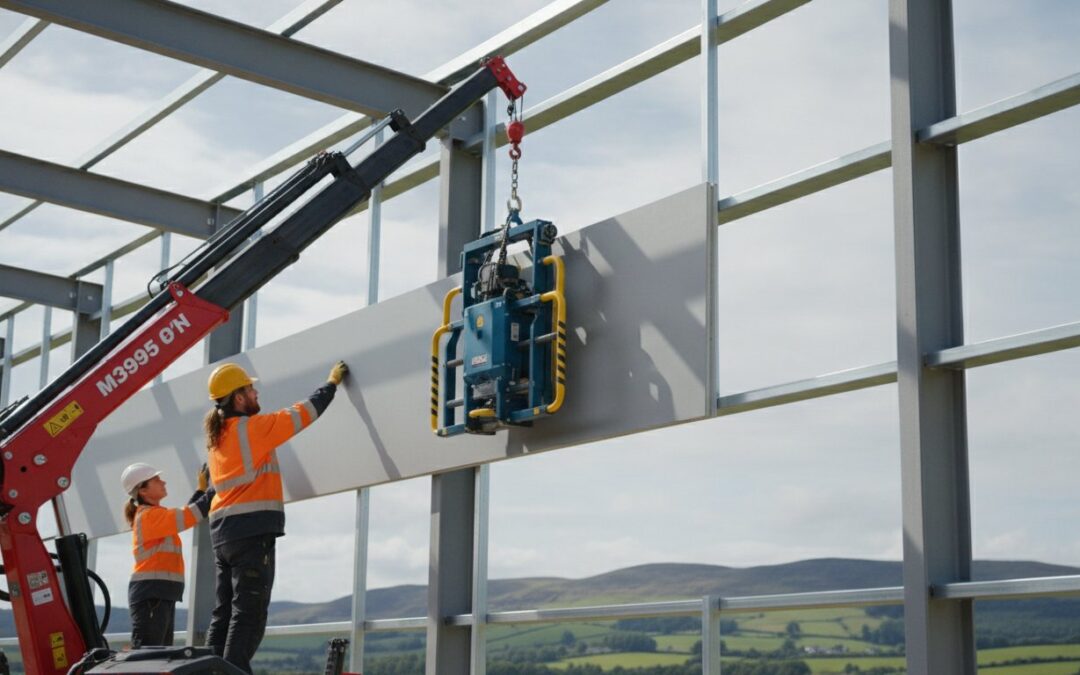
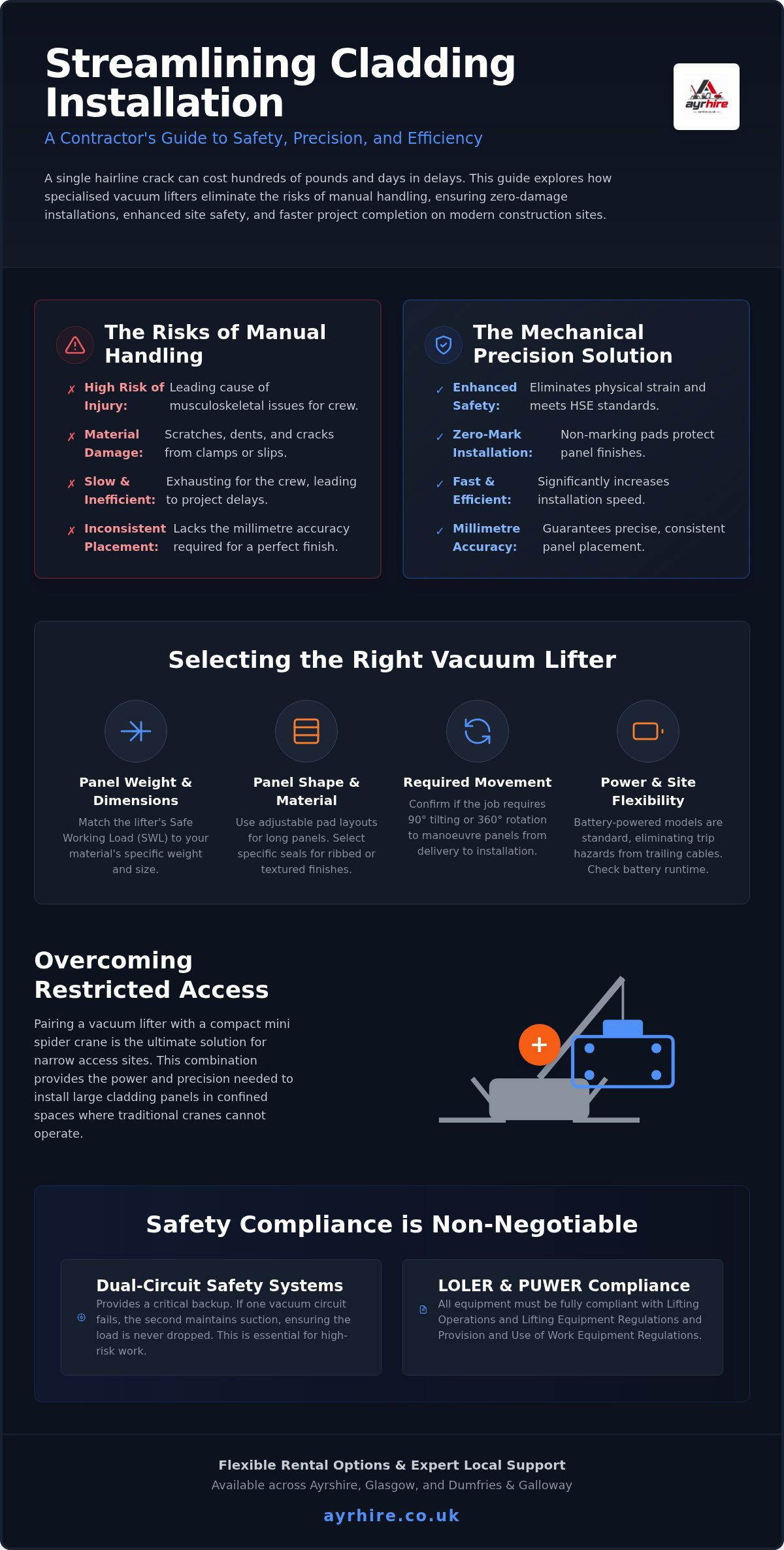
A single hairline crack in a premium cladding panel can cost you hundreds of pounds in replacements and days in avoidable delays. You know the frustration of manual handling on a tight site. It’s slow. It’s risky. It puts your reputation for a perfect finish at risk. Using a specialised vacuum lifter for cladding installation Ayrshire removes these variables from the equation. We understand that on-site efficiency is about more than just lifting; it’s about precision and safety in restricted spaces.
Most contractors agree that manual handling is the weakest link in modern construction projects. It’s exhausting for the crew and dangerous for the materials. This guide will show you how to streamline your workflow using high-performance vacuum lifters and integrated lifting solutions like the TMC25 mini spider crane. You’ll discover how to achieve zero-damage installations while meeting strict LOLER and PUWER standards. We will look at dual-circuit safety systems, narrow-access strategies, and how the right equipment ensures faster project completion times for your next Ayrshire build.
Key Takeaways
- Learn how mechanical precision replaces manual handling risks to ensure a zero-damage finish on every cladding panel.
- Discover how to select the correct vacuum lifter for cladding installation Ayrshire based on specific panel weights and site configurations.
- Understand the logistical advantage of pairing vacuum lifters with mini spider cranes to overcome narrow access challenges on restricted sites.
- Identify the critical safety standards, including dual-circuit vacuum technology and LOLER compliance, required for high-risk construction environments.
- Access flexible rental options and expert local support across Ayrshire, Glasgow, and Dumfries & Galloway to keep your project on schedule.
Why Vacuum Lifters are Essential for Modern Cladding Installation in Ayrshire
A cladding vacuum lifter is a specialised suction attachment designed to handle large, non-porous sheets with absolute precision. For contractors working on cladding in construction across Ayrshire, these tools have moved from being a luxury to a site requirement. The transition from manual handling to mechanical precision is driven by the need for faster project delivery and improved site safety. Relying on sheer manpower to lift heavy panels is no longer a viable option. It is inefficient. It is often dangerous. Using a vacuum lifter for cladding installation Ayrshire ensures that every panel is positioned with millimetre accuracy, regardless of the site conditions.
Local building regulations and safety standards now demand professional lifting solutions for high-risk façade work. Traditional methods simply cannot match the stability of a vacuum system. These lifters provide a constant, monitored grip that remains steady even in the unpredictable coastal winds common in Ayrshire. By integrating these tools into your workflow, you reduce the risk of on-site accidents whilst significantly increasing the speed of the installation process. It is a straightforward way to protect your crew and your project timeline.
The Safety Advantage: Eliminating Manual Handling
Site safety is about more than ticking boxes; it’s about protecting your team’s long-term health. Manual handling of heavy façade materials is a primary cause of musculoskeletal injuries amongst construction workers. Vacuum technology provides a more secure grip than traditional mechanical clamps or slings. Clamps can slip or apply uneven pressure to panel edges, causing instability during the lift. A vacuum lifter uses a constant suction force that is monitored by on-board gauges. This directly helps contractors meet HSE requirements for lifting heavy materials. It keeps your crew away from the immediate danger zone and removes the physical strain of the job.
Protecting Your Materials: Zero-Mark Installation
Modern cladding systems often feature expensive powder coatings or delicate textured finishes. Traditional lifting methods, such as chains or metal grabs, can easily leave permanent scratches or dents. These marks often lead to panel rejections and expensive, time-consuming replacements. Specialised suction pads are designed to be non-marking. They maintain the aesthetic integrity of composite systems and coated metal panels by distributing the lifting force across a wide surface area. Avoiding just one damaged panel can often cover the cost of the equipment hire. This makes it a logical choice for Ayrshire contractors who prioritise a high-quality finish. Faster installation times also mean you can close the building envelope sooner, protecting the interior structure from the elements.
Selecting the Right Vacuum Lifter for Your Cladding Panels
Choosing the correct equipment starts with your panel specifications. You must match the lifter’s safe working load (SWL) to the weight and dimensions of your materials. It isn’t just about the total weight. It’s about distribution. A long, thin panel requires a different pad layout than a square architectural piece to prevent flexing. You also need to decide between horizontal and vertical configurations. Most cladding projects in Ayrshire require 90-degree tilting or 360-degree rotation to move panels from the delivery pack to the wall. Finding the right vacuum lifter for cladding installation Ayrshire involves assessing these movements before the machine arrives on site.
Battery-powered models are the standard for site flexibility. They eliminate trailing cables that create trip hazards on busy floors. Always check the runtime before hiring. For long shifts, ensure the unit has an on-board charger or spare batteries. Adhering to Safety compliance for vacuum lifters means never exceeding the rated capacity. If you’re unsure about your specific panel type, our team at Ayr Tracked Plant & Equipment Hire can advise on the most suitable configuration for your project.
Composite and Metal Panel Solutions
Lifting long-span roofing sheets presents a unique challenge. These materials are prone to buckling if not supported correctly across their length. You need a lifter with an adjustable frame to spread the suction pads effectively. Trapezoidal profiles or micro-ribbed finishes also require specific pad seals. Standard flat pads might not maintain a vacuum on a contoured surface. Look for lifters with specialised foam seals or small-diameter pads that fit within the panel ribs. This ensures a perfect seal and prevents the panel from shifting during the lift.
Specialised Glass and Façade Lifting
Many modern Ayrshire buildings combine metal cladding with structural glass. You don’t necessarily need two different machines for this. A versatile vacuum lifter for cladding installation Ayrshire can often handle both materials with a simple pad swap. For projects involving heavy glazing or complex curtain walling, you might need specialist lifting solutions Scotland. These setups use interchangeable pads designed for different porosities. Whether you are installing glass-reinforced concrete or standard composite panels, the goal remains the same. Precise control. Zero damage. Total reliability.
Overcoming Restricted Access on Ayrshire Construction Sites
Site geography in the West of Scotland varies wildly. One day you’re in a cramped Glasgow alleyway; the next you’re on a soft-ground rural site in Dumfries & Galloway. Large-scale plant often can’t navigate these narrow boundaries. A vacuum lifter for cladding installation Ayrshire requires a compact lifting partner to reach the installation point safely. Modern site managers favour modular, tracked equipment for this very reason. It allows for high-precision façade work in areas that were previously inaccessible. Using smaller, more agile machinery keeps the project moving without the logistical headache of road closures or oversized transport.
The Mini Spider Crane Synergy
Pairing your lifter with mini spider crane hire North Ayrshire creates a powerful, integrated system. These cranes, such as the TMC25 or BG250, are designed for confined spaces. They can fit through standard double doors and set up in internal courtyards where traditional cranes fail. The vacuum lifter attaches directly to the crane’s hook. This setup provides millimetre-perfect positioning whilst working under tight height restrictions. It is the most effective way to ensure HSE safety compliance by removing the need for manual handling in awkward corners. Precision is guaranteed. Risk is minimised.
Material Handling on Difficult Terrain
Getting panels from the delivery truck to the crane is the next hurdle. Rough terrain or narrow paths can stop standard forklifts in their tracks. Using an ALMA multi-loader solves this logistical bottleneck. These tracked carriers maintain stability on the uneven ground common across Dumfries & Galloway. They transport heavy cladding packs directly to the lift point without churning up the site. This approach reduces site congestion and keeps the workspace organised. It ensures that your vacuum lifter for cladding installation Ayrshire is always positioned for maximum efficiency. High-performance tracked machinery turns a difficult site into a manageable one.
Safety Compliance and Dual-Circuit Vacuum Technology
Lifting heavy cladding panels requires more than just mechanical power; it demands a rigorous approach to safety. The EN13155 standard governs non-fixed load lifting attachments across the UK. It ensures that any equipment used on a construction site meets specific structural and functional safety criteria. For contractors, using a certified vacuum lifter for cladding installation Ayrshire is the only way to remain compliant with LOLER and PUWER regulations. Integrated audio-visual alarms are a key part of this compliance. These systems provide a constant monitor of vacuum pressure. If the levels drop below a safe threshold, the operator is immediately alerted through loud sirens and flashing lights. This gives the team sufficient time to lower the load safely before a total loss of suction occurs.
Dual-Circuit Systems: The Fail-Safe
Dual-circuit technology is the industry standard for on-site safety. Unlike single-circuit lifters, professional-grade machinery uses two independent vacuum systems. Each circuit is capable of supporting the full weight of the panel on its own. As per the EN13155 requirement, vacuum lifting devices used on construction sites must feature a dual-circuit system to prevent the load from falling if one circuit fails. This redundancy is your primary fail-safe. If one hose is pinched or a pump fails, the secondary circuit maintains the grip. It’s a non-negotiable feature for any high-level cladding project in Ayrshire.
This commitment to high-standard engineering and safety redundancy is mirrored in other regions; for example, those managing international projects can discover BSS Group for manufacturing and safety solutions in the UAE.
Site Preparation and Operator Competence
Safety starts on the ground. Before the first lift, you must ensure the installation area is clear and the ground is stable for the crane or loader. Pre-lift inspections are a daily requirement. Operators should check the suction pads for any debris, oil, or tears. Even a small amount of grit can break the vacuum seal on a micro-ribbed panel. Pad cleanliness is vital for maintaining a secure, non-marking grip. Because this equipment is highly technical, specialist plant hire Ayrshire requires trained personnel who understand the machinery’s limits. Competent operators ensure the project runs smoothly and safely from start to finish.
Ready to secure the right equipment for your site? Contact Ayr Tracked Plant & Equipment Hire today to discuss our range of LOLER-certified vacuum lifters and spider cranes.
Reliable Vacuum Lifter Hire from Ayr Tracked Plant & Equipment Hire
Securing a vacuum lifter for cladding installation Ayrshire shouldn’t be a complicated process. At Ayr Tracked Plant & Equipment Hire, we provide a straightforward, utilitarian service designed for the professional contractor. Our fleet serves the entire region, including Glasgow and Dumfries & Galloway. We understand that construction timelines are fluid. Because of this, we offer flexible rental terms. You can choose daily hire for quick fixes or weekly hire for larger phases of work. This approach ensures you only pay for the equipment when it’s actively adding value to your site. It’s about efficiency and cost-control.
We don’t just drop off machinery. Our team provides expert site support and technical advice. If you’re facing a complex lift with non-standard panel dimensions, we can help you configure the right setup. We specialise in integrated plant solutions. This means we can provide the vacuum lifter alongside our TMC25 or BG250 mini spider cranes. Combining these tools creates a seamless lifting strategy. It reduces the number of suppliers you need to manage. It simplifies your logistics. One point of contact. One reliable delivery.
Why Choose a Local Ayrshire Specialist?
Working with a local specialist offers distinct logistical advantages. Transport costs are significantly reduced when your equipment isn’t travelling from the other side of the country. Faster delivery times mean you can react quickly to changes on-site. We have a deep understanding of regional construction challenges, from the coastal weather conditions in Ayr to the narrow street access in Glasgow’s urban centres. This local knowledge allows us to provide more accurate advice on which machinery will actually fit and function on your specific site. You get a personalised service from a team that knows the project area. It’s a steady, dependable partnership that prioritises your project’s success.
Booking Your Equipment: The Direct Path
The enquiry process is designed to be fast and transparent. We focus on the practical readiness of our fleet. Every vacuum lifter for cladding installation Ayrshire undergoes rigorous maintenance and LOLER inspections before it leaves our yard. When you book with us, you’re getting machinery that’s ready to work. We also offer complementary access equipment, such as trailer-mounted cherry pickers. These are ideal for secondary tasks like sealing joints or final inspections once the cladding is in place. For contractors who also manage rendering and plastering phases, professional machinery from PFT Wales provides the same standard of reliability for finishing work. Our commitment is to professional standards and reliable machinery. We provide the tools. You get the job done. No fuss. No delays.
Streamline Your Next Ayrshire Cladding Project
Success on site depends on having the right tools for the specific terrain. You’ve seen how mechanical precision reduces material damage and how dual-circuit safety systems protect your crew. Integrating a vacuum lifter for cladding installation Ayrshire with compact plant like mini spider cranes is the most efficient way to handle restricted access. It turns complex logistical hurdles into straightforward tasks. Professional equipment ensures you meet every safety standard whilst keeping your project on schedule.
Since 2026, we’ve supported contractors across Ayrshire and Glasgow with dependable equipment and local expertise. As a member of the Structural Glass Design Ltd group, we specialise in integrated lifting solutions using TMC25 and BG250 spider cranes. We provide the stability your project requires without the unnecessary overheads of national suppliers. Our flexible hire terms mean you get the exact machinery you need, exactly when you need it. We understand the local landscape and the pressure of tight deadlines.
Ready to improve your site safety and speed up your installation times? Contact Ayr Tracked Plant & Equipment Hire for Professional Vacuum Lifter Hire in Ayrshire. Our team is ready to help you get the job done right. Let’s build something better together.
Frequently Asked Questions
Can cladding lifters be used in wet weather conditions in Scotland?
Vacuum lifters can operate in light rain, but the panel surface must be wiped dry to ensure a secure seal. Excessive moisture or standing water on the panel can cause the suction pads to slip. High winds are a more significant concern for Ayrshire contractors. You should always monitor wind speeds and stop lifting if they exceed the manufacturer’s safe operating limits for large panels.
How much weight can a standard cladding vacuum lifter handle?
Weight capacities vary depending on the specific model and pad configuration. Standard lifters in our fleet typically handle between 320kg and 1200kg. It is vital to check the Safe Working Load (SWL) for your chosen vacuum lifter for cladding installation Ayrshire before starting work. Always account for the weight of the panels and any additional lifting accessories to stay within safe limits.
Is a dual-circuit vacuum system mandatory for all cladding installations?
Yes, a dual-circuit system is a legal requirement for construction site lifting under the EN13155 standard. This technology provides an essential fail-safe by using two independent vacuum circuits. If one circuit fails, the second maintains enough suction to hold the load until it is safely lowered. Using a single-circuit lifter on a high-risk building site is not compliant with current UK safety regulations.
Can I use a vacuum lifter with a mini spider crane for internal cladding?
Mini spider cranes like the TMC25 are specifically designed for internal work and confined spaces. They can navigate through standard double doors and set up in tight courtyards where larger plant cannot reach. By attaching a vacuum lifter to the crane’s hook, you can install internal glazing or cladding panels with high precision. This combination is the most effective solution for projects with restricted indoor access.
What type of cladding panels can be lifted with vacuum technology?
Vacuum technology works on most non-porous materials used in modern construction. This includes composite panels, coated metal sheets, architectural glass, and polished stone. Porous materials or panels with heavily textured, unsealed surfaces may not be suitable as they cannot maintain a vacuum seal. Always verify your panel material with us to ensure we provide the correct pad type for a secure grip.
How do I ensure the vacuum pads don’t mark the cladding surface?
Professional vacuum lifters use specialised non-marking rubber or foam seals to protect delicate coatings. To prevent scratches, you must ensure that the pads are completely clean and free of grit or debris before every lift. Even a small amount of site dust can act as an abrasive. Regular inspections and wiping the pads down between panels will maintain the aesthetic integrity of your expensive façade materials.
Do you provide delivery for vacuum lifter hire in Glasgow?
We provide localised delivery services across Glasgow, Ayrshire, and Dumfries & Galloway. Our proximity to these areas allows for faster response times and reduced transport costs compared to national suppliers. Whether you need a vacuum lifter for cladding installation Ayrshire or a full crane and lifter package for a Glasgow city centre site, we ensure the equipment arrives on time and ready for immediate use.
What safety certifications should I look for when hiring a lifter?
You must ensure all equipment is compliant with LOLER (Lifting Operations and Lifting Equipment Regulations) and PUWER standards. Every lifter should be supplied with a current Report of Thorough Examination, typically conducted every six months for lifting accessories. Additionally, check for the UKCA or CE marking to confirm the machinery meets the structural and safety requirements of the EN13155 standard for non-fixed load lifting.