The safest access machine is the one that suits the task, site and people using it. Choosing safe machinery for working at height in Ayrshire means assessing the risks and planning suitable controls, rather than selecting equipment by reach alone. According to The National Archives, the Work at Height Regulations 2005 are the main legislation for work at height in the UK.
It’s easy to focus on how high a job is, but ground conditions, access space, the task and the materials being handled all affect which equipment is suitable. Employers must assess risks and plan how to control them, including how to prevent people or objects from falling.
This guide explains how safety requirements shape equipment choice, when ladders, towers or powered access may suit a task, and what to consider on a site in Ayrshire. You’ll also learn how tracked and lifting machinery can help where access is restricted or materials need careful handling. Use it as a practical starting point for matching machinery to the work and building safety into the decision.
Key Takeaways
- Start with the task, site conditions and risks, then match the access method to the work rather than choosing on height alone.
- Learn how planning, competent operators and suitable equipment help meet working-at-height safety duties.
- Compare when roofs, ladders, towers, boom lifts or hoists may fit the job, and what practical factors affect that choice.
- Find out how tracked machinery and vacuum lifting can support projects where access or material handling is part of the challenge.
- Use a simple site-and-task checklist to narrow down the machinery options before planning the work.
LOLER, PUWER and working-at-height safety requirements
The Work at Height Regulations 2005 are the main legislation for working at height in the UK, according to The National Archives. Employers must assess the risks and plan suitable controls before work starts. That applies to a short repair as well as a larger installation. In Ayrshire and Arran, LOLER and PUWER are also identified as safety requirements for working-at-height equipment.
The main risks when using machinery at height include falls, unstable equipment and objects falling onto people below. Reduce these risks by assessing the site, choosing suitable access machinery, checking its condition and keeping people clear of the work area. Plan emergency or rescue procedures before work begins.
Make the assessment specific to the task. Consider the working position, ground conditions, access route, surrounding obstacles and materials being handled. A machine that can reach the work area may still be unsuitable if the ground is uneven or space is restricted. Plan where the equipment will be positioned and operated, and how people below will be protected from falling objects. Where practical, prioritise collective protection that safeguards multiple people over individual protective measures.
- Set out the task and identify who may be exposed to a fall or falling material.
- Choose equipment that gives safe access to the work position and suits the site conditions.
- Check that workers are competent, or supervised by a competent person whilst training.
- Agree how to stop work and carry out a rescue if an incident occurs.
Training supports these controls. The Working at Height & Harness Awareness course is intended for people who work at height or supervise that work. It lasts half a day, with one trainer to twelve delegates. The course includes theory and practical sessions, and a safety harness is listed as required personal protective equipment. Training should help workers recognise safe and unsafe practices before using access equipment.
For farm safety training courses, eligible farmers registered with Farming Connect can receive funding of up to 80% for listed courses during the next skills application window. Farmers must complete the fully funded farm health and safety e-learning module before applying for Farming Connect machinery handling courses. This gives applicants a defined first step before seeking training support.
FISA safety guides offer another practical reference for forestry work. Its general safety guides are in the 800 series, establishment guides are in the 100 series, and processing guides are in the 600 series. Use the guide series that matches the activity, then apply the relevant safe working practices to the site and equipment. For work at height, consider how fall prevention and access arrangements fit the forestry task, rather than assuming one approach suits every operation.
Roofs, ladders, scaffolds and mobile access towers
Choose access equipment according to the working position, ground and materials. A roof edge, narrow passage and trailer bed each create different access challenges.
Roofs, ladders and access towers
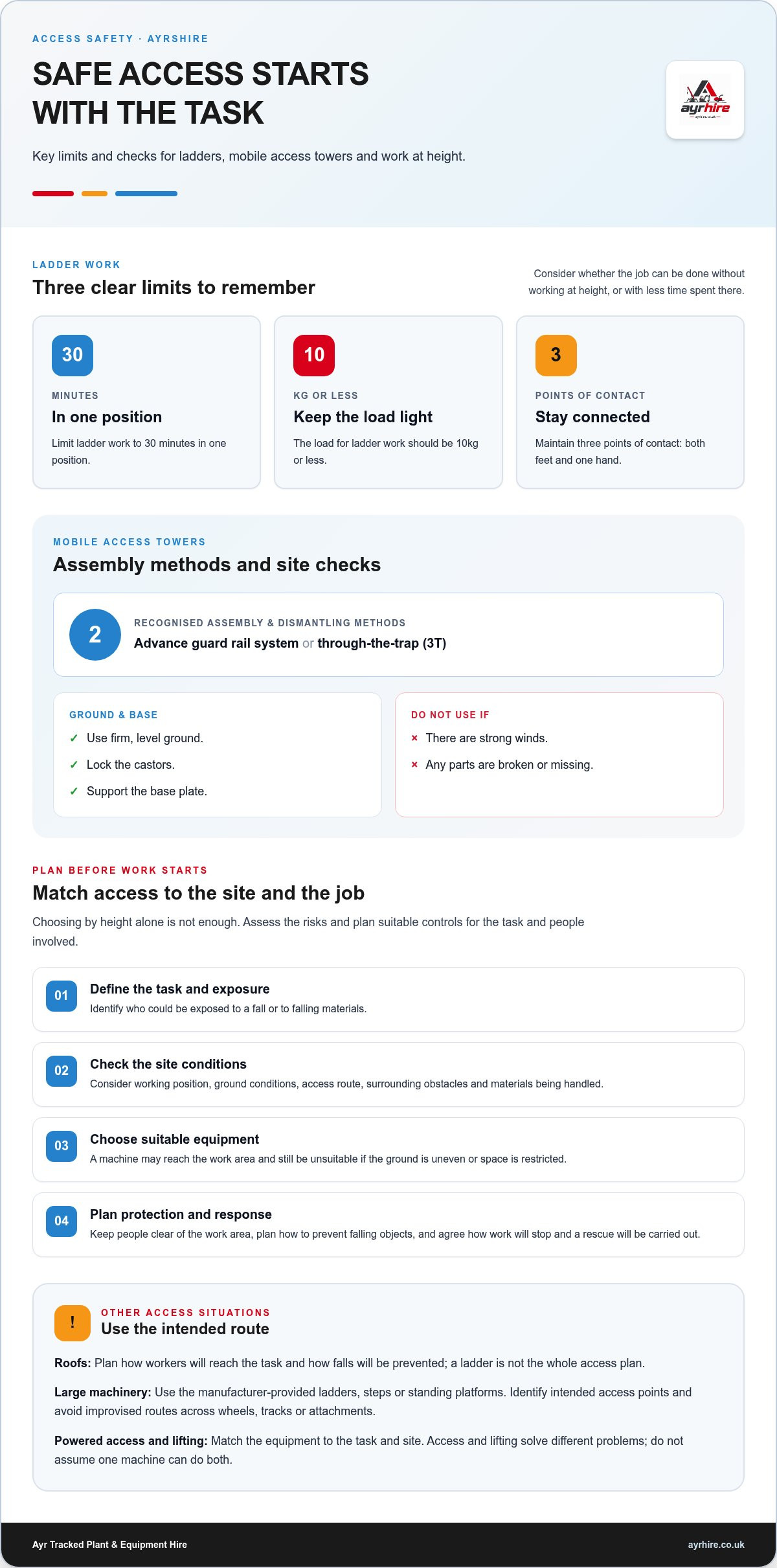
First consider whether the task can be done without working at height, or with less time spent there. For ladder work, limit use to 30 minutes in one position, keep the load to 10kg or less, and maintain three points of contact: both feet and one hand. These limits help decide whether a ladder suits the job or whether another access method is needed.
For mobile access towers, use firm, level ground, lock the castors and support the base plate. The two recognised assembly and dismantling methods are an advance guard rail system and through-the-trap, or 3T. Don’t use a tower in strong wind or if any parts are broken or missing. On roofs, plan how workers will reach the task and prevent falls, rather than treating a ladder as the whole access plan.
Machinery access and lifting solutions
Access large machinery, such as a combine, using the manufacturer-provided ladders, steps or standing platforms. These are designed for reaching that machine and help reduce fall risks. Before climbing, identify the intended access points and avoid improvised routes across wheels, tracks or attachments.
For powered access or lifting, match the equipment to the task and site. A trailer-mounted cherry picker may suit some elevated maintenance jobs, while lifting equipment may help position materials without carrying them up a ladder. Consider the working area, ground, access route and load. Access and lifting solve different problems, so don’t assume one machine can do both.
Access to HGV trailer beds also needs specific planning. FISA identifies this as a concern with serious implications for the timber haulage sector. Consider how workers will reach the bed, where materials will be moved and how people below will be kept clear. Avoid relying on climbing from the vehicle or using an unsuitable makeshift step.
When assessing machinery hire in Ayrshire, distinguish between delivery, operator hire and emergency support. A machinery listing alone doesn’t establish that delivery or an operator is included, or that emergency support is available. Set out which requirements matter for the job when planning access arrangements.
Before choosing, note the task, access route, ground conditions and materials involved. Then compare ladders, towers and powered access against those needs. This clarifies the practical differences: a ladder may suit brief, light work, while a tower or powered platform may provide a better working position for another task.
Boom lifts and passenger or material hoists
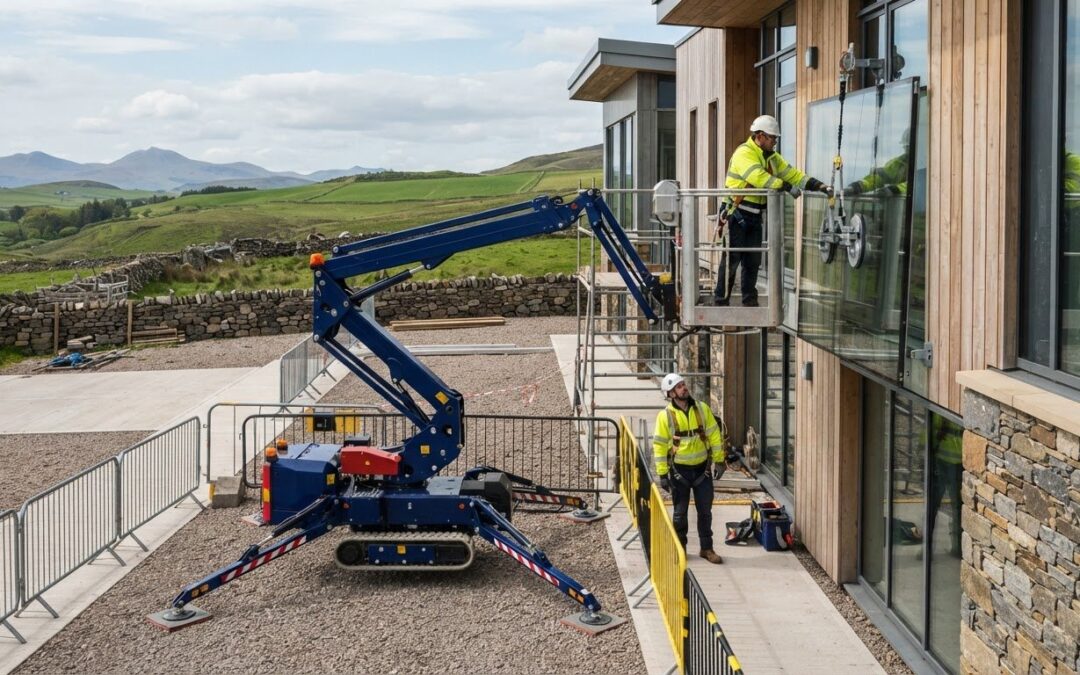
In Ayrshire, mobile elevating work platforms (MEWPs) are available through access machinery hire services. Specify the task, site and access needs. Before using a MEWP or access platform, assess the site, inspect the machine for damage, check its controls, and identify ground hazards, obstructions and emergency arrangements.
Boom lifts and hoists serve different tasks
A boom lift positions a platform and operator at an elevated work area. Its extending or articulating arm can help reach over obstacles, such as a roof edge or structure. Consider the approach route, operating space and ground conditions, as well as the working position. A machine that can reach the task still needs room to manoeuvre and a suitable place to operate.
Passenger and material hoists handle vertical transport, rather than positioning a worker beside a task. A passenger hoist moves people; a material hoist moves equipment or supplies. Identify what needs to travel, where loading and unloading will take place, and how the hoist fits the site layout. Don’t treat a material hoist as a platform for people.
Plan checks before operation
Follow a consistent pre-use check suited to the machine, its operating instructions, the work area and the people involved. For a MEWP, check the platform, access gate, controls, wheels or tracks, and look for visible damage before moving it into position. A fault, restricted route or unstable ground may mean the plan needs to change.
- Walk the route and identify slopes, soft ground and obstacles.
- Check the platform and controls before raising the machine.
- Keep people clear of the operating area and falling-object risks.
- Agree how work will stop and how an emergency will be managed.
Competent operators and suitable training are important. Working-at-height training covers safe and unsafe practices involving MEWPs, suspended platforms, roofs, ladders and mobile access towers. Training helps workers understand how the machine behaves and how to respond if conditions change during the task.
Match the platform to the job. A boom lift may suit work that requires reaching around an obstruction, while a hoist may suit repeated movement between ground level and an elevated area. The working position, load, route and site constraints all shape the choice. No single machine suits every Ayrshire site.
Before arranging hire, describe the work, access route and ground conditions, and whether people or materials need lifting. These practical details help match the task to the machinery type. Include the intended operating area and any obstacles, so the access plan reflects the site, not just the height of the task.
This gives the hire decision a clear safety context. UK employers must take suitable and sufficient steps, so far as reasonably practicable, to prevent materials or objects from falling. Keep this duty in mind when planning work involving elevated platforms, hoists and materials at height.
Choosing machinery for different tasks
Start with the working position, access route and site conditions. Choose the option that lets the task be completed safely without unnecessary complexity.
How do scissor lifts, cherry pickers and scaffold towers compare for work at height? Scissor lifts raise a platform vertically, cherry pickers use a boom to reach work areas, and scaffold towers provide a standing platform assembled on site. Compare the access route, working position, ground and task duration.
Comparing scissor lifts and cherry pickers
A scissor lift suits work directly above its base, where the operator needs a stable platform to reach a defined area. A cherry picker positions its platform using a boom, which may help reach over or around an obstruction. The practical choice depends on whether the task is directly above the machine or offset from it.
Before choosing either option, map the route and intended working position. Check for overhead obstacles, restricted turning space and ground conditions that may affect positioning. Consider whether workers need to move between several points or can complete the task from one position. A trailer-mounted cherry picker may suit elevated work when its access arrangement fits the site.
Comparing scaffold towers with access lifts
A scaffold tower provides a work area that may suit tasks requiring a standing platform with tools close at hand. An access lift may be better for reaching work points that change across a site, provided it can travel and operate safely there. Consider setup, repositioning and how long workers will remain at each location.
For example, a short inspection at several separate points may favour a mobile access lift. A tower may be more practical for work along a fixed section, depending on the site layout. The equipment must also let workers handle tools without leaning beyond a safe working position.
Use these practical questions to narrow the options:
- Does the task take place directly above the machine, or to one side?
- Can the equipment reach the work area without crossing obstacles?
- Will the platform need to move between work points?
- Can the machinery be positioned on the available ground and within the site access route?
- Do workers need a platform for tools or materials as well as access?
Compare the options against the actual job sequence. A roof inspection, for instance, may involve several work points, while a repair beside a building may require reaching over an obstacle. Avoid choosing by equipment name alone. Describe the task, working position and route so the machinery suits how the work will be done.
Plan the work area around the selected machine. Keep people and materials clear of its operating path, and make sure workers understand the platform’s intended use before starting. For safe machinery for working at height in Ayrshire, consider the access route, working position, ground and movement needed to complete the job.
What safe machinery is available for working at height in Ayrshire?
For Ayrshire projects, options to assess include mobile elevating work platforms (MEWPs), scaffold towers and hoists. The right choice depends on the working position, access route, ground and whether people or materials need moving.
A scissor lift raises its platform vertically and may suit work directly above its base. A boom lift reaches out from its base, which can help when the task lies beyond an obstacle. A trailer-mounted cherry picker is another option for elevated access, provided the site can accommodate its route and operating position. Compare the task location with the machine’s movement, not just its maximum reach.
Scaffold towers provide a standing work area assembled on site. They may suit tasks requiring a stable platform and tools close at hand. Mobile towers need firm, level ground, locked castors and a supported base plate. Avoid using them in strong wind or with broken or missing parts. A tower may be less practical when workers must move frequently between separate work points.
Passenger and material hoists move people or supplies vertically. They serve a different purpose from a MEWP: a hoist transports, while a MEWP positions an operator at the task. Choose according to what needs to travel and where loading, unloading and work will take place. Don’t use a material hoist to carry people.
Use this site checklist to narrow the choices:
- Map the access route, working position and obstacles before equipment arrives.
- Assess ground conditions where a lift or tower will stand or travel.
- Identify whether workers need vertical access, reach around an obstacle, or transport between levels.
- Plan how tools and materials will reach the work area without creating extra handling risks.
- Set out an emergency response and keep people clear of the operating area.
Before use, inspect the equipment and controls, review the operating instructions and ensure the operator is competent. Include the site layout in the assessment. A platform that suits an open yard may not fit a narrow access route or confined work area. The work plan should also account for changing conditions, such as an obstructed route or unsuitable ground.
For a tree-work example, a wood chipper processes cut material at ground level; it isn’t access machinery for reaching elevated work. Separate the access decision from the material-handling task, so each machine has a defined role. To plan equipment around site access and ground conditions, explore tracked plant and equipment hire as part of your project planning.
Ayr Tracked Plant & Equipment Hire: FORST TR8 8″ Tracked Wood Chipper
Ayr Tracked Plant & Equipment Hire can support projects where tree work, ground preparation or material movement sits alongside work at height. The FORST TR8 8″ Tracked Wood Chipper is for processing cut wood, not for lifting workers or providing access to elevated work. Keep those machinery roles separate in your site plan.
For related site requirements, Ayr Hire offers a KUBOTA Mini Excavator / Digger, an ALMA Crawler Multi-Loader and Vacuum Lifter Hire. Match each to its specific task, alongside a separately planned access method for work above ground. This keeps the equipment choice practical and clear.
To discuss equipment for your project, contact Ayr Tracked Plant & Equipment Hire or visit ayrhire.co.uk.
Plan your next site move
Before the next job begins, turn the task assessment into a practical equipment plan. Record where the work will take place, how the site can be accessed, and what needs moving or lifting. This gives you a clear basis for discussing safe machinery for working at height in Ayrshire and related site requirements.
Ayr Tracked Plant & Equipment Hire offers equipment for specific site tasks, including the FORST TR8 8″ Tracked Wood Chipper, KUBOTA Mini Excavator / Digger and TMC25/BG250 Mini Spider Crane. These machines serve different purposes, so identify the job each needs to support and plan access equipment separately where workers must reach an elevated position.
Bring your site requirements and intended work to the conversation. A clear outline helps focus on equipment relevant to the task, without treating one machine as the answer to every need. It also provides a useful starting point for organising the work sequence and access arrangements.
Contact Ayr Tracked Plant & Equipment Hire to discuss your project and take the next step with a practical plan.
Frequently Asked Questions
What UK and Scottish regulations apply to machinery used for working at height?
The Work at Height Regulations 2005 are the main legislation for working at height in the UK, according to The National Archives. LOLER and PUWER are also relevant safety requirements for work-at-height equipment in Ayrshire and Arran. For a job in Scotland, use these requirements as the starting point for planning. For example, identify whether the equipment lifts people, materials or both, then assess the task and site before selecting machinery.
How do I choose the right access machinery for a job, site and working height?
Choose machinery by matching the working position and access route to the site, not by height alone. A task directly above the machine may suit a vertical platform, while work beyond an obstruction may need a boom. Check where the equipment can stand, how it reaches the work area and whether materials must also be moved. Then consider operator competence and the planned work sequence to select a practical option.