What if the most effective way to reach a Glasgow city-centre rooftop is through the front door? Traditional lifting methods often stall before they even begin. Navigating narrow lanes like those in the Merchant City or securing expensive permits for street closures can derail your timeline. You need a solution that respects the weight-bearing limits of historic structures while delivering the power of a much larger machine.
It’s a common frustration for site managers across the city. You want a safe, reliable lifting plan that doesn’t involve complex logistics or massive overheads. This guide explains how using a specialised spider crane for rooftop lifting Glasgow can solve these challenges. We’ll show you how to leverage compact technology to navigate tight access points and meet strict safety requirements. No fuss. Just efficient results.
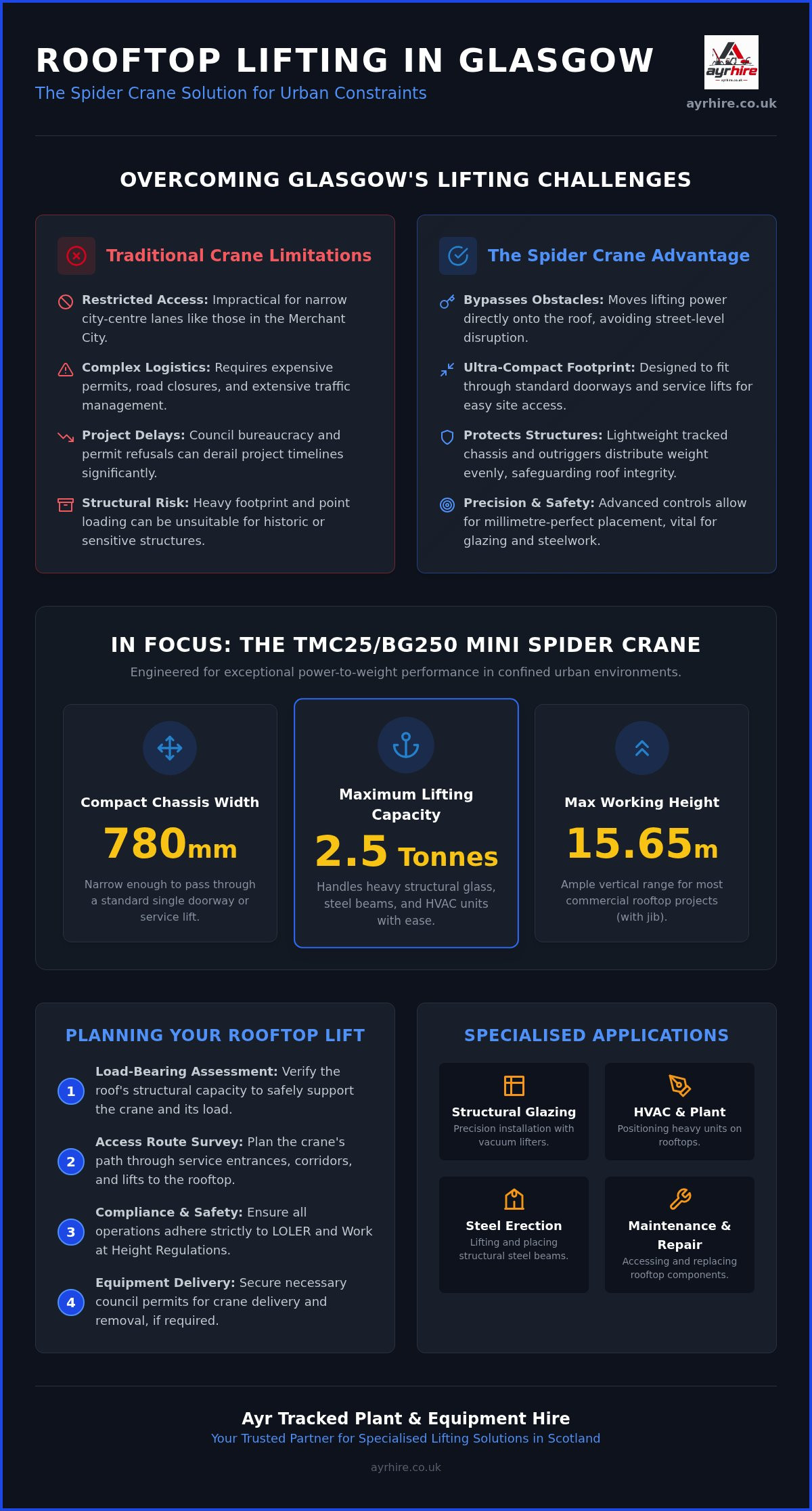
We’ll examine the technical capabilities of the TMC25/BG250 mini spider crane. You’ll learn about its 780mm chassis width and its impressive 2.5-tonne capacity. We also cover why local expertise is vital for compliance with LOLER and Work at Height Regulations. From glass installation to HVAC positioning, find out how to navigate your next project with confidence and precision.
Key Takeaways
- Learn how a spider crane for rooftop lifting Glasgow bypasses street-level access restrictions and protects sensitive roof structures with its lightweight, tracked chassis.
- Explore the specific power-to-weight advantages of the TMC25/BG250 model, capable of lifting 2.5 tonnes while remaining small enough to pass through a standard door.
- Master the planning process for city-centre lifts, including how to handle load-bearing assessments and secure necessary council permits for equipment delivery.
- Discover why pairing mini cranes with vacuum lifters is the most efficient method for precise, safe glass installation in challenging rooftop environments.
- Access professional advice on choosing the right hire terms to suit your project’s duration and budget, ensuring you have the right tools exactly when needed.
Why Use a Spider Crane for Rooftop Lifting in Glasgow?
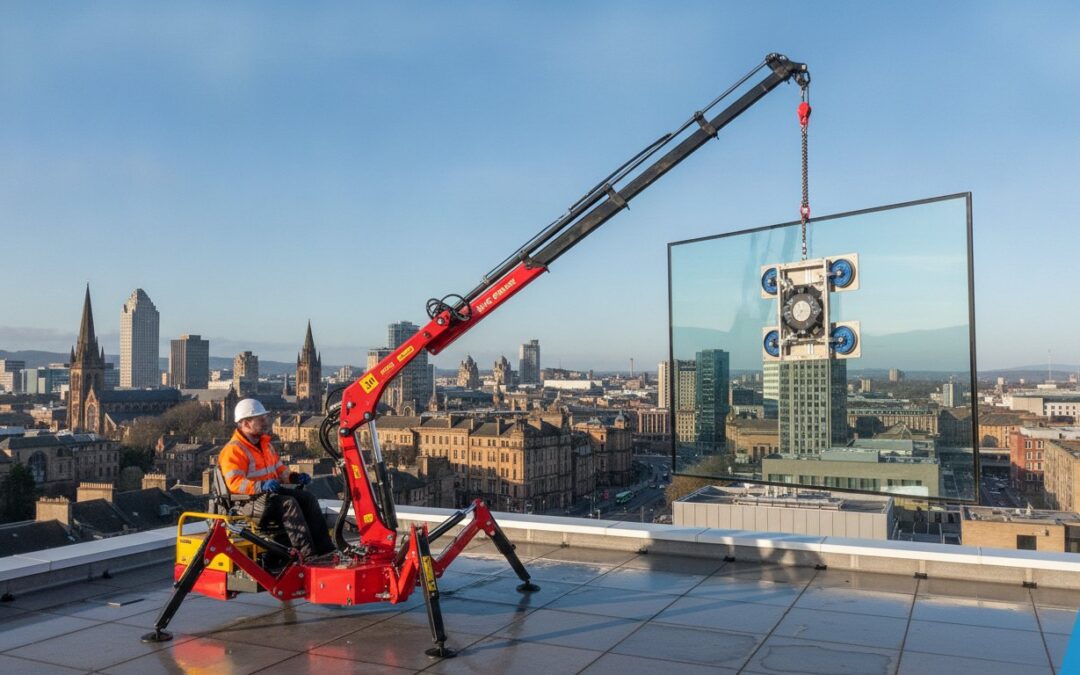
Glasgow’s urban layout presents unique challenges for construction and maintenance. Narrow lanes, busy bus routes, and historic architecture often make traditional lifting methods impossible. A spider crane for rooftop lifting Glasgow solves these logistical puzzles by moving the lifting power directly onto the structure. These machines are ultra-compact. They fit where traditional equipment cannot. They offer a practical way to manage heavy loads without the footprint of a standard site crane.
While a traditional Mobile crane is a staple on large construction sites, its size and weight make it impractical for established city-centre streets. Securing permits for road closures in areas like the Merchant City or Buchanan Street is increasingly difficult. Glasgow City Council frequently refuses these requests to avoid traffic disruption. Spider cranes provide an alternative. They are lightweight enough to be positioned on a roof, allowing work to continue without blocking the street below.
Navigating Glasgow’s Architectural Constraints
Lifting materials onto a traditional red sandstone tenement or a modern office block requires precision. Street-level access is frequently blocked by narrow one-way systems or pedestrian zones. Large cranes require permits that are expensive and time-consuming to secure. Spider cranes bypass these hurdles. They can be craned onto a roof or driven through a service entrance. This eliminates the need for complex traffic management plans. It’s a direct solution for restricted environments. It keeps your project on schedule and avoids unnecessary council bureaucracy.
The Advantages of Tracked Manoeuvrability
Stability is critical on a roof. Using a spider crane for rooftop lifting Glasgow allows you to operate safely on surfaces with strict weight-bearing limitations. These cranes use a tracked chassis to move across various surfaces without causing damage. Once in position, specialised outriggers distribute the machine’s weight evenly. This is vital for protecting the structural integrity of the building.
- Fits through standard 800mm doorways and service lifts.
- Maintains stability on uneven or sloping roof surfaces common in older buildings.
- Manoeuvres easily around existing HVAC plant equipment and structural obstacles.
The TMC25/BG250 is particularly effective for these tasks. It’s small enough to navigate a standard corridor but powerful enough for heavy structural glass or steel. It’s about getting the job done efficiently. You get professional-grade lifting capacity without the fuss of a massive site footprint. It’s the dependable choice for Glasgow’s most challenging sites.
Specifications of the TMC25 and BG250 Mini Spider Cranes
Precision is vital for rooftop lifting. The TMC25 and BG250 models are engineered specifically for these high-stakes environments. They provide an exceptional power-to-weight ratio. This ensures you achieve maximum lift capacity without exceeding the structural limits of the roof. These machines are built for stability. They offer the strength of much larger equipment within a compact, tracked frame. It’s a no-nonsense solution for complex urban sites.
When you use a spider crane for rooftop lifting Glasgow, accuracy is your primary advantage. Advanced controls allow for millimetre-perfect placement of structural steel or glass. This level of control is essential when working amongst existing plant machinery or fragile architectural features. These cranes also offer electric or eco-fuel options. This makes them suitable for indoor use or projects in sensitive city-centre zones where emissions and noise must be kept to a minimum. They stow into a compact form for easy transport, ensuring they arrive on-site ready for immediate deployment.
TMC25: The Compact All-Rounder
The TMC25 is a versatile workhorse for the Glasgow construction sector. It features a lifting capacity of 2.5 tonnes, making it capable of handling substantial loads while maintaining a light footprint. Its maximum working height reaches 15.65m with a jib, providing ample vertical range for most commercial rooftops. The machine weighs 2250kg, distributing this weight effectively through its adjustable outriggers. These outriggers can be configured to suit tight spaces, allowing the crane to set up in areas where traditional equipment simply cannot operate.
The TMC25’s narrow 780mm chassis allows it to pass through standard internal doors, making it the ultimate tool for Glasgow glazing contractors working in confined commercial spaces. If you need to verify specific dimensions for your site, you can view the full fleet details at ayrhire.co.uk. This compact design doesn’t sacrifice performance; it simply makes the performance accessible in difficult locations.
BG250: Enhanced Reach for Complex Elevations
For projects requiring greater horizontal reach or multi-storey access, the BG250 provides enhanced capabilities. It shares the same 2.5-tonne lifting capacity as the TMC25 but is optimised for complex elevations. Its boom system is designed for precision at height. This is particularly useful for installing large glass panes or HVAC units on modern office developments. Safety is integrated into every movement. The BG250 features advanced load-moment indicators that provide real-time feedback to the operator, preventing overloads and ensuring site safety.
Choosing a BG250 is a strategic move for project managers. Standard mobile cranes involve high transport and permit costs. They also require significant street space. The BG250 offers a more streamlined, cost-effective alternative for multi-storey work. It reduces the logistical burden of the project. Safety remains the priority throughout the process. When Planning Your Rooftop Lift, these technical specifications allow for rigorous risk assessments. You get a reliable, high-performance machine that fits the specific demands of Glasgow’s architectural landscape.
Planning Your Rooftop Lift in Glasgow City Centre
Successful projects in a busy urban environment require a methodical approach. Before any equipment arrives, a rigorous site survey is essential. We assess the roof’s load-bearing capacity and identify the most efficient access points. This isn’t just about the lift itself; it’s about the logistics of getting there. In Glasgow, this often means navigating one-way systems and pedestrianised zones. We work closely with you to map out every detail of the spider crane for rooftop lifting Glasgow, ensuring the plan is both safe and compliant.
Securing the right permissions is the next hurdle. Glasgow City Council has strict requirements for equipment delivery and street occupation. We handle the coordination with local authorities to secure necessary permits. This prevents unexpected delays or fines. Our approach aligns with the engineering standards promoted by the Specialised Glazing and Structural Lifting Solutions sector, ensuring that structural integrity and safety are prioritised from the start. We don’t just provide a crane; we provide a fully managed logistical solution.
Step-by-Step Rooftop Placement
Getting a mini crane onto a roof usually involves a “primary lift.” A larger mobile crane hoists the spider crane from the street and places it onto the roof deck. Precision is everything during this stage. Once the crane lands, we use spreader plates to distribute its weight across the building’s structural beams. This prevents point-loading damage to fragile roof surfaces. Every operation is conducted by a CPCS-qualified operator who performs thorough pre-start safety checks. For sites where clear audio coordination is essential, visit Earpiece Hub to find the right radio accessories. We ensure the machine is perfectly positioned and secured before a single load is lifted.
Local Permits and Environmental Zones
Glasgow’s city centre is a Low Emission Zone (LEZ). This means all delivery vehicles must meet specific Euro standards to enter the area. We manage our fleet to ensure full compliance with these regulations and the wider Glasgow City Centre Transport Strategy. This is particularly important for projects in the Merchant City or near George Square, where traffic management is complex. We also consider the local impact, managing noise and vibration levels to avoid disrupting nearby businesses or residents. It’s a professional, quiet, and efficient way to get the job done in the heart of the city.
- Full compliance with Glasgow LEZ requirements for all transport.
- Coordination of council permits for street-to-roof primary lifts.
- Detailed risk assessments and method statements (RAMS) for every site.
By coordinating with local plant hire experts, you ensure a seamless transition from delivery to operation. We understand the specific rhythm of Glasgow’s streets. We know how to work within the city’s constraints to deliver a reliable service that keeps your project moving forward without the usual city-centre headaches.
Specialised Glazing and Structural Lifting Solutions
High-level glass installation requires more than just reach. It requires stability and control. Using a spider crane for rooftop lifting Glasgow allows for the precise movement of large, heavy panes in environments where traditional cranes cannot reach. This is particularly useful for curtain walling or structural glass replacements in the city’s commercial districts. These cranes handle the heavy lifting, significantly reducing manual handling risks for site teams.
Vacuum Lifter Synergy for Glaziers
Efficiency increases when you combine a mini crane with the right attachments. Utilising vacuum lifter hire alongside your spider crane creates a complete glazing solution. These lifters provide 360-degree rotation and 90-degree tilting. This allows for millimetre-perfect alignment of glass panels into their frames. It’s a safer, faster method for handling non-porous materials at height. Our parent company, Structural Glass Design Ltd, brings deep glazing expertise to every hire, ensuring you have the right configuration for your specific pane dimensions.
Safety protocols are non-negotiable. Vacuum lifters feature dual-circuit systems to maintain suction even if power fails. When paired with the TMC25 or BG250, you get a stable platform that minimises the risk of glass breakage or worker injury. It’s about professional standards. You get the job done right the first time. It’s a reliable setup for any glazing contractor in the city.
HVAC and Plant Room Upgrades
Rooftop extensions and plant room upgrades often involve lifting air handling units (AHUs), chillers, or structural steel. A spider crane for rooftop lifting Glasgow is the safest way to position these heavy components. Traditional methods like pulleys or scaffolding are often too slow and introduce unnecessary risks. Spider cranes can be positioned directly next to the installation site, even in restricted rooftop locations. They provide the power needed without the massive footprint of a standard mobile crane.
Minimising downtime is essential for Glasgow businesses. Whether it’s a retail unit in Princes Square or an office block in the International Financial Services District, quick maintenance keeps the doors open. Spider cranes allow for rapid deployment and removal. They provide a high-performance alternative to bulky site cranes that require massive exclusion zones. You can view our crane and vacuum lifter packages to find the right combination for your next maintenance project.
Structural steel lifting for rooftop pods or plant rooms is another key application. The precision controls of the TMC25 allow for the delicate placement of beams amongst existing services. It’s a clean, efficient process that respects the constraints of the building. We provide the tools you need to overcome the logistical hurdles of modern Glasgow construction. No fuss. Just reliable lifting solutions.
Reliable Spider Crane Hire with Ayr Tracked Plant & Equipment Hire
Ayr Tracked Plant & Equipment Hire understands the logistical pressure of city-centre construction. We specialise in niche, tracked machinery designed for the most difficult access points. When you choose a spider crane for rooftop lifting Glasgow, you need more than just a machine. You need a partner who understands the local terrain. From our base in South Ayrshire, we provide comprehensive support across the Glasgow metropolitan area. Our focus is on reliability, efficiency, and professional standards. We provide the steady hand required for demanding projects.
Our fleet is maintained to the highest industry standards. Every machine arrives on-site ready for immediate work. We don’t believe in unnecessary fuss or complex sales language. We provide the technical equipment you need to overcome specific site hurdles. Whether you’re working on a historic tenement or a modern commercial development, our machinery provides the stability and power required for a successful lift. Ayr Tracked Plant & Equipment Hire positions itself as a dependable ally for professional contractors across the region.
Flexible Terms for Glasgow Contractors
Project timelines are rarely static. We offer flexible daily and weekly hire terms to suit your specific schedule. You shouldn’t be forced into high-cost, long-term plant hire for a short lifting task. We provide a quick response for urgent Glasgow-based projects, ensuring your site doesn’t stall. Our pricing is transparent. There are no hidden city-centre surcharges to worry about. You get the equipment you need exactly when you need it. It’s a straightforward approach that respects both your budget and your project’s critical path.
Integrated Plant Solutions
A successful lift is often part of a larger material movement puzzle. You can combine your spider crane for rooftop lifting Glasgow with ALMA multi-loader hire to transport materials across the site before the final lift. This creates a seamless workflow, especially in narrow-access environments. For projects outside the city, explore our specialist plant hire Ayrshire options. We offer a range of niche equipment solutions tailored to professional trades and complex site requirements.
Our expertise is rooted in practical, hands-on experience. Through our parent company, Structural Glass Design Ltd, we have deep roots in the glazing industry. We understand the specific challenges of handling fragile, high-value materials at height. This isn’t just about supplying a machine; it’s about providing the technical insight to ensure the job is done safely and correctly. Contact the team at Ayr Tracked Plant & Equipment Hire today for a no-obligation site consultation. We’ll help you navigate the logistics and provide a reliable lifting plan that gets the job done.
Elevate Your Next Glasgow Project with Precision Lifting
You now have the blueprint for overcoming Glasgow’s toughest architectural constraints. By using a specialised spider crane for rooftop lifting Glasgow, you eliminate the need for costly road closures and complex street-level permits. These machines provide the necessary power while respecting the structural limits of historic and modern buildings alike. It’s a direct solution that keeps your timeline on track and your site compliant with all current safety regulations.
Our fleet of TMC25 and BG250 mini cranes is specifically chosen for narrow-access success. With our deep roots in the glazing industry and local expertise across Glasgow and Ayrshire, we ensure your lift is safe, compliant, and efficient. We don’t just supply equipment; we provide the technical insight required to handle fragile loads and restricted spaces with total confidence. This no-nonsense approach is why contractors across the city rely on our steady hand for their most demanding projects.
Take the first step toward a more efficient site. Enquire about Spider Crane Hire in Glasgow today to secure the right equipment for your project. Let’s get the job done with the right tools and the local support you can trust.
Frequently Asked Questions
How much does it cost to hire a spider crane in Glasgow?
Hire rates for a spider crane for rooftop lifting Glasgow vary based on the model’s capacity and the hire duration. Industry averages in the region suggest daily rates between £250 and £1,000. You should also factor in delivery fees and the cost of a certified operator if you don’t have one on-site. We recommend a site consultation to get an accurate quote tailored to your specific project requirements.
Do I need a special operator for a mini spider crane hire?
You must have a CPCS A66 category qualification to operate a mini spider crane on a regulated site. If your team doesn’t hold this certification, you’ll need to hire the equipment with a qualified operator. This ensures the lift is conducted safely and complies with LOLER 1998 regulations. Hiring an experienced operator often speeds up the project and reduces the risk of site accidents.
Can a spider crane fit through a standard house door?
Most compact models are designed to fit through a standard 800mm doorway. The TMC25 and BG250 feature a narrow 780mm chassis width when stowed. This allows them to navigate internal corridors, service lifts, and narrow alleyways common in Glasgow’s Merchant City. Their ability to move from an internal hallway directly onto a balcony or roof deck is a significant advantage for glazing contractors.
What is the maximum lifting capacity of a rooftop spider crane?
A high-performance mini crane like the TMC25 or BG250 has a maximum lifting capacity of 2.5 tonnes (2500kg). This power is sufficient for most rooftop tasks, including installing structural glass panes or positioning HVAC units. While larger cranes exist, this weight class provides the best balance between lifting capacity and the ground pressure limits of modern and historic rooftop structures.
Do I need a permit from Glasgow City Council for a rooftop lift?
You will likely need a permit if the delivery vehicle or the primary lift crane occupies a public road or pavement. Glasgow City Council requires applications for street occupation and traffic management. We assist with this process to ensure your spider crane for rooftop lifting Glasgow arrives on-site without legal delays. Always allow at least several weeks for permit processing in busy city-centre locations.
How is the spider crane actually placed onto the roof?
The equipment is typically hoisted onto the roof by a larger mobile crane in what is known as a “primary lift.” Once the spider crane is placed on the roof deck, it moves under its own tracked power to the specific work area. This method bypasses the need for the larger crane to remain on the street for the duration of the project, reducing road closure costs and site disruption.
Are spider cranes safe to use on older Glasgow tenement roofs?
These cranes are safe for older structures provided a structural engineer verifies the roof’s load-bearing capacity. The tracked chassis and adjustable outriggers are designed to distribute weight evenly across a larger surface area. By using specialised spreader plates, we can further reduce the point-loading pressure on sensitive red sandstone tenements. It’s a proven method for maintaining the structural integrity of Glasgow’s historic architecture.
What happens if the rooftop has a slope or uneven surface?
Spider cranes are specifically designed to operate on uneven or sloping surfaces. The four outriggers can be adjusted independently to level the chassis, providing a stable and secure lifting platform. This is essential for older Glasgow buildings where roof levels are rarely perfectly flat. Built-in safety sensors and load-moment indicators ensure the crane remains within safe operating limits even when the ground is not level.