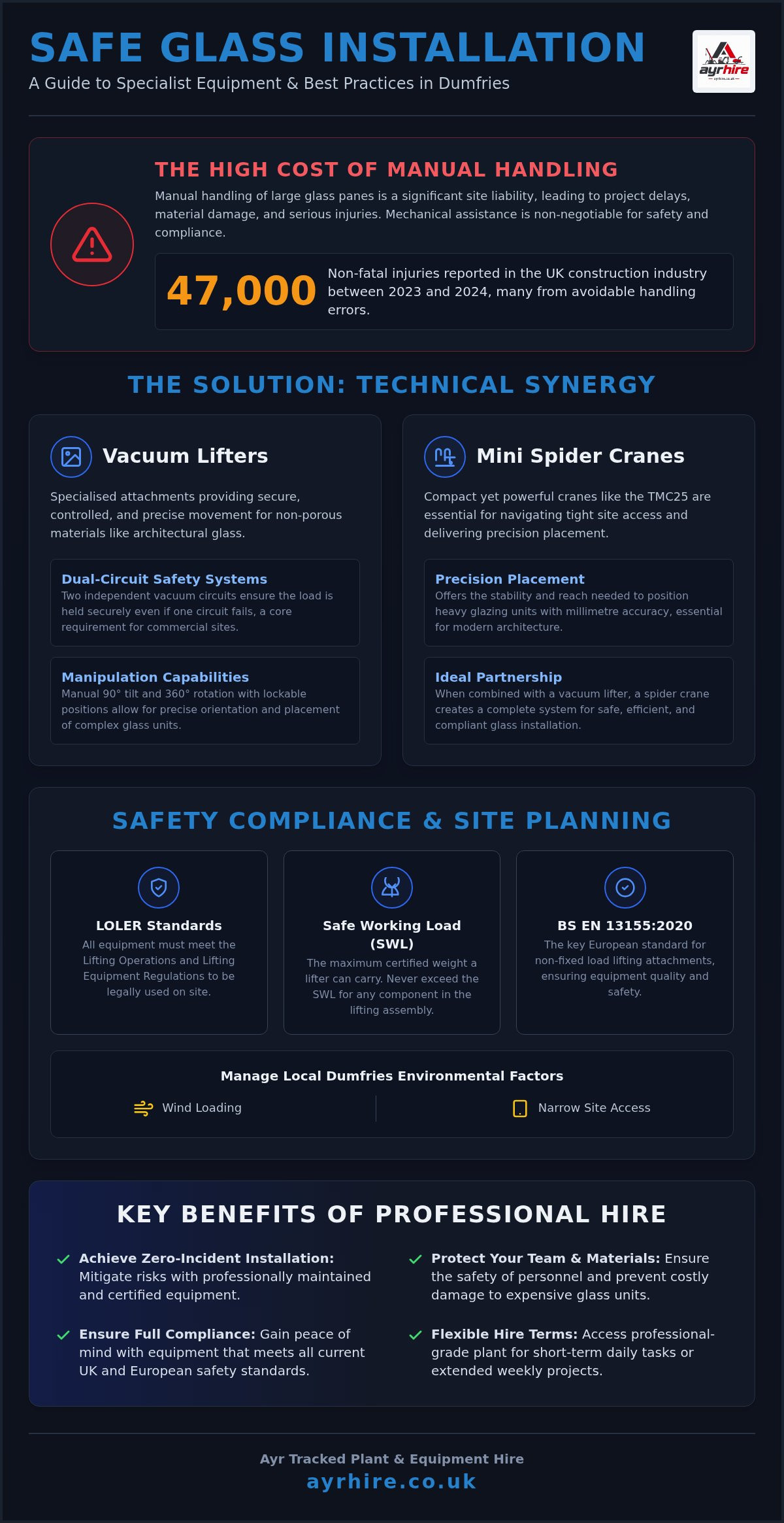
Safe glass installation in Dumfries requires more than just a “sucker”; it requires a technical synergy between the lifter and the crane. In the UK construction industry, there were approximately 47,000 non-fatal injuries reported between 2023 and 2024. Many of these incidents stem from manual handling errors that are entirely avoidable with the right plant. When you are sourcing a vacuum lifter for glass installation Dumfries projects often face logistical hurdles. These range from tight site access to the pressure of strict safety compliance under BS EN 13155:2020 standards.
You likely understand that manual handling of large glazing units is a high-risk gamble you can’t afford to take. Protecting your team and your materials is the absolute priority on any site. This guide will help you master the logistics of glass lifting in Dumfries with expert advice on equipment selection, safety standards, and the benefits of local hire. We’ll examine the essential LOLER requirements. We’ll also explain how to calculate Safe Working Loads (SWL) and show you how to achieve a zero-incident installation using specialist tools like the TMC25 mini spider crane.
Key Takeaways
- Learn how to maintain strict safety standards on site by utilising dual-circuit vacuum systems that comply with BS EN 13155:2020.
- Discover the best methods for managing local environmental factors in Dumfries, including wind loading and narrow site access constraints.
- Identify the correct vacuum lifter for glass installation Dumfries projects by matching equipment capacity to the specific dimensions and weight of your panes.
- Understand the technical benefits of pairing vacuum lifters with TMC25 or BG250 mini spider cranes for precise glazing placement.
- Benefit from flexible hire terms that provide professional-grade plant for either short-term daily tasks or extended weekly projects.
Vacuum Lifters for Glass Installation in Dumfries: Safety and Efficiency
Glazing projects in South West Scotland demand high standards. A vacuum lifter for glass installation Dumfries contractors can rely on must provide more than just suction. It provides security. These specialised lifting attachments are designed specifically for non-porous materials like glass. They’re essential for complying with modern health and safety site regulations. Manual handling is no longer a viable option for large format glazing. It’s too risky. Ayr Hire provides professional-grade solutions that bridge the gap between human effort and mechanical precision.
Why Specialist Lifting is Non-Negotiable
Manual handling of large panes is a major site liability. It’s often the root cause of project delays. In the UK, 47,000 non-fatal injuries occurred in construction during the 2023-2024 period. Many of these involved lifting and handling. Vacuum lifters provide controlled, precision movement for heavy glazing that hands simply cannot replicate. Structural glass requires mechanical assistance to meet LOLER standards. Without it, you risk both your team’s safety and your insurance coverage. Professional lifting gear ensures that expensive architectural glass arrives in the frame, not in pieces on the floor. It’s about protecting the asset and the person.
The Utility of Vacuum Suction Technology
Suction pads create a secure, high-pressure seal on the load. This technology allows for the vertical and horizontal manipulation of massive units. Integrated vacuum gauges are a critical feature. They allow for constant safety monitoring throughout the lift. If the vacuum seal is compromised, the operator knows instantly. This is a level of transparency you don’t get with manual grips. It’s a no-nonsense approach to site safety.
When selecting gear, you must understand the Safe Working Load (SWL). In glazing, the SWL is the maximum weight a lifter is certified to carry under specific conditions, ensuring a safety factor is maintained at all times. It’s the hard limit for your lift plan. Combining these lifters with other plant requires a solid grasp of crane mechanics and safety to ensure the entire assembly is stable. Ayr Hire ensures all equipment meets the BS EN 13155:2020 standard. This gives you total confidence on every Dumfries site. We focus on the practical readiness of our fleet so you can focus on the install.
Technical Specifications: Choosing the Right Lifter for Your Site
Selecting the right vacuum lifter for glass installation Dumfries projects involves more than checking the maximum weight capacity. You must match the equipment to the geometry of the site and the specific dimensions of the glazing. A lifter with a small frame might struggle with the wind loading on a large pane, while an oversized frame won’t navigate the tight access common in Dumfries town centre. Precision is the priority. You need a machine that handles the load and fits the workspace.
Dual-Circuit Safety Systems Explained
Dual-circuit systems are a non-negotiable standard for most commercial glazing projects. These systems feature two independent vacuum circuits. If one circuit loses pressure, the second circuit acts as a fail-safe to hold the load securely until it can be lowered. This redundancy is a core part of HSE vacuum lifter safety guidance. These machines also feature visual and audible alarms. These alerts provide the operator with immediate feedback if vacuum levels drop below a safe threshold. It’s a transparent, reliable way to manage risk on a busy site.
Rotation and Tilting Capabilities
The efficiency of your installation depends on how the glass moves. Manual 90-degree tilt functions allow you to lift panes directly from a stillage and bring them into a vertical position. For more complex architectural designs, 360-degree rotation is often required. This allows for the exact orientation of shaped or oversized units. Many lifters also feature lockable positions. These locks ensure the glass remains stable while the crane or telehandler moves across the site. Whether you’re fitting a standard shopfront or a bespoke residential gable, the ability to manipulate the pane precisely saves time and reduces the risk of edge damage.
Choosing between battery-powered and manual rotation depends on your project flow. Battery-powered systems reduce the physical effort required by the ground crew and are ideal for high-volume glazing programmes. Compatibility with other plant is also essential. Our lifters integrate seamlessly with mini spider cranes like the TMC25 or BG250. If you’re unsure which model fits your specific requirements, you can view our range of lifting equipment to find the right technical match. Getting the specifications right ensures that your vacuum lifter for glass installation Dumfries project is completed safely and without logistical delays.
Selecting Equipment for Dumfries Glazing Projects
Glazing projects in South West Scotland face unique environmental factors. Wind loading from the Solway Firth can turn a large glass pane into a sail, making stability a primary concern. Surface moisture from frequent rainfall also poses a challenge for suction reliability. A vacuum lifter for glass installation Dumfries contractors choose must be robust enough to handle these specific conditions. Opting for a local supplier reduces transport lead times significantly. It also ensures you’re working with a partner who understands the logistical constraints of the region. From the rural estates of Nithsdale to the urban centre, equipment must be ready for immediate deployment.
Site access is another critical variable. Dumfries town centre is characterised by narrow lanes and confined spaces. Large, cumbersome plant often struggles to navigate these areas. Compact, highly manoeuvrable lifting solutions are the only way to ensure a smooth workflow. Using a local specialist means your equipment is delivered on vehicles suited to these regional roads. It’s a no-nonsense approach to site logistics that avoids the delays associated with national suppliers who don’t know the local terrain.
Curtain Walling and Window Installation
Commercial developments in Dumfries often involve multi-storey curtain walling. Precision is essential when installing glass at height. Slimline lifters are the preferred choice for these tasks. They’re designed to fit into the narrow gap between the scaffolding and the building facade. This allows for precise placement without the need to dismantle site infrastructure. You must ensure the lifter frame matches the window pane configuration exactly. This prevents uneven pressure and protects the integrity of the unit. Matching the tool to the task is the most efficient way to maintain a steady project pace.
Handling Specialist and Structural Glass
Bespoke residential builds in Dumfries and Galloway frequently use structural glass. These units are often exceptionally heavy or irregularly shaped. Standard lifter configurations may not provide the necessary support. Extension arms are vital here. They allow you to adjust the pad layout to match the centre of gravity for each unique panel. Pad material also matters. Non-marking pads are necessary for high-end finishes where aesthetics are just as important as structural integrity. All installations must adhere to the UK Building Regulations for Glazing to ensure long-term occupant safety. Using the right vacuum lifter for glass installation Dumfries projects ensures you meet these legal requirements whilst protecting your team on site.
Safe Operation: Combining Lifters with Spider Cranes
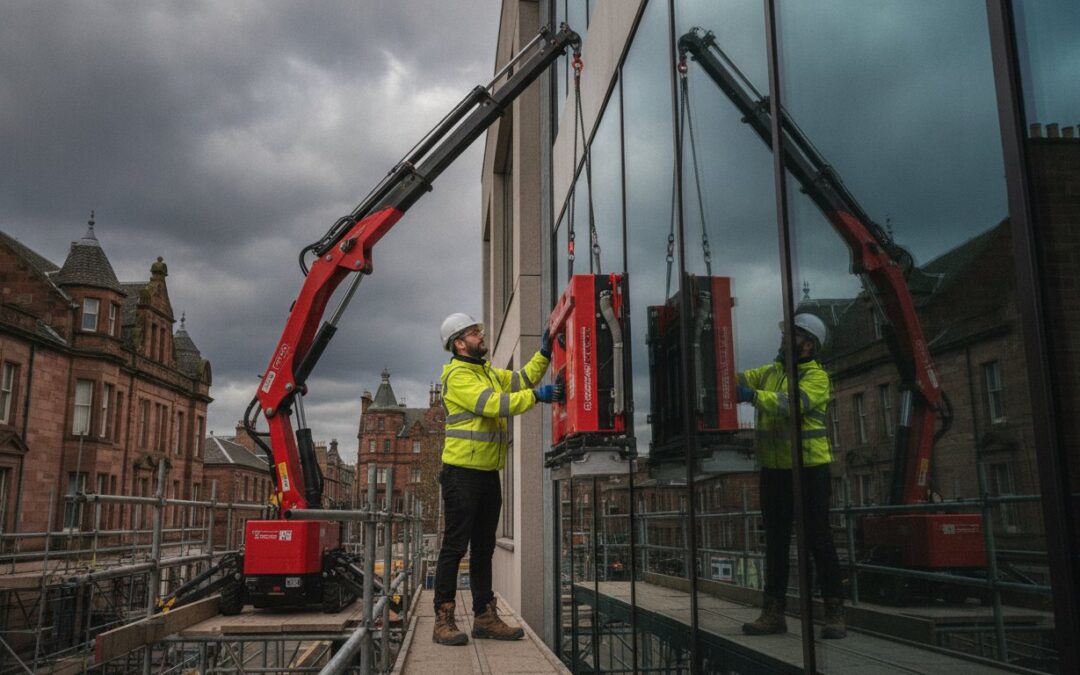
Integrating a vacuum lifter for glass installation Dumfries projects requires a coordinated approach between the lifter and the crane. It’s not just about picking up a pane; it’s about the mechanical synergy of the entire assembly. To achieve a zero-incident installation, you must follow a methodical sequence of checks. This ensures that the plant is working within its technical limits and that the site team remains safe throughout the process.
- Step 1: Verify the combined weight of the lifter and the glass pane. The crane’s safe working load (SWL) must exceed this total at the specific radius required for the install.
- Step 2: Ensure the crane hook height allows for sufficient lifter clearance. Vacuum lifters often have a high profile; you don’t want to run out of head room as you approach the glazing pocket.
- Step 3: Conduct a dry run to check rotation paths. 360-degree rotation requires a clear arc; check for scaffolding, structural beams, or other site obstacles before the glass is in the air.
- Step 4: Monitor vacuum gauges throughout the entire lift. The operator must have a clear line of sight to the gauges to confirm a secure, high-pressure seal at every stage.
The Advantage of Mini Spider Cranes
TMC25 and BG250 mini spider cranes are the ideal partners for glazing in Dumfries town centres. These machines provide the lifting power of much larger plant but with a footprint that fits into narrow alleys or shopfronts. Their tracked mobility allows for precise positioning on the uneven site ground often found in South West Scotland. If your project involves restricted access, you can learn more about mini spider crane hire North Ayrshire and Dumfries services to see how these compact machines solve logistical hurdles.
Site Preparation and Safety Checks
Cleaning the glass surfaces is the first step in ensuring maximum pad adhesion. Dust, moisture, or debris will compromise the vacuum seal instantly. You also need to check battery levels to ensure the lifter has enough power for a full day of heavy lifting. A daily LOLER pre-use inspection of both the crane and the vacuum lifter is a critical legal requirement to ensure the safety of the entire lifting assembly. If you need to discuss the specific requirements for a complex lift, contact us for technical plant hire advice to ensure your project stays on track and within safety regulations.
Specialist Vacuum Lifter Hire in Dumfries: The Ayr Hire Advantage
Selecting a vacuum lifter for glass installation Dumfries projects depends on more than technical specs. It depends on the reliability of your hire partner. We provide a localised service across Dumfries, Ayrshire, and Glasgow. Our approach is grounded and fundamentally utilitarian. We focus on the practical readiness of our equipment. You get the tools you need without unnecessary fuss or delay. This regional commitment ensures that we are always available when you need technical advice or additional plant. We position ourselves as a dependable ally for contractors who value efficiency.
Flexible rental terms are a core part of our service model. We understand that glazing schedules often change due to weather or site delays. You can hire for a single day to finish a specific task. You can also hire for a full week for larger commercial developments. We are part of a broader specialist lifting solutions Scotland strategy. This means we have the depth of fleet to support demanding projects across the region. Our goal is to provide a steady hand that helps you overcome logistical challenges without the overhead of national firms.
Reliable Local Delivery to Dumfries & Galloway
National plant hire firms often struggle with South West Scotland. They’re logistically distant. This leads to high transport costs and unpredictable delivery times. We eliminate these hurdles. Our delivery is prompt and reliable. Our drivers understand the specific logistics of the region. They know the roads. They know how to get plant onto site efficiently, even in restricted town centre spaces. Keeping your glazing project on schedule is our priority. By hiring locally, you ensure that your equipment arrives when you need it, ready for immediate deployment.
Professional Support for Your Project
Reliability comes from rigorous maintenance. Every machine in our fleet is maintained to the highest industry standards. This ensures that when the equipment arrives, it’s ready to work. We provide direct communication with a team that knows the equipment inside out. You aren’t dealing with a faceless call centre. You’re dealing with specialists who understand the “get the job done” attitude. Beyond lifters, you have access to a full suite of specialist plant hire Ayrshire including ALMA crawler multi-loaders. These machines provide the stability and capacity needed for the most demanding site environments. We value consistent performance and long-term professional relationships. Our brand is built on transparency and honesty. We provide the exact tools necessary to ensure a safe, efficient installation every time.
Secure Your Glazing Project Today
Successful glass installation in Dumfries requires a blend of technical precision and local logistical awareness. You now understand the critical importance of dual-circuit safety systems and the mechanical synergy between lifters and mini spider cranes. These tools aren’t just accessories; they’re essential for meeting LOLER standards and protecting your team from manual handling injuries. Sourcing a vacuum lifter for glass installation Dumfries projects from a local specialist ensures you avoid the high transport costs and delays of national firms.
We provide reliable, high-spec equipment maintained to the highest industry standards. Our flexible hire terms support both short-term daily tasks and long-term commercial glazing programmes. We understand the specific site constraints of South West Scotland and provide the “get the job done” attitude your project needs. Contact Ayr Hire for Vacuum Lifter Hire in Dumfries to discuss your technical requirements. Let’s ensure your next installation is safe, efficient, and professional.
Frequently Asked Questions
What is the maximum lifting capacity of a standard glass vacuum lifter?
Standard capacities range from 320kg for in-line models to 1200kg for heavy-duty units like the Hydraulica Kappel. The exact capacity depends on the number of pads and the configuration of the frame. You must always verify the Safe Working Load (SWL) against the weight of your specific glazing unit. For most commercial projects, a 400kg capacity lifter provides the necessary versatility for standard shopfronts and residential windows.
Do I need a separate crane to use a vacuum lifter for glass installation?
Yes, vacuum lifters are attachments that require a host machine, such as a TMC25 or BG250 mini spider crane, to provide vertical and horizontal movement. While the lifter creates the secure seal, the crane handles the weight and positioning. This combination is the standard setup for a vacuum lifter for glass installation Dumfries sites, allowing for precise placement in restricted spaces where larger plant cannot operate safely.
Can vacuum lifters be used in wet or windy weather in Dumfries?
Extreme weather requires a halt to lifting operations to ensure site safety. Wind loading is a major concern in Dumfries and Galloway; a large glass pane can act as a sail, destabilising the crane. Surface moisture can also interfere with the vacuum seal on the pads. You should always conduct a site-specific risk assessment and monitor wind speeds using an anemometer before commencing any glass lifting tasks on your project.
What safety certifications are required for vacuum lifter hire in the UK?
All lifting equipment must comply with the Lifting Operations and Lifting Equipment Regulations 1998 (LOLER) and PUWER 1998. Equipment must be thoroughly examined at least every six months by a competent person. Current standards for non-fixed lifting attachments also follow BS EN 13155:2020. We ensure all our plant is maintained to these professional standards, providing you with the necessary certification for your site health and safety records during the hire period.
How long does the battery last on a cordless vacuum lifter?
Most modern cordless vacuum lifters are designed to last for a full eight-hour shift on a single charge. The actual duration depends on the frequency of the suction cycles and the weight of the loads being handled. Integrated battery gauges allow operators to monitor power levels throughout the day. It’s best practice to charge the unit overnight to ensure it’s ready for a full day of installation work the following morning.
Are vacuum lifters suitable for curved glass or textured surfaces?
Standard vacuum lifters are designed for flat, smooth, non-porous surfaces. Handling curved or textured glass requires specialist pads or dedicated machines with flexible frames. If your project involves architectural glass with a specific radius, you must select a model designed for that geometry. Using a standard flat-panel lifter on curved glass is unsafe as it cannot maintain the required high-pressure seal across the entire pad surface area.
What happens if the power fails while the glass is being lifted?
Professional-grade lifters use dual-circuit vacuum systems and non-return valves to protect the load. If the power fails or one circuit loses pressure, the independent second circuit and the reserve tanks will hold the glass securely. This provides enough time to lower the load safely to the ground. Audible and visual alarms will immediately alert the operator to any drop in vacuum pressure, ensuring transparent and reliable risk management on site.
Can I hire a vacuum lifter for a single day in Dumfries?
Yes, we offer flexible hire terms that include single-day rentals for specific tasks or weekly rates for longer projects. This flexibility is ideal for contractors managing a vacuum lifter for glass installation Dumfries project where the window of opportunity might be limited by weather or site access. Local delivery across Dumfries and Galloway ensures that your equipment arrives promptly, allowing you to maintain your project schedule without paying for unnecessary downtime.