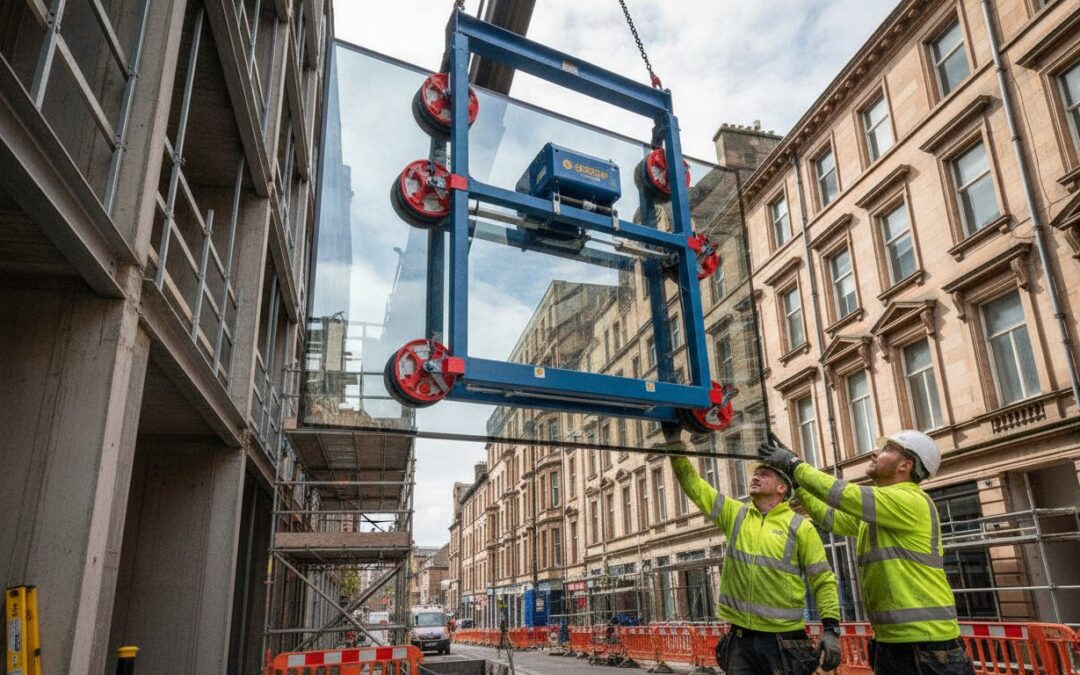
A single sheet of structural glass hangs suspended over a narrow Glasgow street. One minor calculation error in the Safe Working Load (SWL) could result in thousands of pounds in breakages and a total site shutdown. When the stakes are this high, your choice of vacuum lifter hire Glasgow becomes the most critical decision on your risk assessment. It’s the kind of high-pressure scenario that defines modern urban construction.
You already know that glass installation in the city centre is never just about the lift itself. It involves navigating strict delivery windows, meeting 2026 LEZ standards, and the constant demand for perfect safety records. We understand the need for precision and the frustration of equipment that doesn’t meet the specific demands of a tight urban site. Reliability isn’t just a preference; it’s a requirement for your bottom line.
This guide provides the technical expertise you need to master glass handling and secure reliable lifting solutions for your next project. We’ll examine the latest 2026 LOLER inspection frequencies, clarify SWL requirements, and show you how to maintain an efficient workflow in the most restricted environments. You’ll gain a clear path to zero material damage and full regulatory compliance on every job.
Key Takeaways
- Match Safe Working Load (SWL) and dual-circuit safety standards to your specific materials to ensure total lift security.
- Navigate the 2026 Glasgow Low Emission Zone (LEZ) and city centre pedestrian restrictions with efficient, compliant delivery planning.
- Secure your site against liability by mastering the latest 2026 LOLER documentation requirements and mandatory pre-use equipment checks.
- Access professional vacuum lifter hire Glasgow with flexible daily or weekly rental terms designed for both small jobs and major contracts.
- Reduce the risk of expensive breakages by utilising specialist narrow-access machinery tailored for high-value structural glazing and cladding.
What is a Vacuum Lifter and Why is it Essential for Glasgow Sites?
A vacuum lifter is a specialised mechanical attachment designed to handle non-porous materials with absolute security. It uses high-grip suction pads to create a powerful, airtight seal. This technology is essential for moving structural glazing, heavy cladding panels, and polished stone. By 2026, the Glasgow construction industry has moved decisively away from manual lifting. Site managers now prioritise mechanical precision to meet rigorous safety standards and protect high-value architectural components.
Securing vacuum lifter hire Glasgow is no longer just an option for large-scale projects. It’s become the standard for any job involving fragile or heavy materials. Suction-based lifting is the only method that provides the stability required for modern glass panels. It eliminates the need for slings or chains that can damage edges or obscure the installer’s view during a critical fit.
How Vacuum Lifting Technology Works
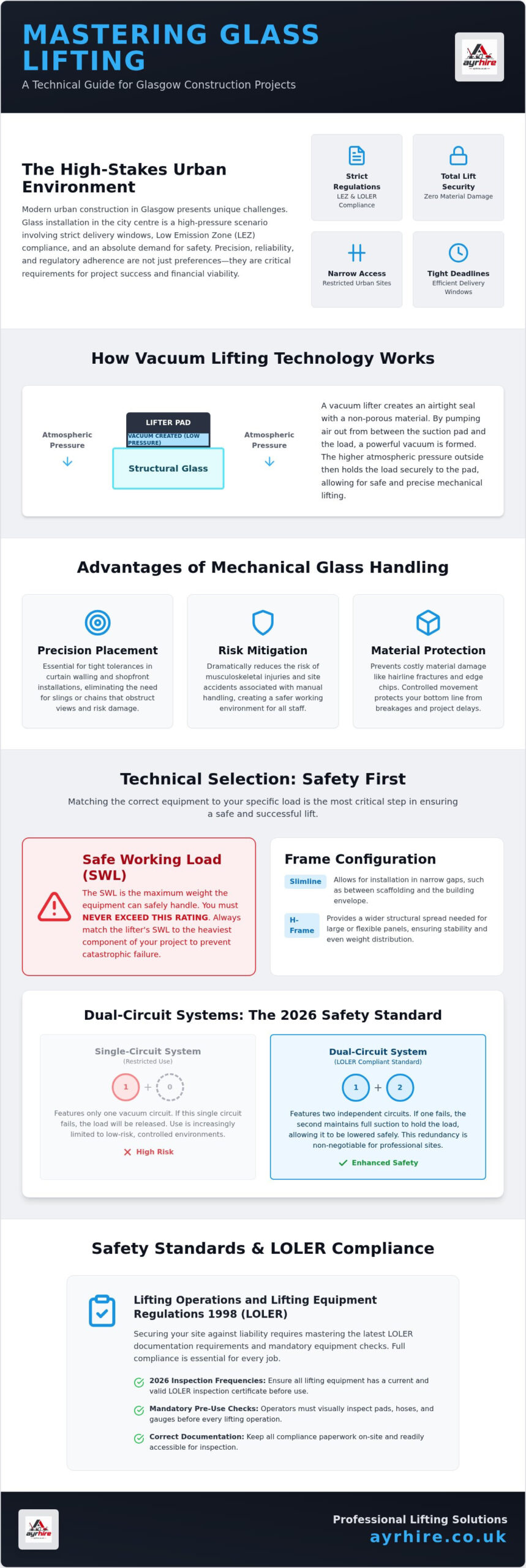
The physics behind the equipment is straightforward but effective. When the suction pads make contact with a smooth surface, the lifter removes the air between the pad and the material. This creates a vacuum. The external atmospheric pressure then holds the load firmly against the pads. This bond is incredibly strong, provided the surface seal integrity is maintained.
You’ll need to choose between manual and powered vacuum systems based on your specific load frequency. Manual lifters require the operator to use a hand pump to create the seal. They’re perfect for smaller, one-off tasks. Powered systems use integrated battery pumps to maintain constant suction automatically. These are the industry standard for high-frequency lifting on busy sites. We prioritise the use of non-marking pads across our fleet. This ensures that architectural finishes and delicate coatings remain undamaged throughout the installation process.
The Benefits of Mechanical Glass Handling
Switching to mechanical handling offers immediate safety advantages. Manually moving heavy glass is high-risk work. It frequently leads to musculoskeletal injuries and site accidents. A vacuum lifter removes this physical burden. It allows your team to focus on the technical aspects of the installation rather than the weight. It creates a safer, more professional working environment.
- Precision placement: Essential for curtain walling and complex shopfront installations where tolerances are tight.
- Risk mitigation: Reduces the likelihood of site injuries and long-term health issues for glass handlers.
- Material protection: Prevents the hairline fractures and edge chips often caused by traditional lifting methods.
Cost protection is a major benefit that often goes overlooked. A single broken panel in a Glasgow city centre project can cause massive delays and unexpected expenses. Mechanical lifting provides the steady, controlled movement needed to protect your bottom line. It’s a reliable way to ensure that expensive materials arrive in place exactly as intended.
Technical Selection: Matching Lifter Specifications to Your Load
Safe Working Load (SWL) is the absolute limit for any lifting operation. It’s the maximum weight the equipment can safely handle under specific conditions. You must never exceed this rating. Doing so risks catastrophic equipment failure and immediate danger to ground crews. When arranging vacuum lifter hire Glasgow, your first task is to match the equipment’s SWL to the heaviest component of your project. Precision here prevents site delays and ensures operator safety.
By 2026, dual-circuit vacuum systems have become the non-negotiable safety standard for professional construction sites. These systems feature two independent vacuum circuits. If one fails, the second maintains sufficient suction to hold the load until it can be safely lowered. This redundancy is a critical component of maintaining compliance with the Lifting Operations and Lifting Equipment Regulations 1998 (LOLER). Single-circuit lifters are increasingly restricted to low-risk, factory-floor environments where secondary safety measures are more easily managed.
Frame configuration also dictates site efficiency. Slimline frames allow for installation in narrow gaps, such as the tight space between scaffolding and the building envelope. H-frames provide the structural spread needed for larger, heavier sheets of glass or cladding. You should also consider the control method for rotation and tilt. Manual control is often sufficient for standard vertical installs. Hydraulic control offers the precision required for complex overhead glazing or angled curtain walling installations.
Calculating Your Required Lifting Capacity
Calculating weight requires more than just a guess. You must factor in the glass thickness and the weight per square metre. For example, standard 10mm glass weighs approximately 25kg per square metre, but triple-glazed architectural units are significantly heavier. In 2026, experienced site managers prefer a 20% capacity buffer to account for wind loading. High-altitude lifts or exposed sites in the West of Scotland often face sudden gusts that increase the effective load on the suction pads. If you’re working with curved glass, ensure you specify specialised pads designed to maintain surface contact on a radius.
Battery Life and On-Site Reliability
Glazing shifts are often long and demanding. You need equipment with a battery run-time that lasts the full duration of the working day. Modern lifters feature audio-visual low-vacuum warning systems; these provide immediate alerts if pressure drops below safe levels. Integrated chargers allow for easy overnight topping up. For remote sites without reliable mains power, consider units with swappable backup battery packs to prevent expensive downtime. If you’re unsure which technical specifications suit your project, view our range of specialist lifters to compare capacities and features.
Navigating Glasgow Site Challenges: Access and Logistics
Glasgow’s urban layout presents unique obstacles that generic hire companies often overlook. Effective vacuum lifter hire Glasgow requires more than just equipment; it demands a logistical strategy tailored to the city’s specific constraints. By 2026, all delivery vehicles entering the city centre must meet strict Low Emission Zone (LEZ) standards. We ensure our transport fleet is fully compliant, avoiding the heavy fines and site delays associated with non-compliant logistics.
Managing deliveries in pedestrianised areas like Sauchiehall Street or the Merchant City requires precise timing. These zones often have limited access windows, usually restricted to early morning slots. Coordinating your lifter delivery with crane hire windows or road closure permits is essential to avoid expensive site downtime. In the West End, residential window replacements often involve narrow tenement lanes. Our specialised equipment is chosen for its compact footprint, allowing for setup in spaces where larger units simply cannot operate.
Urban Site Constraints in Glasgow City Centre
Unloading in high-traffic areas like Hope Street or Renfield Street requires a “get-in, get-out” approach. You don’t have the luxury of extended kerbside time. Utilising compact, battery-powered lifters allows for quick deployment directly from the delivery vehicle. For internal glazing during office fit-outs, we provide units small enough to fit through standard doorways and into goods lifts. This local knowledge of Glasgow’s unique lane access and rear elevations ensures that even landlocked sites receive the equipment they need without compromising LOLER Compliance.
Weather Considerations for West of Scotland Projects
The West of Scotland is notorious for unpredictable weather. High winds are the primary concern for any glazing project. You must monitor wind speeds constantly, especially when working on exposed sites near the Clyde or on high-rise developments. Wet or freezing conditions can also compromise the integrity of vacuum seals. Moisture on the glass surface acts as a lubricant, reducing the friction required for a safe lift. It’s vital to keep pads and glass surfaces dry to maintain seal integrity.
In 2026, the industry-standard maximum safe wind speed for lifting large glass panels is 10 metres per second, though site-specific risk assessments may require a lower threshold based on the panel’s surface area.
Safety Standards and LOLER Compliance for Glass Lifting
Safety is the foundation of every successful lifting operation. In the 2026 construction environment, regulatory scrutiny is higher than ever. When arranging vacuum lifter hire Glasgow, you must ensure all equipment arrives with a valid Report of Thorough Examination (ROTE). This document is your legal proof of compliance. For lifting accessories like vacuum lifters, this examination is mandatory every six months. Operating without this certification isn’t just dangerous; it’s a direct breach of British safety standards that can lead to immediate site closure.
Daily pre-use checks are your first line of defence. Before the first lift of the shift, operators must inspect the suction pads for nicks, tears, or debris. Even a minor scratch can compromise the vacuum seal. You should also verify that the vacuum gauges reach the required green zone quickly and that the battery levels are sufficient for the planned workload. If the equipment features secondary safety devices like slings or safety straps, ensure they are in good condition. These are often required when lifting over public spaces or above specific heights.
Mandatory Safety Certification
Never accept a delivery without verifying the ROTE. A reputable supplier will provide this documentation as standard. You should also confirm the competence of your lifting team. Operators should hold a valid CPCS or NPORS card specifically for vacuum lifting equipment. Maintaining a comprehensive site safety file is vital for potential HSE inspections. This file should include the equipment’s certification, the operator’s credentials, and a signed-off lifting plan. It’s a methodical approach that protects both your crew and your professional reputation.
Risk Mitigation on Glazing Sites
A robust lifting plan must include a detailed risk assessment. This document identifies potential hazards and outlines the steps taken to control them. Establishing clear exclusion zones beneath the lifting path is a priority. No one should ever stand under a suspended load, regardless of the equipment’s safety features. Communication is equally critical. Establish clear protocols between the operator and the banksman, using either hand signals or two-way radios. Finally, ensure your team understands the emergency lowering procedures. In the rare event of a total power failure, you need a pre-planned method to return the load to the ground safely. Contact our team to discuss LOLER-compliant lifting solutions for your next project.
Professional Lifting Solutions with Ayr Tracked Plant & Equipment Hire
Ayr Tracked Plant & Equipment Hire provides the specialist machinery required for complex urban lifting. Our fleet consists of modern, dual-circuit vacuum lifters maintained to strict 2026 standards. We understand that project timelines vary. That’s why we offer flexible rental terms, ranging from daily hire for quick glass replacements to weekly rates for major structural glazing contracts. Our focus is on reliability. We serve sites across Glasgow, Ayrshire, and Dumfries with a rapid response service that keeps your workflow moving.
Securing vacuum lifter hire Glasgow is only one part of the equation. Many sites require a combination of tracked plant to overcome access barriers. Our local expertise ensures you get the right tool for the specific constraints of your site. We position ourselves as a steady hand for your project, capable of supporting demanding installations without unnecessary fuss.
The Synergy of Vacuum Lifters and Spider Cranes
Our TMC25/BG250 mini spider cranes are the perfect partners for our vacuum lifters. These compact cranes provide the reach and precision needed to position glass panels in restricted spaces. When ground conditions are uneven or access is particularly narrow, mini spider crane hire North Ayrshire provides the stability required for a safe lift. It’s a combination that allows for surgical precision in tight city centre environments.
Getting the glass to the lifting point can be equally challenging. We solve this through ALMA multi-loader hire. These tracked carriers transport heavy glazing units across rough terrain or through narrow gaps that would stop a standard forklift. This integrated approach makes us a one-stop solution for glazing contractors. We manage the entire logistics chain from delivery to final installation.
Booking Your Hire: The Ayr Hire Process
We’ve simplified the enquiry process to save you time. You can expect quick quotes and technical advice from a team that understands the machinery inside out. We don’t just drop off equipment. We coordinate delivery and collection to match your site schedule. This ensures the lifter is there exactly when your team is ready to begin work. It’s a methodical and transparent service that respects your project’s timeline.
Our goal is to be a reliable ally for your business. We remove the logistical friction so you can focus on the technical fit. Whether you’re working in a tight Merchant City lane or a large industrial development, we have the tools and the local knowledge to get the job done. Contact our team today to secure specialist lifting solutions Scotland.
Secure Your Next Precision Lift in Glasgow
Successful glazing installations in 2026 rely on the intersection of high-spec technology and local logistical foresight. Matching your equipment to the specific Safe Working Load (SWL) of your materials ensures your project remains fully compliant with the latest LOLER standards. It also protects your bottom line by preventing the high cost of material breakage during complex installs. Precision isn’t just about the machinery; it’s about the planning that happens before the first suction pad makes contact with the glass.
Navigating the specific challenges of Glasgow’s city centre requires a partner who understands the local landscape. From LEZ boundaries to the narrow lanes of the West End, we provide the specialised machinery and delivery expertise needed to keep your site moving. Our 2026 fleet is fully LOLER compliant and ready to support your most demanding narrow-access requirements. Whether you are handling structural glass or heavy cladding, we provide the stability and precision your project deserves. Reliable vacuum lifter hire Glasgow is the foundation of a safe and efficient site workflow.
Enquire about vacuum lifter hire for your Glasgow project today to secure a dependable specialist for your next contract. We look forward to supporting your team on-site and helping you achieve a perfect finish.
Frequently Asked Questions
How much does it cost to hire a vacuum lifter in Glasgow?
Hire costs vary based on the lifter’s capacity, the duration of the rental, and the complexity of the delivery logistics. We offer flexible daily and weekly terms to suit both small residential window replacements and large-scale structural glazing projects. To receive an accurate quote tailored to your specific site requirements in Glasgow or Ayrshire, we recommend contacting our technical team directly. We focus on providing high-quality, dual-circuit equipment that ensures your project remains on budget.
Is a vacuum lifter safe to use in the rain?
Lifting in wet conditions requires extreme caution. Moisture on the surface of the glass or the suction pads acts as a lubricant, which significantly reduces the friction needed to maintain a secure grip. Whilst many professional vacuum lifters are designed for outdoor use, you must ensure all contact surfaces are wiped dry before attempting a lift. Always perform a test lift in a safe area and monitor the vacuum gauges constantly to ensure seal integrity.
What is the maximum wind speed for using a glass vacuum lifter?
The industry-standard maximum wind speed for safe lifting is typically 10 metres per second. However, this threshold can be lower depending on the surface area of the glass panel and the height of the lift. Large panels act like sails in high winds, which can lead to the load spinning or swinging uncontrollably. Site managers should always conduct a specific risk assessment for vacuum lifter hire Glasgow projects when working in exposed locations.
Can I use a vacuum lifter with a standard mini excavator?
You can use a vacuum lifter with a standard mini excavator, such as our Kubota mini diggers, provided the machine has the necessary lifting capacity and reach. The excavator must be fitted with a suitable lifting point and the total weight of the lifter and the glass must remain well within the machine’s Safe Working Load (SWL). This combination is often an effective solution for ground-level glazing or shopfront installations where a crane might be impractical.
Do I need a special licence to operate a vacuum lifter?
There is no specific legal licence, but the Health and Safety Executive (HSE) requires all operators to be “competent.” In the UK construction industry, this is usually demonstrated through a valid CPCS or NPORS card specifically for vacuum lifting equipment. Employers are legally responsible for ensuring that anyone operating the machinery on-site has received formal training and understands the safety protocols, emergency lowering procedures, and daily pre-use inspection requirements.
What is the difference between single-circuit and dual-circuit vacuum systems?
The primary difference is safety redundancy. A single-circuit system relies on one vacuum line to hold the load. If that line fails, the load will fall immediately. A dual-circuit system features two independent vacuum circuits. If one circuit experiences a pressure drop, the second circuit is designed to hold the load securely until it can be lowered to the ground. By 2026, dual-circuit systems are the mandatory safety standard for professional glazing sites in the UK.
Are your delivery vehicles compliant with the Glasgow LEZ?
Yes, our delivery fleet is fully compliant with the Glasgow Low Emission Zone (LEZ) standards for 2026. This allows us to deliver specialist plant and lifting equipment directly to city centre sites, including the Merchant City and Sauchiehall Street areas, without incurring fines or facing access restrictions. We understand the logistical pressures of urban construction and ensure our transport strategy supports your site’s environmental requirements and specific delivery windows.
Do you provide LOLER certification with every hire?
We provide a valid Report of Thorough Examination (ROTE) with every piece of equipment we hire. Under current UK legislation, lifting accessories like vacuum lifters must undergo a thorough examination by a competent person every six months. We maintain our entire fleet to these rigorous standards to ensure you remain fully compliant with vacuum lifter hire Glasgow safety regulations. This documentation is essential for your site safety file and HSE inspections.