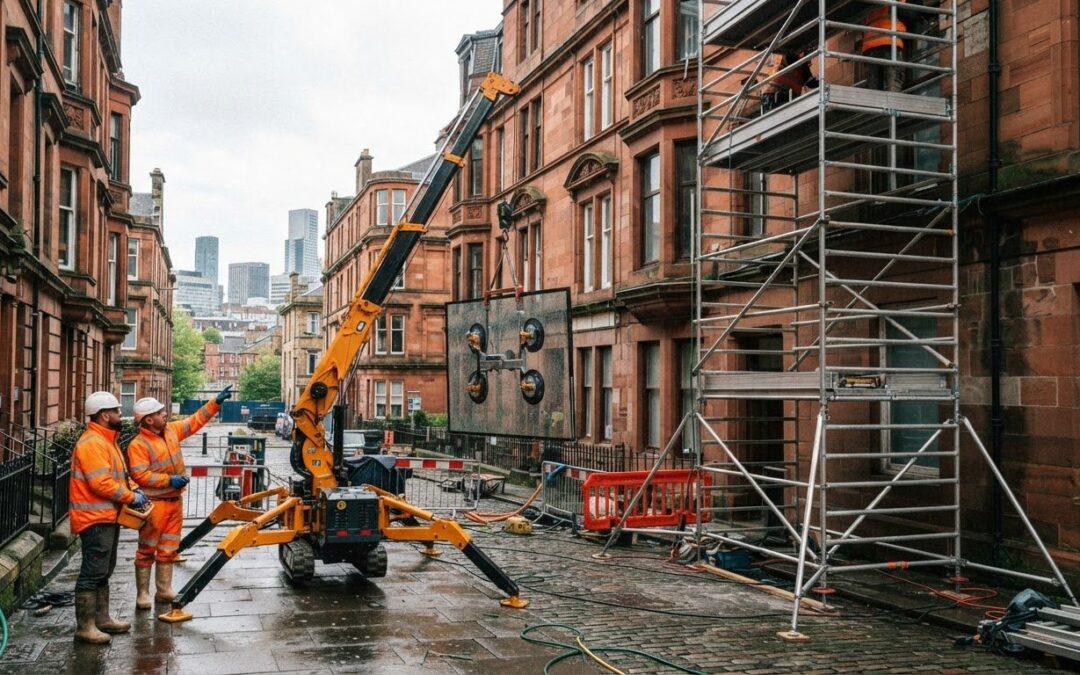
Scaffolding may seem like the obvious choice for a high-level repair in Glasgow, but it isn’t always the most practical setup. If you’re weighing up spider crane vs scaffolding for repairs Glasgow, start with the work itself: scaffolding provides a platform for sustained access, while a spider crane lifts suitable loads into position.
Restricted access, limited space, ground conditions and disruption can all affect the decision. The right setup depends on whether workers need a stable working area, lifting support, or both, and how long access is required.
This article compares the options by access, lifting needs, site constraints and project duration. It also covers practical checks to make before work begins, including the route to the work area, space for equipment set-up and whether the ground is suitable. Ayr Tracked Plant & Equipment Hire hires the TMC25/BG250 Mini Spider Crane for suitable lifting tasks. It supports planned lifts, but does not replace scaffolding when the task needs an extended work platform.
Key Takeaways
- For spider crane vs scaffolding for repairs Glasgow, match the equipment to the task: a platform for ongoing access, or lifting support for specific items.
- Map the access route and work area, then assess ground conditions and set-up space before deciding what can be used safely.
- Consider how long workers need access and whether they’ll return repeatedly to a broad work area.
- Equipment type alone doesn’t determine safety. Plan for worker access, lifting hazards, falling objects and activity around the site.
- Ayr Hire’s TMC25/BG250 Mini Spider Crane suits appropriate lifting tasks, with the project requirements assessed against the machine’s verified limits.
Spider crane vs scaffolding for Glasgow repairs: what problem are you solving?
Start with the job, not the equipment. Do workers need a stable platform for repeated access, lifting support to move materials into position, or both? Scaffolding and a spider crane have different purposes. The decision behind spider crane vs scaffolding for repairs Glasgow depends on the task, the site and how the work will be carried out.
Scaffolding is a temporary structure that provides access and a working platform. A spider crane is lifting equipment, not a general-purpose platform for tradespeople. It can lift suitable materials or components into position when the planned lift, site access, ground conditions and machine limits allow.
| Decision factor | Scaffolding | Spider crane |
|---|---|---|
| Primary function | Provides a platform for repair work. | Lifts and positions suitable loads. |
| Access needs | Workers need to reach the platform and move around the work area. | The machine needs a route and suitable space to set up. |
| Work duration | Can suit repairs requiring repeated access over an extended period. | Can suit specific lifting tasks within the repair programme. |
| Material handling | Materials can be available at the platform, subject to planned loading. | Can lift loads within the applicable load-chart limits. |
Neither option is automatically safer or more efficient. The setup must suit the task and site. Some projects need separate access and lifting solutions, either at different stages or as part of a coordinated plan.
What scaffolding provides during repair work
Scaffolding gives workers a platform for tools, materials and repeated access to a repair area. It can suit extended work across a façade or roof section, where tradespeople need to move along the work area rather than reach one point briefly. The layout and loading must suit the task. Planning and safe use matter, particularly where the building and surrounding activity affect how the structure can be arranged.
What a spider crane can do on a repair site
A spider crane lifts; it does not provide a standing work platform. It may help move suitable repair materials or components into position when the lift plan allows. Before choosing one, assess the route to the set-up area, available space, ground conditions, and the load’s weight and position. The machine’s current load chart and operating limits determine what it can lift in the planned configuration. Glasgow sites vary, so assess the specific building and work area rather than assuming one set-up will suit every job.
How spider cranes and scaffolding differ on Glasgow repair sites
Once the task is clear, consider how each option would work in the actual space. The access route, set-up footprint, ground conditions, reach and duration can all affect the decision. A solution that suits one Glasgow building may not fit another, so assess the specific site.
Access, setup space and ground conditions
Trace the route from the delivery point to the work area. Check entrances, internal routes, changes in level and overhead obstructions such as canopies, cables or tree branches. Then identify where a crane could stand and operate, or where scaffold components could be brought in and assembled. A spider crane’s compact design does not mean it can be set up anywhere; it still needs suitable working space.
Ground conditions matter too. The surface must be suitable for the planned equipment and its support arrangements. For a spider crane, the set-up position and any outrigger arrangements must follow the machine’s operating guidance. For scaffolding, the base and layout need to suit the building and site. Don’t assume a paved surface, courtyard or indoor floor can take the loads without assessment.
Repair duration, reach and material movement
Consider how often workers need to return to the repair area and how far they need to move along it. Repeated work at one elevation, such as repairing a broad section of façade, may need a stable, continuous work position. A crane may suit discrete lifts, such as raising a suitable component to a specific level, if the load chart and site plan allow. Reach alone is not enough: the load, its position and the crane configuration all affect a lift.
Plan how each lift will be carried out, including coordination with people working nearby. The Health and Safety Executive’s UK lifting operation regulations guidance is a useful reference when planning and managing lifting work.
Scaffolding supports continuous worker access; a spider crane carries out planned lifting operations. They can address different parts of the same repair, but that requires safe coordination, suitable space and a clear sequence of work. For spider crane vs scaffolding for repairs Glasgow, decide from the site plan and repair programme, not the equipment’s appearance alone.
For lifting tasks, consider mini spider crane hire as part of project-led equipment planning.
Is scaffolding or a spider crane the safer choice for repairs?
Neither option is automatically safer. The equipment must suit the task, and the work needs proper planning. A scaffold can provide a stable place to work, but access, platform layout and protection around the repair area still matter. A spider crane can help with planned lifts, but introduces lifting hazards that need to be managed. For spider crane vs scaffolding for repairs Glasgow, assess the full work set-up, including nearby trades, pedestrians and other site operations.
The Work at Height Regulations 2005 are relevant where repair work exposes people to a risk of falling. Check current HSE guidance when planning access and work at height. For crane use, the Lifting Operations and Lifting Equipment Regulations 1998 (LOLER) are also relevant. Refer to current HSE lifting guidance and verify the requirements that apply to the specific operation before work begins.
Risks to assess before using scaffolding
Consider how workers will reach and move around the platform, whether its configuration suits the repair, and what tools or materials it will carry. The structure’s stability and inspection arrangements also need appropriate planning. Consider falling objects and how to protect people below or passing near the work area. Don’t assume a platform is suitable simply because it reaches the right height; its design and anticipated loading must match the job.
Risks to assess before using a spider crane
A crane lift needs a suitable plan. Check the load against the machine’s current load chart for the planned configuration, and consider ground conditions, set-up position and clearances. Manage the lifting zone so workers and others aren’t exposed to avoidable risk. Nearby activity may need coordination, particularly if the lift route crosses a shared work area. HSE guidance on lifting operations and LOLER provide relevant references; confirm current details and applicability rather than relying on assumptions.
Consider how the hazards differ. Scaffolding centres on safe worker access, platform suitability and risks around the work area. Crane use centres on load movement, stability and keeping people clear of the lifting operation. Either set-up can create problems if it is poorly matched to the site or task.
Choose the set-up that controls the risks for the actual work, not the one that appears safer at first glance. A competent, project-specific plan should account for access, falling-object exposure, lifting activity and interaction with the public or other site operations.
How to choose between a spider crane and scaffolding for your Glasgow repair
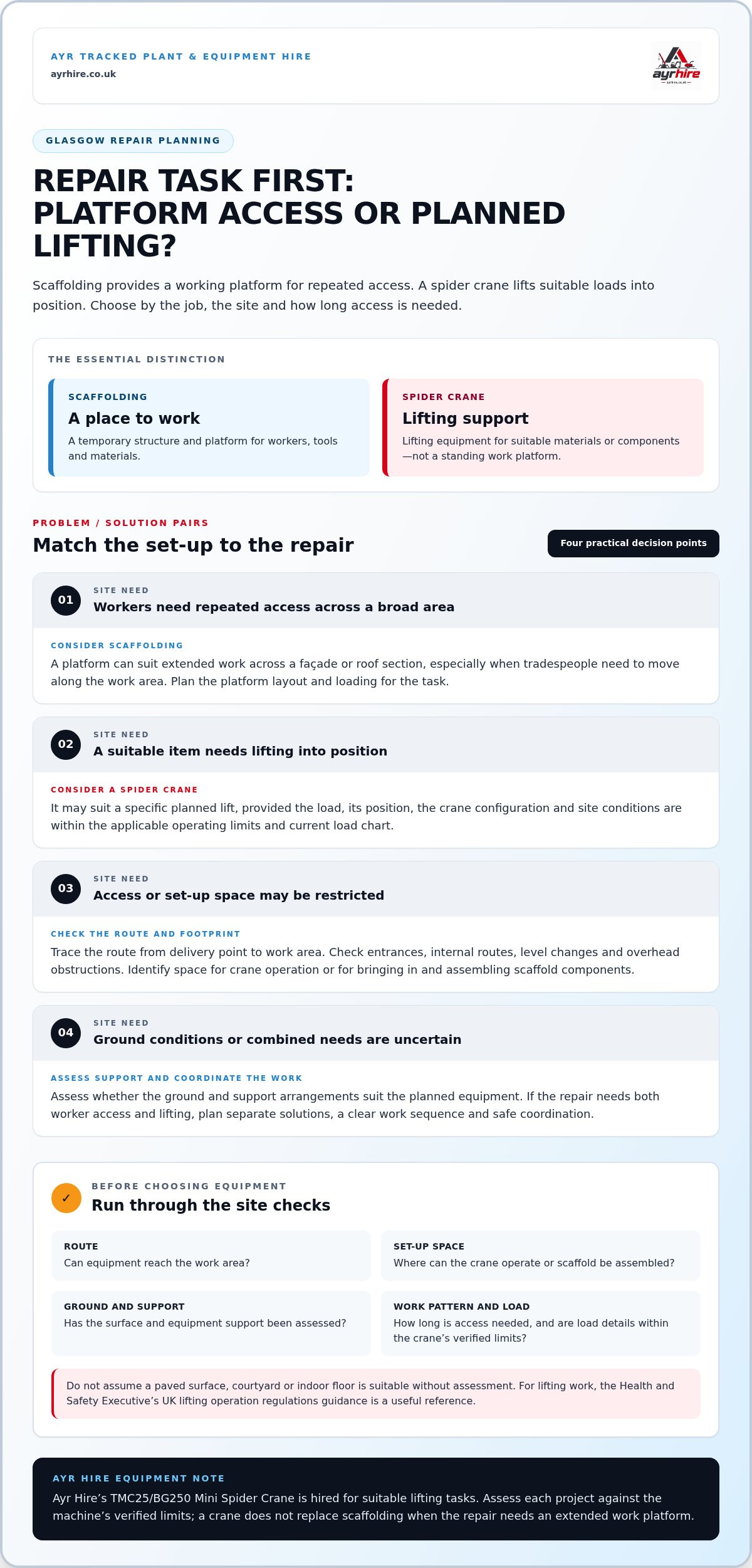
Use the repair plan to decide what the equipment needs to do. Do workers need repeated access across a broad area, or is the main requirement lifting specific items into position? This five-step check helps turn that question into practical information for a Glasgow site.
A five-step equipment decision
- Step one: Define the repair. Describe the work, where workers need to stand, and the materials or components to be handled. A localised repair may have different access needs from work spread across a roof or façade.
- Step two: Identify the main requirement. Decide whether the job needs continuous worker access, a planned lift, or both. Scaffolding supports ongoing work from a platform; a spider crane lifts suitable loads.
- Step three: Map access and set-up. Record the route from the delivery point, intended set-up area, ground surface, overhead obstructions and available clearances. A compact crane still needs a suitable route and space to set up.
- Step four: Assess duration and lifts. Note how long workers need access and whether they’ll return repeatedly. For a crane lift, record the load and destination so the planned operation can be assessed against the machine’s load chart and limits.
- Step five: Review site constraints. Compare suitable methods against the work sequence and competent safety assessment. Include nearby activity, public access and any restrictions that could affect how the work area is managed.
Useful site information includes clear photographs of the access route, set-up position, ground surface, overhead or side obstructions, and exact repair location. Add notes on the materials to be moved and their destination. This gives the equipment assessment a practical starting point instead of relying on assumptions about the site.
For further compact lifting considerations, see this mini spider crane hire guide for North Ayrshire.
When the project may need more than one method
Access and lifting can be separate needs within one repair programme. Workers might need a platform for sustained work, while particular materials need a planned lift. That doesn’t mean both methods should operate at the same time. Sequence the work and coordinate people, equipment and lifting activity through the project plan. Ayr Hire provides specialist lifting equipment for suitable jobs. For an appropriate lifting task, consider mini spider crane hire as part of your project planning.
Spider crane hire for Glasgow repairs: planning the next step
The comparison comes down to the job each method needs to do. If a repair calls for a planned lift and the site can accommodate the machine’s set-up, Ayr Hire hires the TMC25/BG250 Mini Spider Crane for suitable lifting tasks. It is not a universal replacement for scaffolding, which provides worker access. For spider crane vs scaffolding for repairs Glasgow, let the project brief, access, ground conditions and verified machine limits guide the decision.
What to prepare when planning a crane hire
Clear site information helps assess whether the crane suits the lifting task. Describe what needs to be moved, where it needs to go and how the work will be sequenced. Use an accurately established load weight rather than an estimate, so the planned lift can be assessed against the machine’s current limits.
- Repair and lift location: identify where the item will be collected and its intended landing position.
- Load details: describe the item and provide its verified weight, along with relevant information about its shape or handling.
- Access route: note the approach to the set-up area, including entrances and internal routes where relevant.
- Site conditions: describe the ground surface, available set-up space and overhead or nearby obstructions.
- Work sequence: explain when the lift needs to happen and how it fits around workers and other site activity.
Photographs can show details that are difficult to describe in writing. A simple marked-up plan can also identify the route, crane position, lift location and landing area. Together, these details support practical equipment selection and site planning.
A practical local hire option from Ayr Hire
Ayr Hire specialises in plant and lifting equipment hire across Glasgow, South Ayrshire, North Ayrshire, East Ayrshire and Dumfries & Galloway. The TMC25/BG250 Mini Spider Crane suits appropriate lifting tasks where access and ground conditions allow it to be set up. Its suitability depends on the specific lift and verified machine limits, not simply on its compact design.
For related compact lifting considerations, read the mini spider crane hire guide for North Ayrshire. If your repair involves a suitable lifting task, discuss your Glasgow repair project with Ayr Hire and share the key site and load details.
Make your repair setup fit the work
The choice between scaffolding and a spider crane comes down to the job. Scaffolding provides a platform for ongoing access; a crane supports planned lifting. For spider crane vs scaffolding for repairs Glasgow, consider the repair location, access route, ground conditions, duration and materials to be moved. These details help shape a practical plan for the site.
Safety depends on suitable equipment and competent planning, not on choosing one option by default. Some projects need access and lifting at different stages, with the work carefully coordinated.
Ayr Hire hires the TMC25/BG250 Mini Spider Crane for suitable lifting tasks, with selection guided by the project and verified machine limits. Ayr Hire focuses on specialist plant and lifting-equipment hire across Glasgow, South Ayrshire, North Ayrshire, East Ayrshire and Dumfries & Galloway.
Planning a repair that involves lifting? Discuss your Glasgow repair project with Ayr Hire and share the site and load details.
Frequently Asked Questions
When is a spider crane better than scaffolding for repairs?
A spider crane may suit repairs involving planned lifting, provided it can reach and set up safely at the site. Scaffolding is more likely to suit work where people need a stable platform for repeated access over time. They do different jobs. Compare the repair task, access route, ground conditions and work sequence rather than choosing based on equipment size or assuming one option is always more efficient.
Can a spider crane replace scaffolding for building repairs?
No, not for every repair. A spider crane is lifting equipment, whereas scaffolding provides a working platform for people and tools. A repair requiring sustained access may need a platform; a task involving materials to be lifted may need crane support. Some projects have both requirements, possibly at different stages. The work plan, site constraints and suitable safety arrangements determine which methods fit the job.
Is a spider crane suitable for a Glasgow property with restricted access?
It may be suitable if the access route, set-up area, ground conditions and lifting requirements fall within the crane’s verified limits. Restricted access alone doesn’t prove it will fit or operate safely. Assess entrances, internal routes, overhead obstructions, clearances and the intended lift position at the specific property. Compare those details with current machine information and competent planning before deciding whether a spider crane is appropriate.
What should I check before hiring a spider crane for repairs?
Start with the item to be lifted and its accurately established weight, then identify the lift and landing positions. Record the route to the set-up area, ground surface, available space and overhead obstructions. Check the machine’s current load chart and operating limits against the planned lift. The site plan should also address the lifting zone and nearby workers or activity, so the operation fits the repair programme.
Can scaffolding and a spider crane be used on the same repair project?
Yes, they can serve different needs within one repair project, but their use must be planned and coordinated. Scaffolding may provide ongoing worker access, while a spider crane handles specific lifting tasks. Consider the site layout, work sequence, lifting zone and access arrangements. Don’t assume both methods can operate simultaneously; the project-specific assessment should establish whether that arrangement is suitable and how activities will be coordinated.
Who decides whether a spider crane or scaffolding is safe for repairs?
The decision should follow a site-specific assessment of the task, access, equipment limits and relevant risks. Competent people responsible for planning and carrying out the work should use current guidance and applicable requirements. Consider worker access, ground conditions, lifting activity and people nearby. This comparison can help frame the decision, but it isn’t a substitute for a project assessment, lift plan or equipment-specific instructions.
What information should I provide when arranging spider crane hire in Glasgow?
Describe the repair and lifting task, the item and its verified weight, the intended lift and landing positions, and the site access route. Include ground conditions, known obstructions and the planned work sequence. Photographs or a marked-up plan can help show the layout. Ayr Hire hires the TMC25/BG250 Mini Spider Crane for suitable lifting tasks across Glasgow, South Ayrshire, North Ayrshire, East Ayrshire and Dumfries & Galloway.