
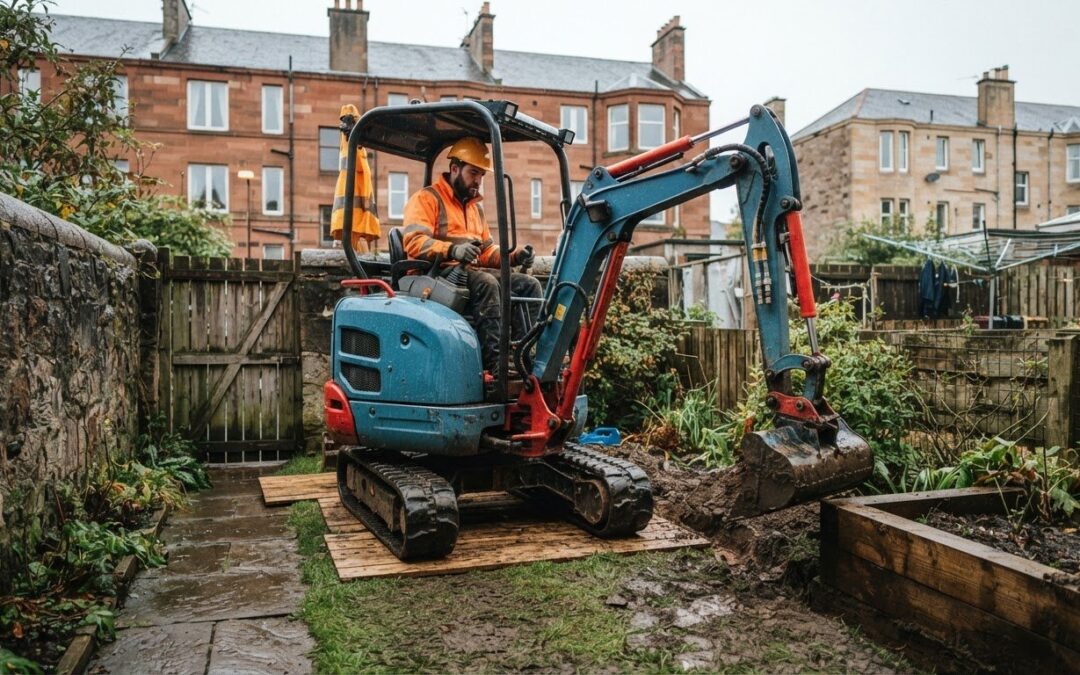
The most powerful digger isn’t always the right one for a small garden. If you’re searching for the “best mini digger for small garden Glasgow” projects, start with the route into the garden and the work to be done, not just the size of the excavation. A narrow gate, steps, soft ground or finished paving can shape your choice as much as digging depth and bucket size.
Before a machine arrives, think about protecting lawns, paths, walls and planted areas. The right hire choice should suit both the task and the space, helping you avoid access surprises and unnecessary disturbance. This guide explains how to compare mini diggers with manual tools, assess access and ground conditions, and plan for surface protection and spoil removal. It also covers practical steps for hiring Ayr Hire’s Kubota mini excavator in Glasgow, with flexible daily or weekly hire terms. By the end, you’ll have a clearer basis for choosing a machine that fits your garden groundworks.
Key Takeaways
- The best mini digger for small garden Glasgow projects depends on the excavation task, access route and ground conditions.
- Measure the narrowest access point and compare it with the machine’s full dimensions before choosing a digger.
- For shallow, limited work, manual tools may cause less disruption than hiring an excavator.
- Plan the work area and surface protection around your garden’s layout and ground conditions.
- Prepare the task details, access measurements and surface notes before hiring a Kubota mini excavator from Ayr Tracked Plant & Equipment Hire.
Choosing a mini digger for a small Glasgow garden: what the job demands
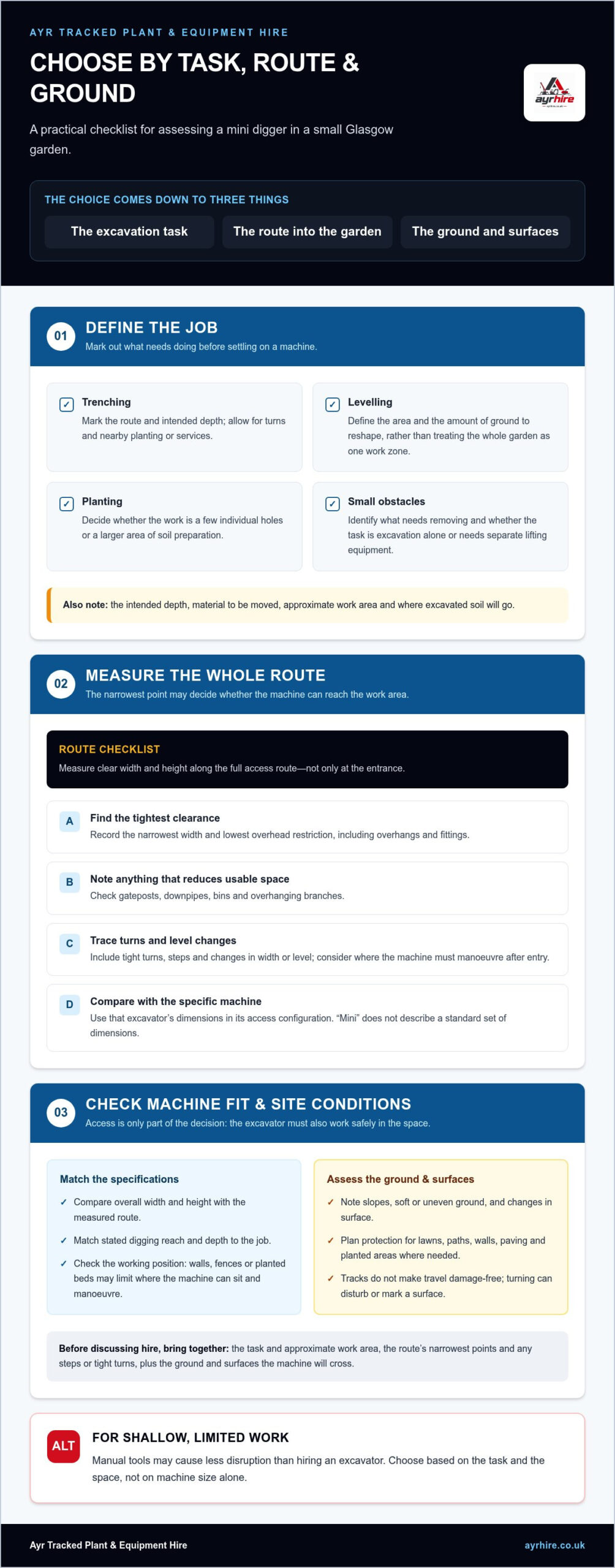
The best mini digger for small garden Glasgow groundworks depends on three things: the excavation task, the route into the garden and the ground where the machine will work. A trench for drainage or services calls for a different approach from levelling a patch, preparing a planting area or removing a small obstacle. Start by defining the job rather than assuming a particular machine size.
“Mini digger” describes a category of compact excavators, not a standard set of dimensions or capabilities. A garden-suitable machine is one whose dimensions, working reach and digging capability fit both the planned task and the site conditions. The Mini excavator overview provides general background, but you’ll need to compare the specific machine’s dimensions and operating specifications with your project.
Which small garden jobs suit a mini digger?
A compact excavator can help with defined groundworks that would otherwise involve sustained manual digging or moving soil by hand. Before choosing a machine, mark out the work area and note the intended depth, the material to be moved and where excavated soil will go. These details help you assess whether an excavator is appropriate and avoid hiring for a task it isn’t suited to.
- Trenching: Mark the route and intended depth, allowing for turns and nearby planting or services.
- Levelling: Define the area and the amount of ground to reshape instead of treating the whole garden as one work zone.
- Planting: Consider whether you need a few individual holes or a larger area of soil preparation.
- Small obstacles: Identify what needs removing and whether the work involves excavation alone or a separate lifting requirement.
A mini excavator is intended for excavation and associated soil movement. Specialist lifting or substantial earthmoving is a different type or scale of work and may call for different equipment. Set out the limits of the garden project before selecting a machine.
Why Glasgow garden access changes the choice
Glasgow gardens vary in layout. Access may involve a side passage, a gate, a tight turn beside a boundary wall or steps that interrupt the route. Each restriction affects whether a machine can reach the work area. Measure the narrowest point and note changes in width or level along the entire route, not just at the entrance.
Include anything that reduces usable clearance, such as gateposts, downpipes, bins or overhanging branches. Note sharp turns and where the machine would need to manoeuvre once inside. Measuring the whole route lets you compare it with the machine’s dimensions and reduces the risk of choosing a digger that fits through the entrance but cannot reach the work area.
Before arranging hire, bring together three details: the task and approximate work area, the route’s narrowest points and any steps or tight turns, and the ground or surfaces the machine will cross. This gives your hire discussion a practical starting point and connects machine choice to the actual garden, rather than relying on the label “mini”.
Mini digger features that matter most in a confined Glasgow garden
In a tight garden, a machine’s working capability matters only if it can reach the work area and operate there. Compare its full dimensions with your measured route, then check its reach, digging depth and working position against the excavation plan. The best mini digger for small garden Glasgow projects is the one that fits both the access constraints and the job, not simply the smallest machine available.
The narrowest point on the route can decide whether a mini digger is suitable, even if the rest of the garden has ample working space. Measure clear width and height, including overhangs or fittings, and account for the room needed to turn after entry. Dimensions and operating specifications vary by model, so use the figures for the specific excavator you’re considering rather than relying on a general “mini” label.
How to compare dimensions, reach and digging depth
Write down the narrowest access width, lowest overhead restriction and dimensions of the intended work area. Compare those measurements with the machine’s overall width and height in its access configuration. Then match its stated digging reach and depth to the job. A shallow planting area and a deeper trench have different requirements, so check the exact model specifications rather than planning around assumed figures.
Consider the working position too. The excavator needs enough room to sit securely and manoeuvre while its arm reaches the excavation. Even if a machine can enter the garden, a wall, fence or planted bed may limit where it can be positioned. Sketch the work area and mark nearby boundaries to make this constraint clear before arranging hire.
What tracked running gear means for garden access
Tracks provide a continuous contact area for moving the excavator, but they don’t make travel damage-free. Turning can disturb or mark a surface, depending on the machine, its movement and the ground beneath it. Don’t assume grass, paving or a path is suitable simply because the machine is tracked. Assess the route and plan protection where needed.
Slopes, soft ground and tight turns need particular attention. A narrow passage may provide enough clearance but leave little room to turn, while soft or uneven ground can affect movement and positioning. Record these conditions alongside your measurements. If the route includes a slope or a change in surface, include that in your hire discussion so the choice reflects the whole site, not just the entrance.
Plan where spoil will go so excavated material doesn’t obstruct the working area or access route, and follow current UK safety guidance for excavation work. Keep the machine’s dimensions, working position and actual ground conditions central to your planning. Ayr Tracked Plant & Equipment Hire’s Kubota mini excavator hire is an option for planned garden groundworks. Sharing the task and site details helps focus the hire discussion. For general background on compact excavators, Caterpillar’s Mini Excavators page outlines the category. Use the hire machine’s specifications when assessing your garden.
Mini digger, manual tools or another machine: compare options for your garden
Excavation and material movement are different jobs. A mini digger is designed to break ground and move soil within the work area. A multi-loader is for moving loads, not digging. Manual tools may be simpler for a small, shallow task, especially if getting machinery through the garden would involve more preparation than the work itself.
Choose the method that matches the task, available access and how material needs to be handled. This helps you identify the best mini digger for small garden Glasgow projects without assuming that hiring an excavator is always the practical answer.
When manual digging may be the simpler choice
Hand tools can suit a few planting holes, a short, shallow trench or a small patch that needs levelling. They avoid machine access and positioning, which can matter in a garden with delicate planting or a difficult route. The trade-off is physical effort. Digging and moving soil by hand can take longer, particularly if the work area or volume grows beyond the original plan.
There’s no single size threshold that makes manual work right or wrong. Consider the depth, the amount of soil to remove, your available time and whether you can manage the physical work comfortably. If the task expands, reassess the method rather than continuing with an approach that no longer fits.
When a mini digger is the more practical hire
For a larger, defined excavation, such as a longer trench or repeated digging across a work area, a mini digger can reduce manual excavation. It still needs adequate access and room to operate. A machine that can reach the garden may not be practical if the excavation is boxed in or there’s no suitable position from which to dig. Caterpillar’s Mini Excavators page offers a manufacturer’s overview of the compact excavator category. Compare the specific hire machine’s specifications with your task.
Separate digging from shifting material. If soil, paving or other loads need to be transported around the site, a loader may suit that part of the job, but it doesn’t replace an excavator for breaking ground. If moving loads is the main challenge, ALMA multi-loader hire in Glasgow is a distinct equipment option.
- Choose hand tools for limited, shallow work where access or disruption makes machinery disproportionate.
- Consider a mini digger for a defined excavation with enough access and working room.
- Consider a multi-loader when transporting loads, rather than digging, is the central need.
Before settling on a method, estimate the work area and depth, identify what must be excavated and decide where the material will go. This keeps the equipment choice proportionate to the garden project.
Plan access and protect garden surfaces before mini digger hire in Glasgow
A short site check can prevent a poor equipment match and help limit avoidable disturbance. Work through four steps: define the excavation, measure the route, assess surfaces and spoil, then plan where the machine will work. Gardens in Glasgow, South Ayrshire, North Ayrshire, East Ayrshire, Dumfries & Galloway and surrounding areas vary in layout, so base your decision on the property and ground conditions rather than assumptions.
Measure the route from delivery point to work area
Start at the point where the machine will arrive and trace the full route to the excavation. Measure the narrowest gate and passage, and note tight turns, overhead restrictions, steps, raised thresholds, slopes and fixed obstacles. Compare each restriction with the confirmed dimensions of the specific machine. A clear entrance alone doesn’t show that the whole route is suitable.
Record where gates open and whether handles, posts or nearby structures reduce usable clearance. A passage may be wide enough in a straight line but too confined for a turn. Note changes in level as well. These details help you assess the route as a whole and discuss access using measurements rather than estimates.
Assess surfaces, spoil and the working area
Identify what the machine would cross and where it would sit: lawn, paving, paths or ground near walls, drains and planted beds. Tracks don’t guarantee damage-free travel. Consider suitable surface protection for the material and site conditions, and keep vulnerable planting or items that could obstruct movement out of the planned working area where practical.
Plan the spoil location before excavation starts. Mark where soil will be placed, how it will be moved and whether the pile could block the route or working position. Keep space for the excavator to manoeuvre and for people to stay clear of its operating area. A tight garden can become difficult to work in if excavated material is left wherever space first appears.
Ground conditions need an on-site assessment. Don’t assume a lawn will support the machine or that a route will be firm enough after wet weather. Soft ground, slopes and changes in surface can affect movement and positioning. Include what you observe in the site plan, then make a considered decision about access and protection.
- Define the work: Mark the excavation area and intended depth.
- Measure the route: Record restrictions from the arrival point to the work area.
- Assess the site: Note surfaces, planting, slopes and ground conditions.
- Plan the operation: Choose the working position and spoil area.
This preparation helps you judge the best mini digger for small garden Glasgow groundworks using the actual site conditions. If the project involves a wider mix of access or material-handling needs, Ayr Tracked Plant & Equipment Hire’s guide to specialist plant hire in Ayrshire outlines other equipment considerations. For planned garden excavation, explore Kubota mini digger hire and prepare your task, route measurements and surface notes for a focused hire discussion.
Hire a Kubota mini excavator for your Glasgow garden project
Ayr Tracked Plant & Equipment Hire’s Kubota mini excavator hire is an option for planned garden groundworks in Glasgow and surrounding areas. The right choice depends on the job and the site. A clear description of the excavation, access route and surfaces involved helps make the hire discussion practical and focused.
Before arranging hire, gather a few details. Note what you’re digging, the approximate work area and the intended result, such as a trench, levelled patch or prepared planting ground. Include the expected depth and the material you’ll need to move. This connects the machine choice to the work rather than relying on a general description such as “a small garden job”.
What to prepare before arranging mini digger hire
Measure the access route from the delivery point to the work area. Record the narrowest gate or passage, tight turns, overhead restrictions and any steps, slopes or raised thresholds. Add notes on the machine’s planned working position, nearby boundaries and the route back out. These measurements give you a useful basis for comparing the site with the machine’s dimensions.
Include surface and site information too. For example, note whether the route crosses lawn or paving, whether drains or planted beds are close to the work area, and where excavated soil can be placed. Mention any soft or uneven ground you’ve identified. If you have a preferred hire period, state whether daily or weekly hire terms best fit your project plan.
- Task: What needs excavating, over what area and to what intended depth?
- Access: What are the measured restrictions and changes in level along the route?
- Site: Which surfaces, boundaries and planted areas need consideration?
- Timing: Would daily or weekly hire terms suit the planned work?
How Ayr Tracked Plant & Equipment Hire fits the Glasgow project
Ayr Tracked Plant & Equipment Hire provides tracked plant and equipment hire across Glasgow and surrounding areas, including Kubota mini excavators for garden groundworks. Flexible daily or weekly hire terms let you describe the period that suits your plan. Sharing measurements and site notes gives the hire discussion useful context, particularly where access or working space is constrained.
The best mini digger for small garden Glasgow work is the one that suits the excavation and the garden as it is, not as you hope it will be. Organise your task details, route measurements and surface considerations before choosing the next step. For planned groundworks, explore Ayr Tracked Plant & Equipment Hire’s equipment hire and view the available plant hire options.
Set your garden project up for a confident start
A good hire decision gives you a workable starting point for the groundworks, with fewer unknowns once the project begins. Before moving ahead, turn your measurements and task notes into a simple plan: what needs doing first, where excavated material will go and how you’ll keep the work area clear.
That preparation makes it easier to decide whether the best mini digger for small garden Glasgow work is right for your site and planned hire period. You can then move forward with a clearer view of the job instead of trying to solve access or layout questions on the day.
Ready to plan your garden groundworks? Explore Ayr Hire’s plant and equipment hire options and take the next step towards getting your project under way.
Frequently Asked Questions
Will a mini digger fit through a standard garden gate?
Not necessarily. “Standard” gate sizes vary, and mini diggers come in different dimensions. Measure the clear opening with the gate fully open, then compare it with the exact machine’s width in its access configuration. Also account for gateposts, a turn immediately beyond the entrance and any height restriction, such as a low arch or overhanging branch. The delivery route and the route through the garden both need to work.
Can a mini digger work in a small garden without damaging the lawn?
There’s no guarantee a mini digger will leave a lawn undamaged. Tracks can mark turf, especially during turns or if the ground is soft. Protective ground mats may help spread the load, but their suitability depends on the machine and site. If the lawn is important, plan a dedicated route, keep turning on lawn to a minimum and consider whether the work can be reached without crossing the most vulnerable area.
Is a mini digger suitable for digging a garden trench?
Yes, a mini digger can suit a garden trench if its dimensions and digging capability match the planned route and excavation. For example, a trench beside a fence may leave little room to position the machine or place spoil. Mark the route and intended depth, identify any known buried services before digging, and allow space for excavated material. Match the machine’s specifications to the actual trench, not an assumed depth.
Can a mini digger be used on wet ground in Glasgow?
It depends on the ground at the time of the work, not simply the location. Wet or soft ground can affect traction, machine movement and the risk of rutting. Check the route and working area close to the hire period, paying attention to saturated lawn, standing water and soft patches. If the surface won’t reliably support the machine, revise the access plan or wait for more suitable conditions rather than forcing the route.
Do I need experience to operate a mini digger?
For private land and your own work, a formal licence or certification isn’t required in the UK. That doesn’t mean experience is unimportant: controls and machine behaviour take care to learn. Read and follow the hire and operating instructions, keep people clear of the working area and avoid unfamiliar manoeuvres in confined spaces. If you’re new to operating one, take time to understand the controls before beginning the excavation.
Is a mini digger better than hiring a larger excavator for a garden?
Often, a compact machine is a more practical starting point for garden work, but the task and access decide. A larger excavator may be excessive where space is limited, while a mini digger still needs enough room and suitable capability for the job. Compare the work with the exact machine specifications. For the best mini digger for small garden Glasgow projects, focus on fit and task, whether in Glasgow, South Ayrshire, North Ayrshire, East Ayrshire or Dumfries & Galloway.