What if the best lifting option for your Glasgow site isn’t the one with the biggest headline capacity? The right choice depends on the load, the route into position, the available working space and how the task fits your programme. Choosing lifting solutions for construction Glasgow projects can feel uncertain, particularly where access is restricted or equipment arrival needs to fit a planned lift.
A clear site brief helps narrow the options. This guide explains how to match the task to equipment such as mini spider cranes, vacuum lifters and crawler multi-loaders, or a trailer-mounted cherry picker for work at height. You’ll learn which details about the load, access and site set-up matter when selecting equipment, and what to include in a practical hire enquiry. Ayr Tracked Plant & Equipment Hire serves Glasgow with specialist lifting equipment on flexible daily or weekly hire terms.
Key Takeaways
- Break the lift down into the load, movement path, landing point and working conditions before comparing equipment.
- Use the task and access challenge to narrow the equipment category, then consider how the lift will be planned and carried out.
- A clear site brief for lifting solutions for construction Glasgow projects should cover arrival arrangements, route clearance, ground conditions and nearby site activity.
- Include the load details, site constraints and intended placement in your hire enquiry to help identify a practical equipment option.
Lifting solutions for construction in Glasgow: start with the job
What needs lifting, where does it need to go, and what could restrict the task? Start there, not with a machine name or headline capacity. A lift is shaped by the load, its route from collection point to landing point, and the conditions at both ends. For lifting solutions for construction Glasgow projects, a short, accurate brief makes equipment comparisons more useful and helps the team plan around the actual site.
A lifting solution is equipment matched to a specific load and planned task, taking account of the route, working area and site conditions. This keeps the focus on the whole lift. General references such as this overview of types of construction equipment show the breadth of machinery used on building projects, but your site brief is what helps narrow the options for a particular job.
What information defines a construction lift?
Record what the load is, its approximate weight and its dimensions. Note whether it has a regular shape or needs a particular orientation. Then map the lift: the starting position, route, landing point and exact placement required. A load that must pass through a restricted opening or be set down in a particular position presents a different task from one moved across an open work area.
- Load: Type, approximate weight, dimensions and any placement requirements.
- Route: Starting point, travel path, access openings and intended landing position.
- Working conditions: Overhead obstructions, uneven ground, available space and nearby activity.
Consider these details together. A clear route may still lead to a cramped landing area, while a suitable working space may have ground conditions that need careful review. Flag uncertainties in the brief rather than relying on assumptions. Equipment suitability depends on the complete task, not just the object being moved.
Why Glasgow site conditions shape equipment choice
Some Glasgow projects may involve urban access, coordinated arrival arrangements or limited working space. Others may have straightforward access and room to position equipment. Don’t assume every site shares the same constraints. Describe the specific entrance, route, working area and planned timing so the equipment choice reflects your project, not a general picture of the city.
A concise site brief can capture the essentials before you compare equipment categories. Include where equipment is expected to arrive, any access restrictions, the ground condition in the intended working area and other site activity that could affect the lift. This helps you assess whether a specialist option, such as a mini spider crane, vacuum lifter or crawler multi-loader, fits the task. Next, compare those categories against the load and site requirements.
Compare specialist lifting equipment for Glasgow construction tasks
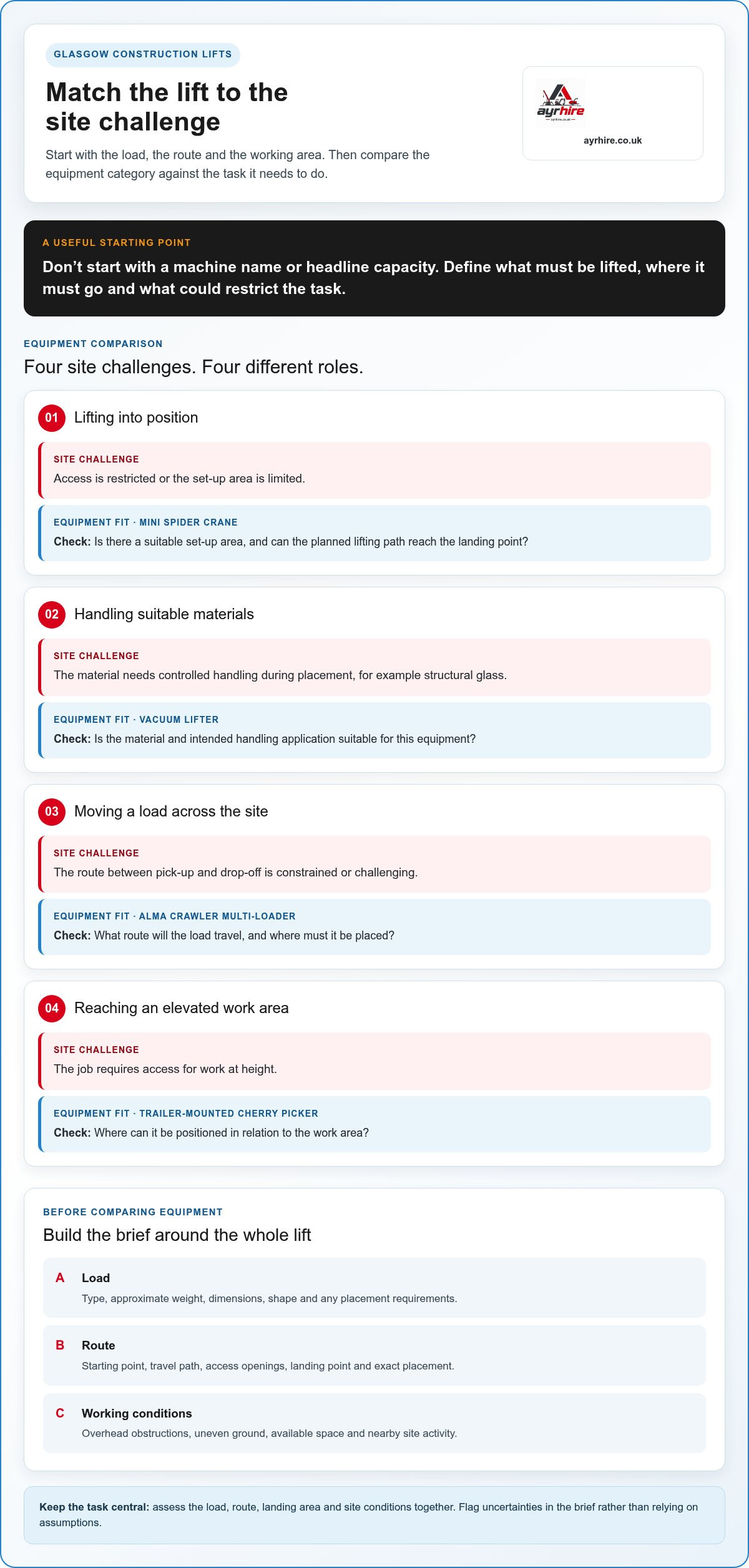
Match the equipment category to the job’s main requirement: lifting a load into position, handling suitable materials, moving a load along a route or reaching a work area at height. These are distinct tasks. A tracked carrier and a cherry picker, for example, aren’t interchangeable simply because both can help on a construction site. Use the comparison below to build a shortlist, then plan around the specific load and site conditions.
Task: Specialist lifting into position
Access challenge: Restricted access or a limited set-up area
Equipment category: Mini spider crane
Planning question: Is there a suitable set-up area, and can the planned lifting path reach the landing point?
Task: Handling suitable materials, including structural glass
Access challenge: The material needs controlled handling during placement
Equipment category: Vacuum lifter
Planning question: Is the material and intended handling application suitable for this equipment?
Task: Moving loads across the site
Access challenge: A constrained or challenging route between pick-up and drop-off points
Equipment category: ALMA crawler multi-loader
Planning question: What route will the load travel, and where must it be placed?
Task: Reaching an elevated work area
Access challenge: The job requires access for work at height
Equipment category: Trailer-mounted cherry picker
Planning question: Where can it be positioned in relation to the work area?
When a mini spider crane may fit the lift
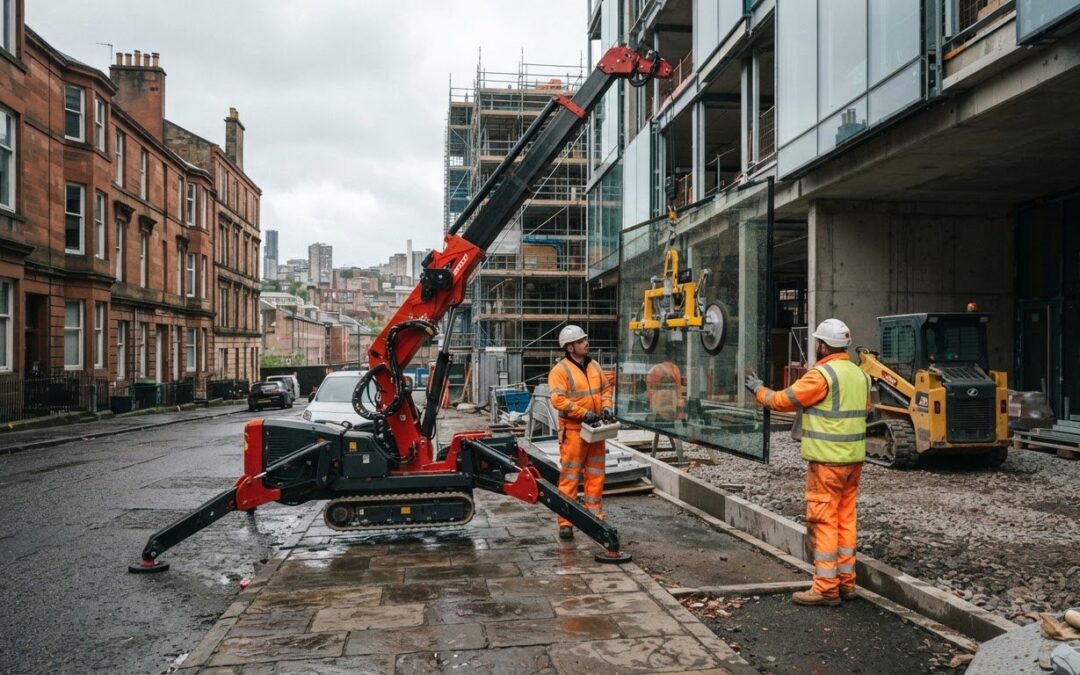
A mini spider crane may suit specialist lifting where access or working space shapes the choice. Compact access alone doesn’t determine suitability: the set-up area, ground conditions, load and route all matter. Map where the crane would be positioned and how the load must travel before comparing options. For a focused equipment guide, see mini spider crane hire in North Ayrshire, supporting efficient lifting solutions for construction Glasgow projects.
When a vacuum lifter or tracked carrier may be relevant
A vacuum lifter is relevant for suitable applications such as handling structural glass. A tracked multi-loader has a different role: moving loads along a site route, including where access is challenging. Describe both the material and the journey it needs to make. The ALMA multi-loader hire in Glasgow guide provides further narrow-access context.
Keep the lift plan central to the comparison. The HSE’s guidance on safe lifting practices in construction offers additional material-handling context. Ayr Tracked Plant & Equipment Hire’s specialist lifting equipment is available for construction projects in Glasgow and across South Ayrshire, North Ayrshire, East Ayrshire and Dumfries & Galloway.
How to assess lifting options before hiring in Glasgow
Use a clear sequence to turn a lifting requirement into a practical equipment shortlist. Define the task, record the site constraints, compare suitable equipment categories, then plan how the lift will take place. This keeps the decision grounded in the work rather than a machine’s headline capacity. Equipment suitability depends on the load, route, set-up space and planned lift.
- Define the task. Describe what must be lifted or moved, where it starts and where it needs to finish. Note any handling or placement requirements.
- Record site constraints. Map the access route and working area. Include ground conditions, obstacles, overhead restrictions and space for equipment to be positioned.
- Compare equipment categories. Consider whether the task calls for lifting into position, handling a suitable material, moving a load along a route or reaching an elevated work area.
- Plan the lift. Consider the sequence, site activity and coordination needed for the operation. Equipment choice should fit the planned lift, not dictate it.
Build a useful site and load brief
Give the equipment hire enquiry enough detail to support a meaningful comparison. Record the load material, approximate dimensions and weight, plus how it needs to be handled. Describe the route from collection point to landing position, including narrow sections, uneven ground, obstructions and the available set-up area. State the intended placement clearly. Include site timing or other work that could affect access.
For example, a load that must pass through a restricted route and be positioned precisely has different planning considerations from one moved over an open, clear area. This distinction focuses attention on both the load and its journey. If a measurement is approximate, label it as such rather than presenting an estimate as exact. A concise, accurate brief gives Ayr Tracked Plant & Equipment Hire a practical basis for matching specialist equipment to your Glasgow project.
Include safety planning in the equipment decision
Equipment selection is only one part of the decision. The lift must also be considered in the context of the project’s safety arrangements and the equipment’s intended use. The Health and Safety Executive’s construction guidance on lifting operations is a relevant reference when reviewing risks and planning site work. Use it alongside project-specific information, not as a substitute for planning the lift itself.
CDM 2015 concerns health and safety management for construction projects. LOLER applies to lifting equipment and lifting operations within its scope. Their relevance depends on the project and equipment use, so a short hire guide cannot provide a complete statement of legal duties. The people responsible for the project should consider applicable requirements and ensure the operation is properly planned for its circumstances.
For lifting solutions for construction Glasgow projects, the finished brief should connect the load, route, working area and placement to a considered equipment choice and lift plan. That is the basis for a clear, useful hire enquiry.
Prepare a Glasgow site for specialist lifting equipment
A hire-ready site brief should explain how equipment will reach the work area, where it can be positioned and how the lift fits around site activity. Preparation varies with the equipment, load and site layout. A route that works for one machine may not suit another, so record the actual conditions rather than relying on assumptions.
Check access, set-up space and the working area
Map the route from the site entrance to the intended working position. Walk it where practical, noting restricted gateways, turns, slopes, overhead obstacles and any concerns about the surface or ground conditions. Then assess the working area itself: is there room to position the equipment, and can the load travel to its landing point without crossing active work areas?
- Access route: Note entrances, narrow points, turns and overhead obstructions that may affect equipment movement.
- Working area: Mark the intended position and identify ground conditions, slopes or limited space that could affect set-up.
- Lift zone: Identify people, vehicles, stored materials and other tasks that could overlap with the planned movement.
- Landing point: Keep the destination clear and describe where the load needs to be placed.
Be specific about concerns. “Restricted access” is less useful than noting where the restriction occurs and what it looks like. Photographs or a marked-up site plan can help explain the layout in an enquiry, particularly when the route and working area aren’t obvious from a written description.
Coordinate delivery and the lifting sequence
Plan arrival around the site’s access arrangements and other scheduled activity. Identify a practical delivery window, the person coordinating the lift and how site-specific information will be shared with the team. The delivery route, set-up area and lift sequence should work together, not be treated as separate details.
Before equipment arrives, brief the relevant site personnel on its expected movements and the planned order of work. Make clear which areas need to remain accessible or clear, and how changes to the site plan will be communicated. Align these arrangements with the project’s safety planning and the people responsible for the work. Keep the plan specific to the selected equipment and task rather than assuming one arrangement will suit every lift.
For lifting solutions for construction Glasgow projects, a clear brief connects access, set-up and coordination in one practical plan. Ayr Hire’s Glasgow equipment hire team provides specialist lifting equipment for construction projects.
Arrange lifting equipment hire for your Glasgow construction project
Ayr Tracked Plant & Equipment Hire provides specialist equipment hire for construction projects in Glasgow. A well-prepared enquiry connects the job to a relevant option and gives the hire discussion a clear starting point. Explain what needs lifting or moving, where the work will take place and how the load must be handled or positioned. Include the site constraints that could affect equipment access and use.
What to include in a lifting equipment enquiry
Set out the task in practical terms. Note the load type, approximate weight and dimensions, its starting point and intended placement. Then describe the route and working area, including access restrictions, ground conditions, obstacles and available space. Add the site location, relevant timing constraints and your preferred hire period. Clear details help shape an equipment discussion around the real job.
- Load and task: What is being lifted or moved, and what handling or placement is required?
- Site: Where is the work, and what access, ground or working-space conditions may affect it?
- Timing: When is the equipment needed, what project activity affects the work, and is daily or weekly hire more suitable?
Match the enquiry to Ayr Hire’s specialist equipment
Different equipment categories address different tasks. For lifting into position, include details that help assess whether a mini spider crane fits the planned work. Ayr Hire’s TMC25/BG250 mini spider crane is a hire option. For suitable material-handling applications, describe the material and how it needs to be placed when enquiring about vacuum lifter hire. If the main requirement is moving a load along a site route, explain the route and destination when considering an ALMA crawler multi-loader.
Keep the task clear. A trailer-mounted cherry picker is relevant where the work involves access at height, rather than moving a construction load. Matching the enquiry to the job helps distinguish between lifting, material handling, load movement and elevated access. For lifting solutions for construction Glasgow projects, Ayr Hire offers flexible daily or weekly hire terms to help project teams plan around their work period.
Before sending your enquiry, bring together the load information, site location, access notes, intended placement and preferred hire period. If details are approximate, label them clearly. This gives a practical picture of the work and helps focus the conversation on equipment suited to the project, without relying on assumptions about site access or equipment requirements.
Discuss your Glasgow lifting equipment hire with Ayr Hire and share the task and site details to start planning a suitable hire option.
Make the next lift part of the project plan
Once you’ve shaped a hire enquiry, carry the decision into the project programme. Give one person responsibility for keeping lift-related details current, especially if the work area, load or sequence changes. A change on site can affect the assumptions behind the original equipment choice. Keeping the plan current helps the team work from the same information, rather than relying on notes that no longer reflect the job.
For lifting solutions for construction Glasgow projects, turn the requirement into a clear conversation about the task and hire period. Ayr Hire provides specialist equipment hire with flexible daily or weekly terms. Bring your working brief and outline what the lift needs to achieve.
Discuss your Glasgow lifting equipment hire and take the next step towards a practical plan for your site.
Frequently Asked Questions
What lifting equipment is suitable for a construction site in Glasgow?
The suitable equipment depends on the specific operation. Placing a load into position, handling suitable glass or transporting materials across a site call for different equipment categories. Consider what the equipment must do at the start and finish of the task, not just the load itself. Ayr Hire provides specialist equipment hire for Glasgow projects, including mini spider cranes, vacuum lifters and ALMA crawler multi-loaders.
Can a mini spider crane work on a restricted-access construction site?
A mini spider crane may be relevant for specialist lifting where access is restricted, but the route to the working area and the space available for set-up still matter. A narrow entrance may be manageable, while a tight turn or obstructed landing area presents a separate constraint. Ayr Hire hires TMC25/BG250 mini spider cranes. Include site measurements and the intended lifting path in your enquiry.
When should a construction project use a vacuum lifter?
A vacuum lifter can suit an application involving compatible materials, including some structural-glass handling tasks. Consider the material’s surface and dimensions, as well as how it will be positioned at the destination. Glass panels that need careful placement require a handling method suited to the panel and task. Ayr Hire provides vacuum lifter hire. Describe the material and placement requirements when discussing lifting solutions for construction Glasgow work.
How do I choose between a spider crane and a tracked multi-loader?
Distinguish a lifting task from a transport task. A mini spider crane is a specialist lifting option; an ALMA crawler multi-loader is relevant when the job involves moving a load across a site. Some projects may involve both moving and placing a load, so describe each stage separately. The route, destination and site layout help clarify which equipment category fits each part of the work.
What information should I provide when hiring lifting equipment in Glasgow?
Give Ayr Hire a clear account of the job: load type, approximate weight and dimensions, task, site location and intended placement. Add practical context, such as whether the work area is shared with deliveries or other trades, and any access arrangements that could affect arrival. Include your preferred hire period and relevant project timing. Ayr Hire serves Glasgow, South Ayrshire, North Ayrshire, East Ayrshire and Dumfries & Galloway.
What safety guidance applies to lifting equipment on a construction site?
Follow current official guidance and the project’s safety arrangements. The Health and Safety Executive provides construction guidance covering lifting hazards and information on CDM 2015. LOLER may also be relevant to lifting equipment and operations, depending on their use. These requirements are context-specific, so a general FAQ cannot replace the project’s own planning. Refer to the responsible site personnel and applicable HSE guidance for the work being carried out.