Will a crane that fits through the doorway also make it to the work area and complete the lift safely? Choosing a spider crane for indoor use means looking beyond compact size. Doorways, corridors and turns can restrict access, while floor capacity and sensitive finishes may affect where the crane can be set up.
It’s easy to focus on the load’s weight and overlook the lifting radius. A crane’s rated capacity changes with its configuration and reach, so assess the load and lift plan together. This guide explains how to check the access route, floor and working area, then compare the crane with the load and required radius. It also covers the site details to prepare for a hire enquiry in Ayrshire or nearby areas. Ayr Tracked Plant & Equipment Hire hires the TMC25/BG250 mini spider crane for projects where a compact lifting machine may suit the site and lift requirements.
Key Takeaways
- When choosing a spider crane for indoor use, survey the full route, including turns, thresholds, overhead obstructions and the final setup area.
- Use the crane’s load chart to assess capacity at the required radius and boom configuration, rather than relying on a headline figure.
- Compare the load, lift height, working radius and crane dimensions with the building’s floor and access constraints.
- Plan how to manage people, adjacent trades and vulnerable surfaces before the lift begins.
- Prepare route measurements, load details and floor constraints for your hire brief, then assess Ayr Hire’s TMC25/BG250 mini spider crane against the job.
Why choosing a spider crane for indoor use takes more than checking capacity
An indoor lift can be constrained before the crane reaches the load. A narrow entrance, tight corridor or occupied work area can limit access and leave little room to position the machine. The floor, nearby trades and available setup space also influence how the lift can be carried out.
A spider crane is a compact lifting machine designed for selected jobs where access or working space is restricted. Its configuration differs from that of larger conventional cranes, but compact dimensions don’t guarantee it will pass through every building or suit every lift. This overview of types of cranes, including mini cranes explains where these machines sit within the broader range of lifting equipment.
Indoor crane suitability depends on the complete lift and site, not capacity alone.
Break the decision into checks that answer different questions:
- Route: Can the crane get from the delivery point to the work area, including turns and changes in floor level?
- Load: What is being lifted, and how will it be prepared for the lift?
- Working radius: How far must the crane reach from its setup position to the load’s pick-up and landing points?
- Floor and setup: Can the intended area support the planned setup, including the stabilisers, without damaging finishes?
- Sequence: Can the lift take place safely around other work, occupants and building restrictions?
When a spider crane may suit an indoor lifting job
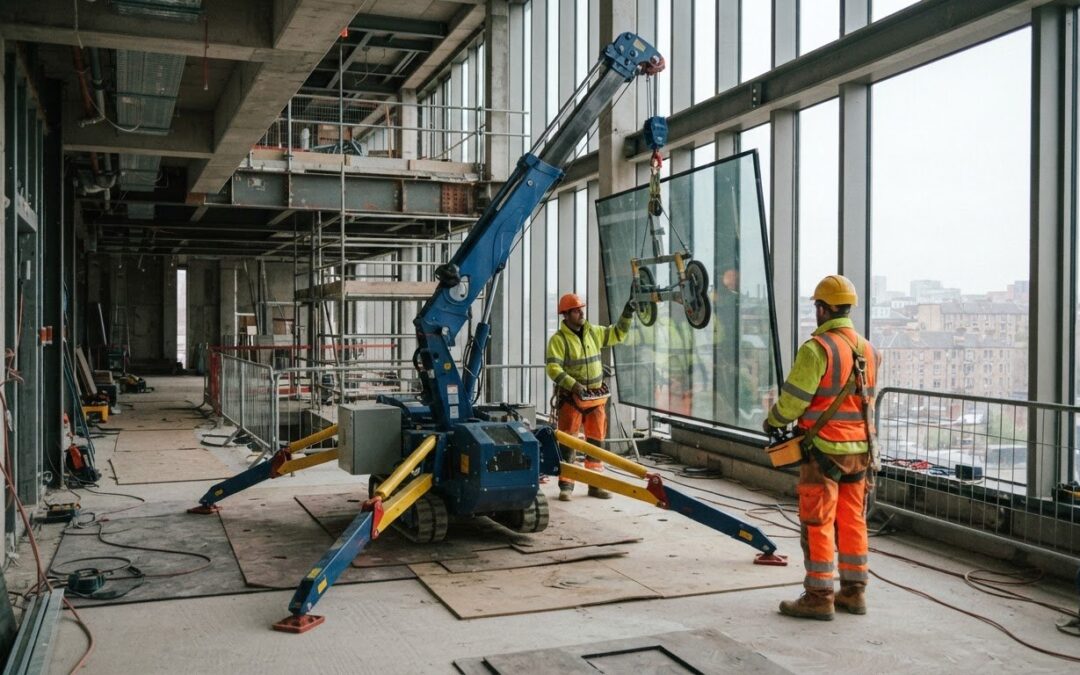
Confined-space installation, building maintenance and refurbishment can involve lifting equipment or materials into places that are awkward to reach with larger cranes. A spider crane may suit a job where access or working space is restricted, provided there is a workable position for the machine and a clear path for the load.
Assess the actual lift rather than assuming a compact crane will fit. A machine might pass through an entrance but be unable to negotiate a turn or set up near the lifting point. Check the full access route and planned lift before choosing equipment.
The indoor constraints that shape the choice
Check doorways, corridors, turns, thresholds and overhead obstructions, including services that could interfere with the crane or load. Then assess the proposed setup area. Floor loading limits, finished surfaces and the space needed to position stabilisers can all affect where the crane can work.
Buildings also bring operational constraints. Other trades, occupants and building rules may restrict access or affect when the lift can happen. Identify who needs to be kept clear, which areas need protection and how the work sequence will be managed. These details turn a general equipment choice into a practical assessment of the whole indoor lift.
Measure the access route before comparing indoor spider crane models
Start with the route, not a model shortlist. A crane that fits through the entrance may still be unable to negotiate a corridor turn, pass beneath an overhead service or reach the planned setup area. A measured survey gives you practical limits to compare with the transport dimensions of the specific crane.
Build a route survey that reflects the whole journey
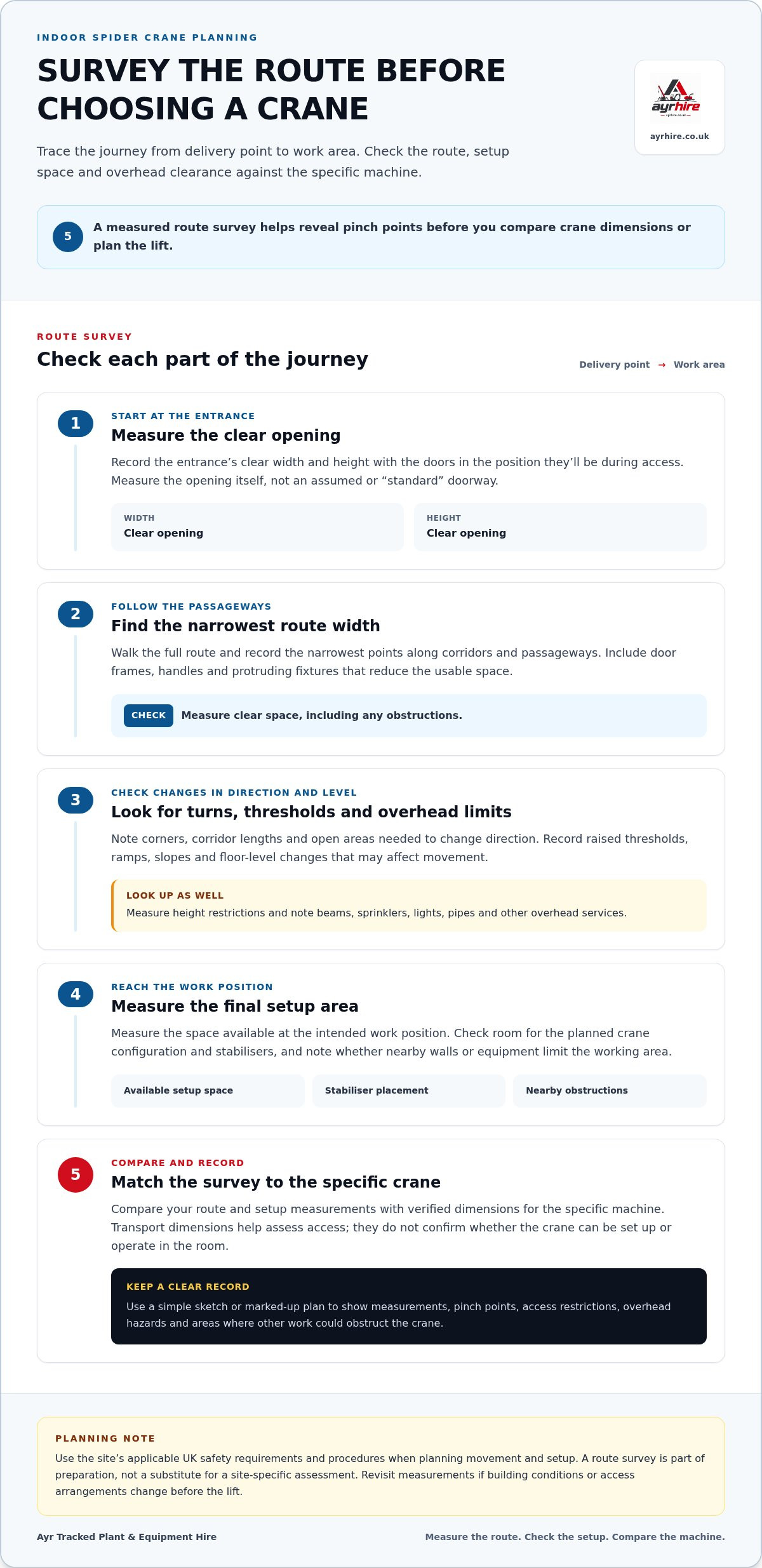
Walk the route from the delivery point to the work area. Measure clear openings rather than relying on drawings or a description such as “standard doorway”. Record the narrowest width and lowest height, allowing for door handles, frames and temporary obstructions. Note where the route changes direction or level.
- Entrance: Measure the clear width and height with doors in the position they’ll be during access.
- Route width: Record the narrowest points along corridors and passageways, including protruding fixtures.
- Turns and turning space: Check corners, corridor lengths and open areas where the crane may need to change direction.
- Thresholds and floor changes: Note raised thresholds, ramps, slopes and changes in floor level that may affect movement.
- Final setup area: Measure the space available at the work position, including room for the planned crane configuration and stabilisers.
Look up as well. Measure height restrictions and note beams, sprinklers, lights, pipes and other overhead services. If the crane must reach another floor, establish how it will get there. A goods lift, ramp or other internal transport route may impose its own dimensions or movement restrictions, so include these where they apply.
Check the setup area and overhead envelope
Transport dimensions show whether the crane can travel along the route. They don’t show whether it can be set up or operate in the room. Compare your measurements with verified dimensions for the specific machine, both for access and for the intended working configuration. Allow for stabiliser placement and check whether nearby walls or equipment limit the working area.
Keep your measurements with a simple sketch or marked-up plan. This makes it easier to spot pinch points and describe the route in a hire brief. Record access restrictions, overhead hazards and areas where other work could obstruct the crane. These details help the project team plan how equipment will be brought in and positioned.
Use the site’s applicable UK safety requirements and procedures when planning movement and setup. A route survey is one part of preparation, not a substitute for a site-specific assessment. Revisit the measurements if building conditions or access arrangements change before the lift.
Once you’ve recorded the route and setup constraints, compare them with the dimensions of the crane being considered. Don’t assume it will fit a typical doorway. For details about Ayr Hire’s mini spider crane hire, visit Ayr Hire.
Compare lifting capacity, working radius and floor limits, not headline figures
A crane’s headline capacity is only a starting point. Rated capacity changes with boom configuration and working radius, so a machine that can lift a load close in may not be able to lift the same load at the reach your job requires. A rated capacity at one radius cannot represent every lift. Use the correct model-specific load chart for the planned configuration and lift position.
Match the actual load to the crane’s load chart
Before comparing machines, record the load’s weight and dimensions, along with its centre of gravity and lifting points. Include rigging and lifting accessories in the total suspended load where applicable. Then establish the planned working radius and lift height, and match these details to the chart for the exact crane model and configuration. Don’t assume a figure from another model, or a maximum capacity quoted without its operating conditions, applies to your lift.
Use a simple comparison record to keep the relevant factors together:
Load: Weight, dimensions, centre of gravity and lifting points.
Radius: Required reach from the crane’s working position to the load.
Lift height: Height needed to pick up, move and place the load.
Crane dimensions: Verified transport dimensions for the model being considered, alongside the site’s measured route.
Site limits: Floor capacity, setup area, stabiliser positions and any restrictions on the planned lift.
This comparison helps expose mismatches early. A load may fall within a crane’s stated capacity under one configuration, yet the required radius or lift height may call for a different chart position. For Ayr Hire’s TMC25/BG250 mini spider crane, use current manufacturer documentation for model specifications. Don’t rely on an unverified capacity, dimension or reach value.
Assess floors, stabilisers and surface protection
Floor capacity and ground-bearing pressure are related, but they are not interchangeable checks. Floor capacity concerns what the structure can support in the proposed location. Ground-bearing pressure describes how the crane’s load is applied to the supporting surface, including through its stabilisers. The assessment needs site-specific floor information and verified equipment data, not an assumption based on the floor’s appearance.
Identify the floor construction and condition, any unsupported areas, and known loading restrictions. Establish the stabiliser loads and bearing details from the relevant equipment information, then consider how those loads interact with the floor. If structural information is incomplete, don’t treat a protective mat or other surface covering as proof that the floor can safely support the setup.
For choosing a spider crane for indoor use, compare the lift chart and the floor assessment together. A suitable load and reach still need a viable setup position, with stabilisers placed within the site’s structural limits.
Plan the indoor lift around people, surfaces and building constraints
A suitable crane is only one part of an indoor lift. The job also needs a clear sequence, controlled access and a shared understanding of who is doing what. In an occupied building, a route that was clear during the survey may be busy on the day, and nearby trades can create new obstructions or conflicting activity.
Equipment selection identifies a possible machine; a complete lifting plan accounts for the specific load, site, people and sequence.
Coordinate the lift with the indoor worksite
Agree when the lift can take place and how the work area will be managed. Where possible, plan around building use and other trades so equipment movement and lifting don’t overlap with routine access or nearby tasks. Decide who controls access, who communicates with the lifting team and how work will pause if the route or lifting area becomes obstructed.
Use a practical pre-lift checklist:
- Access control: Identify who can enter the route and lifting area, and how temporary restrictions will be communicated.
- Work sequence: Confirm when equipment will be moved in, positioned, used and removed, including any dependencies on other work.
- People and adjacent trades: Identify occupants, workers and trades who could enter or be affected by the lift.
- Communication: Agree clear signals and a shared method for stopping or pausing the operation if conditions change.
- Clear route: Keep the travel path clear during equipment movement and positioning, not just at the start of the shift.
Make exclusion arrangements proportionate to the work and building layout. Prevent people from entering the operating area, and make sure those affected know when access is restricted and when it can resume.
Protect the building and account for operating conditions
Before moving equipment, identify finished floors, fragile surfaces, doors, walls and nearby structures that could be damaged by contact or loading. Plan how to protect the route and work area. Surface protection can help guard finishes, but it doesn’t establish that a floor or structure can support the crane.
Ventilation, emissions and noise also need a site-specific review. The implications depend on the selected model, its power source and the building’s restrictions. Consider enclosed or poorly ventilated areas, noise-sensitive rooms and any rules about equipment operation. Don’t assume one spider crane’s operating characteristics apply to another.
Plan the lift in line with current UK requirements. LOLER applies to lifting operations and lifting equipment; PUWER covers work equipment, including its suitability for the intended use, safe condition and use by trained people. Set out the site-specific risk assessment and lifting arrangements rather than relying on generic assurances. This is central to choosing a spider crane for indoor use, because occupants, surfaces and operating conditions can shape how the job is carried out.
For an indoor crane hire discussion based on your site and lifting requirements, read about spider crane hire from Ayr Hire.
Arrange indoor spider crane hire in Ayrshire with a clear project brief
A well-prepared hire brief connects the building conditions with the demands of the lift. It also makes it easier to discuss suitable equipment without relying on assumptions about access, reach or floor capacity. Bring together your measurements and site assessment before arranging hire.
Prepare a useful indoor crane hire brief
Describe the building and the full access route, from the delivery point to the work area. Include the working floor, proposed setup location and any limits on moving equipment between levels. Share measured access dimensions, plus floor information such as known loading restrictions, vulnerable surfaces or areas that need protection.
Then set out the lift itself. Include:
- Load details: The load’s weight, dimensions, lifting points and any known centre-of-gravity considerations.
- Lift requirements: The required lift height, estimated working radius and where the load will be picked up and placed.
- Site conditions: Route restrictions, overhead obstructions, floor constraints and room for the planned setup.
- Work coordination: Proposed work dates, building access arrangements, other trades and any sequencing requirements.
Be clear about which details are measured and which are estimates. A working radius based on the intended crane position, for example, is more useful than a general description such as “across the room”. If a detail is still being assessed, flag it in the brief so it can be considered alongside the rest of the lift information.
Match the project to Ayr Hire’s local mini spider crane hire
Ayr Hire hires the TMC25/BG250 mini spider crane. Assess its suitability for your indoor lift against the project details, including the load, required reach, access route and floor conditions. Include those details in your hire brief rather than relying on a headline capacity or assuming a compact machine will fit the site.
Ayr Hire serves South Ayrshire, North Ayrshire, East Ayrshire, Dumfries & Galloway and Glasgow, with flexible daily or weekly hire terms. If your project is in North Ayrshire, the related article Mini Spider Crane Hire North Ayrshire offers a local point of reference as you prepare your brief.
Choosing a spider crane for indoor use is a site-specific decision. A clear project brief gives the discussion a practical starting point and brings the lift requirements together in one place. Discuss your indoor lifting project with Ayr Hire.
Turn your site assessment into a workable next step
Before the project moves forward, bring the people responsible for the building, the lift and surrounding work together around the same site information. A marked-up route plan and a clear description of the intended lift can keep assumptions out of the conversation. If site conditions change, such as access becoming restricted or the load position shifting, revisit the plan rather than relying on the original assessment.
That preparation gives choosing a spider crane for indoor use a practical purpose: it connects the equipment decision to what the job will actually involve. You don’t need every detail to be final before taking the next step, but measured information and clearly identified unknowns make the project discussion more useful.
Use your site notes to move from assessment to hire planning. Discuss your indoor lifting project with Ayr Hire and take the next step with a clearer brief. Careful preparation can help your team approach the lift with greater confidence.
Frequently Asked Questions
Can a spider crane lift a load through a window?
It may be possible if the opening, crane position, load path and lifting configuration suit the job. Allow for the load’s full dimensions, not just the width of the window, and consider clearance at the sill and beyond the façade. A panel may pass through the opening but still lack room to turn or reach its landing point. The planned radius and model-specific load chart must support the lift.
Can a spider crane work in a basement?
A spider crane may be used for a basement lift if it can reach the work area and be positioned safely. Consider how it will get down there, whether a ramp or goods lift is involved, and whether the route has enough headroom for the machine. Check floor capacity and ventilation too. In a poorly ventilated space, the crane’s power source and operating conditions need particular attention before planning the work.
Can a spider crane lift glass indoors?
A spider crane can be used on some indoor glazing jobs, but lifting the glass also requires a suitable handling arrangement. A large pane, for instance, may need a vacuum lifter, with its own requirements for the glass, attachment and lifting method. Assess the pane’s weight, dimensions and centre of gravity alongside the crane configuration and accessories. Ayr Hire offers vacuum lifter hire, and the equipment must be assessed as part of the complete, project-specific lifting plan.
What does working radius mean on a spider crane?
Working radius is the horizontal distance from the crane’s centre of rotation to the load. For planning, consider the crane’s position and where the load needs to be picked up and placed, as the radius can differ between those points. Permitted capacity varies with radius and boom configuration. Use the load chart for the specific crane and planned setup, rather than treating its maximum capacity as valid at every reach.
Can indoor spider crane hire be arranged for a short project?
Yes. Ayr Hire offers flexible daily or weekly hire terms for specialist equipment, which can suit different project programmes in Ayrshire and nearby areas. Set out the intended hire dates and the time required for access preparation, positioning and the lift itself. If other trades or building users need to be coordinated, include those arrangements in the programme so the planned hire period reflects the work involved.
How should a lift involving several indoor trades be coordinated?
Agree the sequence and who controls access before equipment arrives. Confirm when the route will be cleared, who will keep others out of the lifting area and how the team will communicate a pause. Share the arrangements with relevant trades and building personnel. If materials, barriers or work activities change the route or setup area, review the plan before the lift proceeds.