
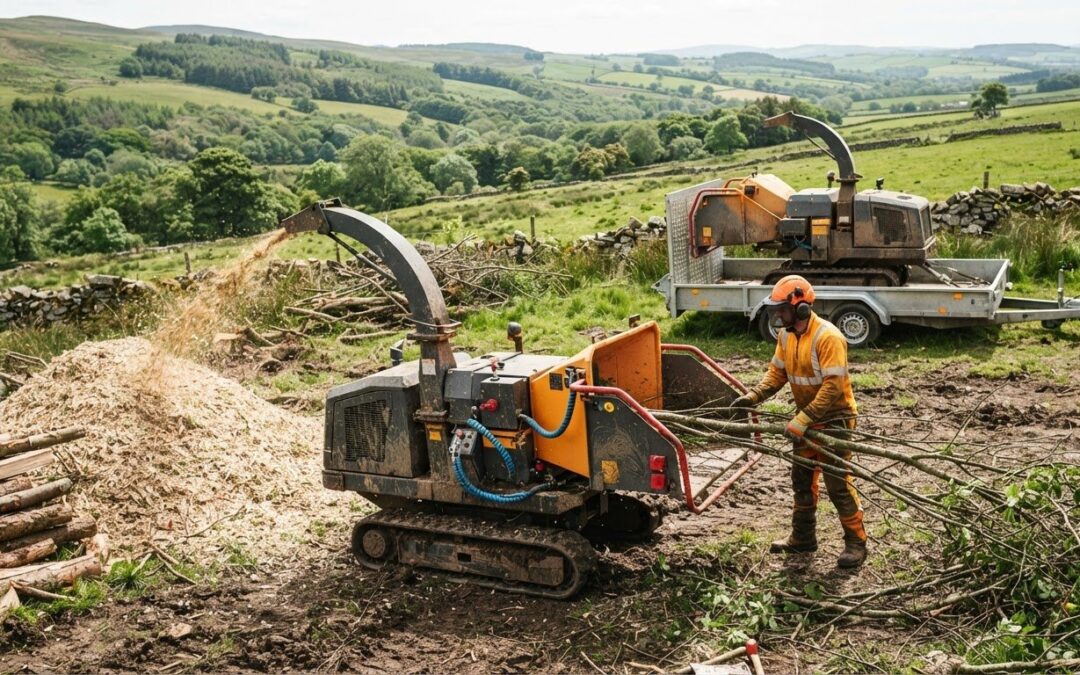
Hiring can make sense for a short job, but the balance can shift when the work runs on. The FORST TR8 hire cost per week is only one part of the decision: a wood-chipper comparison puts buying ahead after five weeks of use. Treat that as a benchmark, not a universal break-even point, since the result depends on the hire charge, purchase outlay and how often the machine is used.
It’s sensible to focus on the weekly rate first. But the real cost of hiring also includes the time and planning involved in collecting and returning the chipper, whilst buying brings ongoing ownership and maintenance costs. A hire quote depends on the job duration, machine requirements and collection or delivery arrangements, and is given after a quote request.
This guide compares hiring with buying, explains how to assess the five-week benchmark against your workload, and shows how to plan around collection and delivery. Use the practical checks to decide which option fits the job.
Key Takeaways
- Compare the hire period with how often you’ll use the chipper; the best-value option depends on the workload, not just the weekly rate.
- Include collection, return and lost working time in your hire calculations, as logistics can affect the job’s overall cost.
- Check whether a hire quote shows VAT separately so you can compare the total cost on a like-for-like basis.
- Assess how location, timing and transport arrangements affect the practical cost of hiring for your job.
- Use the decision guide to weigh a short-term hire against the ongoing costs and responsibilities of ownership.
Wood Chipper Hire Vs Buy – Which Is Best?
Hiring suits a defined job; buying suits repeated work. To assess the FORST TR8 hire cost per week, weigh the hire period against likely future use. A weekly charge alone won’t show the full difference. Ownership also brings maintenance, storage and transport responsibilities.
Start with your work pattern. For a single clearance or short project, hiring gives you access to a chipper without keeping and maintaining one between jobs. If tree work recurs regularly, ownership may be worth considering. Focus on how often the machine would be used, not only the length of one job.
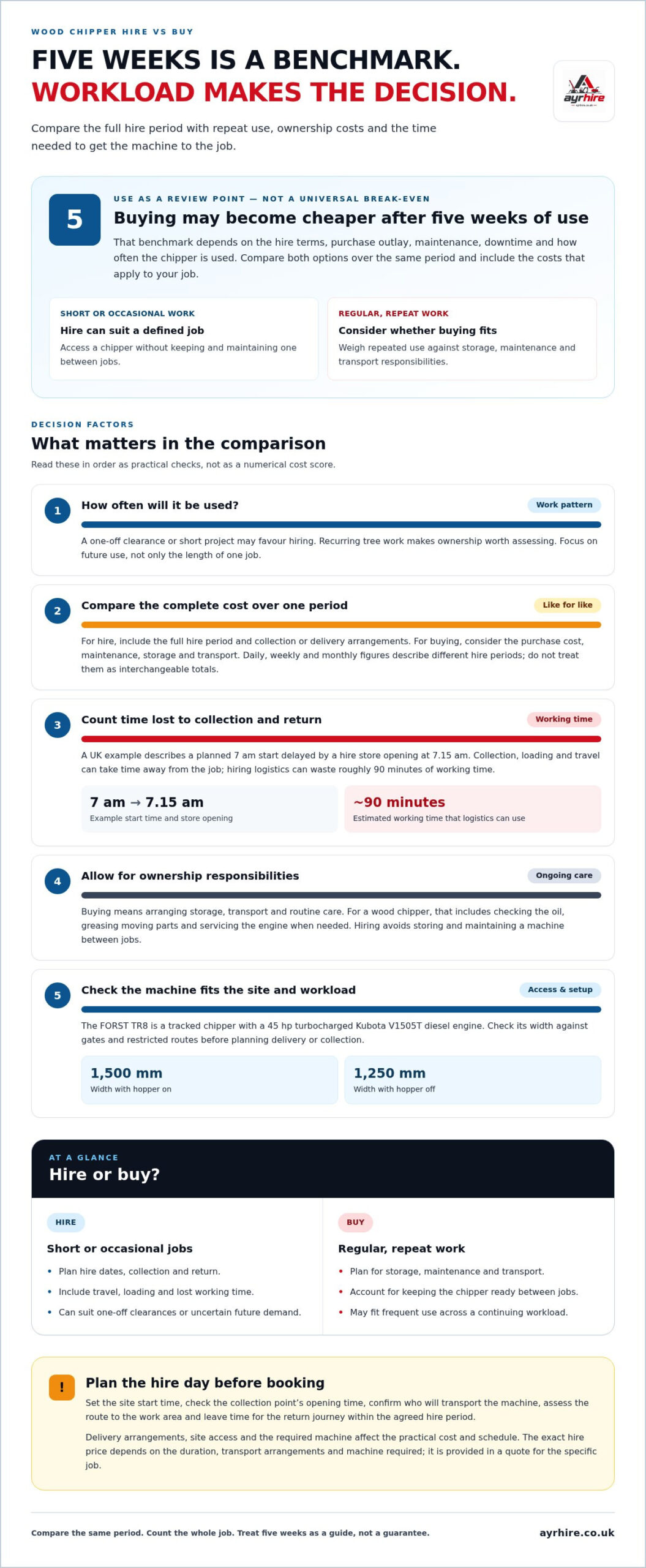
A five-week use threshold is sometimes cited as the point when buying a wood chipper may become cheaper than renting. Treat it as a comparison guide, not a universal calculation. The result depends on hire terms, purchase cost, maintenance and downtime. Compare both options over the same period and include the costs relevant to your situation.
The FORST TR8 is a tracked chipper with a 45 hp turbocharged Kubota V1505T diesel engine. Its width is 1,500 mm with the hopper on and 1,250 mm with the hopper off. Those dimensions matter when planning access through gates or along restricted routes. Before choosing, match the machine to the site, feed material and planned workload.
Buying means arranging routine care. For a wood chipper, that includes checking the oil, greasing moving parts and servicing the engine when needed. Hiring avoids storing and maintaining a machine between jobs. In either case, allow for the time needed to prepare the site, operate the chipper and manage the resulting material.
| Option | Work pattern | Ongoing responsibilities | Best fit |
|---|---|---|---|
| Hire | Short or occasional jobs | Plan hire dates, collection and return | One-off clearances or uncertain future demand |
| Buy | Regular, repeat work | Arrange storage, maintenance and transport | Frequent use across a continuing workload |
Use the table as a first screen, then build a job-based comparison. List expected working days, transport arrangements and periods when the chipper would sit unused. For buying, include maintenance and storage. For hiring, include the full hire period and the time needed to arrange collection or delivery.
Your hire price depends on the hire duration, transport arrangements and machine required; the exact figure is given in a quote for your case.
Choose the option that fits your workload: hire for a contained job, or consider buying if repeat use justifies the responsibilities of ownership.
The page says buying one of its wood chippers becomes cheaper than renting after 5 weeks of use. That is a useful threshold for a first comparison, but the page’s figures should still be read as estimates rather than an individual hire quote. Those amounts give a point of reference for weighing rental against ownership, without establishing what a particular job will cost.
Keep the comparison on a consistent basis: a daily figure, weekly figure and monthly estimate describe different rental periods and should not be treated as interchangeable totals. First identify the hire period that matches the planned work, then compare that rental amount with the cost of owning and keeping the chipper ready for use. If the workload is uncertain, the hire figures can help frame an estimate, while the 5-week point offers a reason to review the choice as use accumulates. The decision still turns on actual demand, not just the lowest headline rate. A quote for the required machine and arrangements remains the practical check before committing.
Time costs and collection logistics
A hire can affect the working day before the FORST TR8 reaches the site. In one UK example, a planned 7 am start is delayed because the hire store opens at 7.15 am. Collection, loading and travel then take time away from the job itself. A realistic comparison should count these hours alongside the hire period.
Hiring logistics can waste roughly 90 minutes of working time. That estimate shows why the advertised hire duration isn’t the whole calculation. A crew waiting for equipment can’t begin chipping, clear access routes or organise brash in the same way. If the job has a fixed start, even a short delay can disrupt the sequence.
Map the day before booking. Note when the team needs the chipper, where it will be delivered or collected, and how it will reach the work area. Allow time for loading, travel and unloading, as well as any return journey. Site access and the delivery plan both affect the schedule.
Build a workable collection plan
Use these steps to identify avoidable delays before the hire begins:
- Set the site start time. For a 7 am start, compare it with the collection point’s opening time.
- Plan the transport. Confirm who will collect the machine and how it will be moved safely.
- Allow for access. Check the route from the vehicle to the work area, including gates and turning space.
- Set a return plan. Leave time for loading, travel and returning the chipper within the agreed hire period.
For a restricted route, the FORST TR8’s width is relevant: it measures 1,500 mm with the hopper on and 1,250 mm with the hopper off. Compare those dimensions with the site entrance and working route before setting the delivery plan. A narrow gate may affect where unloading can happen and how the crew stages material.
Delivery arrangements also affect how much of the hire period is productive. If the chipper arrives before work, allow time for unloading and setup. If it must be returned after chipping, finish early enough to prepare it for collection. Build these arrangements into the schedule rather than treating them as spare time.
Prepare the site while delivery is underway. Mark the machine’s working position, clear the route for branches and decide where chipped material will go. These steps help the crew start promptly after the chipper arrives. Make the plan specific to the site, not just the job’s expected duration.
Compare options using productive hours, not only hire days. A collection that conflicts with a 7 am start, or a return that cuts short the final shift, can change the value of hiring. For a chipper-led job, tracked wood chipper hire is one part of planning; transport, site access and the work sequence matter too.
Does the FORST TR8 hire price include VAT?
A weekly hire figure alone doesn’t tell you whether VAT is included. The quote should make clear whether the stated amount includes VAT or whether VAT is added. Compare the total payable, not just the headline hire charge. That gives you a clearer basis for budgeting and comparing options.
Look for wording such as “including VAT” or “excluding VAT” beside the hire amount. If the quote separates the hire charge and VAT, use the final total for your cost comparison. If the invoice later shows a different total, compare its line items with the original quote before processing payment.
Keep the quote and invoice together. The quote records the agreed hire details, while the invoice shows the amount charged. Comparing them helps you spot changes to the hire period or delivery arrangements and keeps project costs clear.
How to read a hire quote
Use this short review before adding a chipper to your job budget:
- Find the VAT wording. Identify whether the quoted amount includes VAT or excludes it.
- Read the total. Use the final payable amount for your budget, rather than relying on a pre-VAT figure.
- Review each charge. Separate the machine hire from transport or other listed costs.
- Match the period. Check that the quoted hire duration fits the dates planned for the job.
For example, if a quote shows the hire charge before VAT and a separate total, budget against that total. Make sure the quote clearly identifies whether VAT is included or added. This avoids comparing amounts presented on different bases.
VAT treatment and quote presentation are separate questions. The quote tells you how its amount is displayed; it doesn’t, by itself, explain the tax treatment behind every charge. Avoid calculating an assumed VAT amount from a headline figure when the quote already provides a total. Use the document’s own breakdown instead.
For a business job, record the VAT wording alongside the equipment cost in your project records. Keep the hire period and delivery details with the same entry. That makes invoice checks easier if the plan changes. For personal budgeting, use the total you are expected to pay.
Your hire price depends on the hire duration, transport arrangements and machine required; the exact figure is given in a quote for your case. VAT wording should sit clearly alongside that figure, so you can assess the full amount before planning the job.
Before accepting the quote, check that the hire dates, delivery arrangements, VAT and total payable match your job plan. This helps you compare costs accurately and avoid mistaking a pre-VAT charge for the full hire cost.
Are FORST TR8 hire rates different by location or season in the UK?
Location can affect delivery and collection arrangements. A site farther from the equipment’s base may involve different transport logistics. Season can also affect scheduling and site planning, but neither factor determines a universal hire rate.
Separate the equipment hire from the costs linked to moving it. Compare the same hire period and machine, then consider whether transport is included or charged separately. A site near a collection point and one requiring a longer delivery journey may have different totals, even when the equipment and hire duration match.
Access matters too. A narrow entrance, limited unloading space or difficult route can affect where the chipper is dropped off. The FORST TR8 measures 1,500 mm wide with its hopper on, and 1,250 mm with its hopper off. Include those dimensions when planning the site route and unloading point.
What location changes in practice
Use the site address and access plan to compare logistics accurately. For example, a job with straightforward vehicle access may allow direct unloading near the work area. A restricted site may need more handling or a different unloading position. Those practical differences affect the delivery plan, not necessarily the underlying equipment rate.
- Distance: Consider how far the machine must travel to reach the site.
- Access: Match the chipper’s width to entrances and working routes.
- Collection: Include travel time and return arrangements in the job plan.
- Hire dates: Align the booked period with the work sequence.
Treat season as a scheduling factor, not an automatic change to the hire rate. A winter clearance and a summer tree-work project may have different dates, site conditions and work sequences, which can affect the hire period or delivery plan. Compare the actual arrangements for your job rather than assuming a seasonal premium or reduction.
If wet ground changes where a vehicle can unload, the site plan may need adjusting. If the project date changes, the hire period and delivery schedule may change too. Share the site location, requested dates and access details when comparing costs. This helps distinguish the equipment charge from delivery arrangements.
When comparing the FORST TR8 hire cost per week, use matching dates, hire duration and transport assumptions. One quote may cover delivery, whilst another may show collection separately. A lower headline figure isn’t directly comparable if the included arrangements differ. Read each breakdown and compare the final total for the same job requirements.
Your hire price depends on the hire duration, transport arrangements and machine required; the exact figure is given in a quote for your case.
For a practical comparison, plan your tracked chipper hire around the site address, access route and working dates. These details give you a clearer view of how location and timing shape the job’s overall hire arrangements.
Ayr Tracked Plant & Equipment Hire: FORST TR8 8″ Tracked Wood Chipper
Ayr Tracked Plant & Equipment Hire offers the FORST TR8 8″ Tracked Wood Chipper for hire. It’s a practical next step when your job needs a tracked chipper and you’ve weighed hire duration, site access and collection logistics.
Share the job location, access route and planned hire period when discussing the requirements. These details help frame the equipment and transport arrangements around the work. If the site also needs support moving materials or preparing access, the ALMA Crawler Multi-Loader and KUBOTA Mini Excavator / Digger are other relevant offerings.
Contact Ayr Tracked Plant & Equipment Hire to discuss the FORST TR8 for your job.
Make the next job easier to plan
Before choosing a hire period, turn the work plan into a clear equipment brief. Note the type of material, site access, transport arrangements and intended working dates. That gives you a practical basis for discussing the FORST TR8 hire cost per week and whether the machine suits the job.
Ayr Tracked Plant & Equipment Hire offers the FORST TR8 8″ Tracked Wood Chipper, alongside equipment such as the KUBOTA Mini Excavator / Digger and TMC25/BG250 Mini Spider Crane. If your project involves more than chipping, consider how each required machine fits the site sequence and access plan. The price depends on the job, hire duration and transport arrangements, with the exact figure provided after a quote request.
Share your project requirements with Ayr Tracked Plant & Equipment Hire to discuss the right equipment for the work. A clear brief is a useful first step towards a well-organised job.
Frequently Asked Questions
What is the weekly hire cost for a FORST TR8 wood chipper in the UK?
The listed weekly rate gives you a direct starting point for budgeting a job. For work in Ayrshire, Dumfries & Galloway or Glasgow, consider the hire period and delivery arrangements alongside the equipment charge. The final quote should reflect the planned hire and the job’s requirements.
Which UK hire companies rent out the FORST TR8?
Ayr Tracked Plant & Equipment Hire rents out the FORST TR8 8″ Tracked Wood Chipper. It serves customers across South Ayrshire, North Ayrshire, East Ayrshire, Dumfries & Galloway and Glasgow. For a local project, share the site location and intended hire dates when arranging the equipment. This helps set out the relevant hire and delivery details for your job without assuming that every UK location has the same arrangements.
What is the daily hire rate for a FORST TR8, and are weekly discounts available?
These are separate hire terms, not a stated weekly discount. Compare them against the days you expect to use the chipper and your project schedule. For instance, a job spanning several working days may suit a weekly booking better than arranging separate daily hires.