
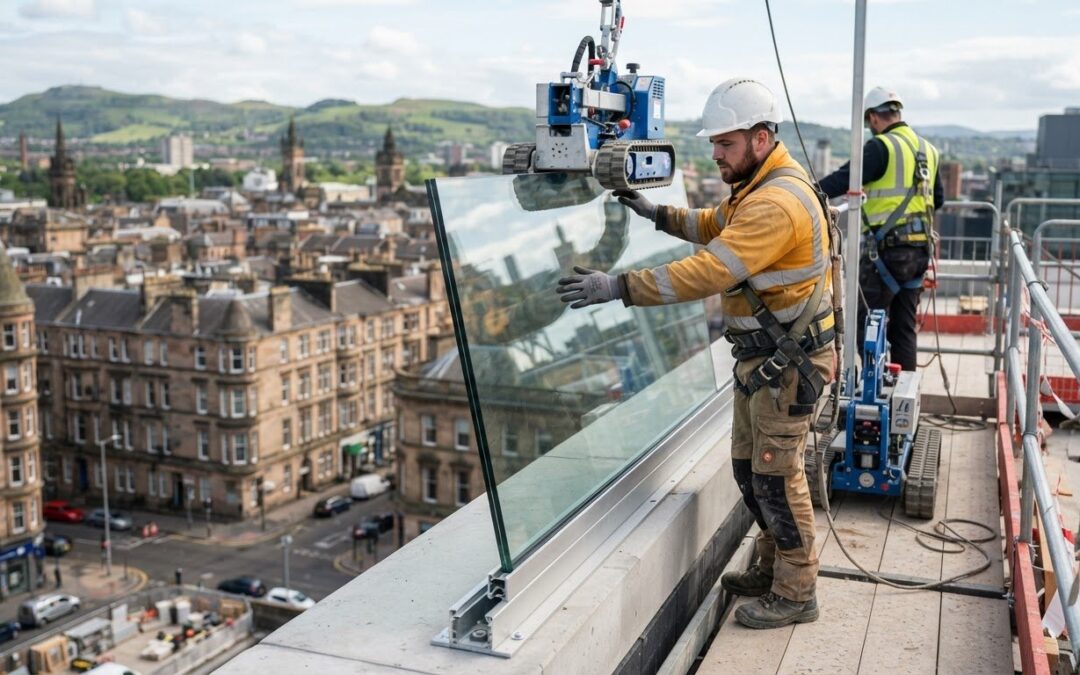
For safe glass installation at height, UK rules identify glazing wholly or partly within 1,500 mm of floor level in doors, and within 800 mm elsewhere, as critical locations requiring safety glass. Glazing beside a door is also critical when it is within 300 mm of the door edge and 1,500 mm of floor level. For external balconies and edges with a drop greater than 600 mm, the minimum balustrade height is 1,100 mm.
The height of the work matters, but so does where someone could collide with the glass or fall if it breaks. This distinction affects the glass specification and the measures needed to protect workers during installation.
This guide explains where impact risks are higher, how UK requirements apply to glass balustrades and what to consider when planning glazing work at height. It covers key thresholds, the difference between safety glazing and fall protection, and how suitable lifting equipment can support a controlled installation.
Key Takeaways
- Identify critical glazing locations and understand the role of BS EN 12150, the toughened-glass product standard identified by the British Standards Institution.
- Assess how glass position and the consequences of breakage affect impact and fall-through risks.
- Understand what a glazing work risk assessment and method statement should address, including falling glass and worker protection.
- Compare access options against site conditions and the glass-handling task, including where vacuum lifter hire may support the work.
Critical locations and glazing height thresholds
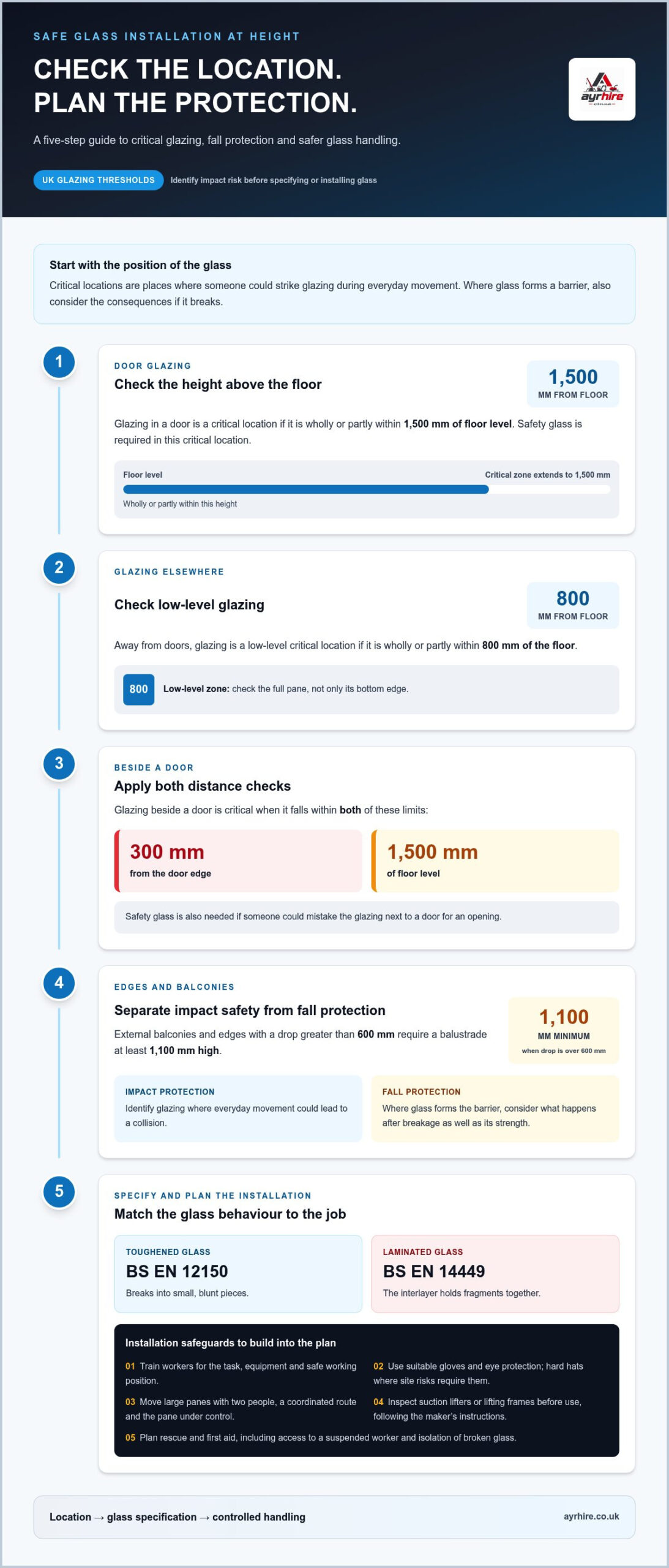
For safe glass installation at height, first identify glazing that could be struck during everyday movement. In the UK, glazing in a door is a critical location if it is wholly or partly within 1,500 mm of floor level. Elsewhere, glazing is a low-level critical location when it is wholly or partly within 800 mm of the floor. Beside a door, the threshold applies within 300 mm of its edge and 1,500 mm of floor level. Glazing next to a door also needs safety glass if someone could mistake it for an opening.
These thresholds help identify where accidental impact could cause serious injury. Building regulations also address glass that protects people from falling. External balconies and edges with a drop greater than 600 mm require a minimum balustrade height of 1,100 mm. Where the glass itself forms the barrier, its post-breakage behaviour matters as much as its strength. Toughened glass breaks into small, blunt pieces; laminated glass holds fragments together with an interlayer.
For product standards, the British Standards Institution identifies BS EN 12150 as the relevant standard for toughened glass, and BS EN 14449 for laminated glass. These materials suit different applications. A balustrade must provide fall protection, so the glass specification must account for what happens after breakage, not just routine impact.
Workers should be trained in the safety measures for window installation and fragile surfaces, including body positioning and carrying glass correctly. Operators need training for the equipment and task they perform; competence means understanding the planned lift and safe working position.
Use suitable gloves and eye protection when handling glass, and wear a hard hat where site risks require one. Workers on fragile surfaces should use fall arrest systems, and a stable platform is needed even when a fall seems short.
Move large panes with two people working together, using coordinated handling and a planned route. Keep the pane under control, and avoid carrying it near an exposed edge or from an unstable position.
Choose suction lifters or lifting frames suited to the pane and the lift. Before use, inspect them for damage, secure attachments and proper working condition, following the equipment maker’s inspection instructions. Plan rescue and first aid before work begins, including how to reach a suspended worker and isolate broken glass.
Installation height and human-impact risk
Impact risk depends on where people might strike the glazing and what lies beyond it. Access, handling and breakage risks all need to shape the work plan.
Choosing High-Level Access Equipment
Scaffold, a MEWP and rope access provide different ways to reach glazing; the site and installation task determine the practical choice. Scaffold offers a fixed working area, while a MEWP can reposition workers and glass. Rope access suits restricted locations but requires a suitable planned system. High-level installation costs in the UK are quoted after a request and depend on access, pane size and weight, handling complexity and site constraints. For wider site logistics, explore tracked plant hire information.
Risk Assessments and Method Statements
A risk assessment identifies hazards and who could be harmed, while a method statement records how the work will be controlled. Together, they help the team plan the lift, access method, work area and response to changing conditions. Consider the pane’s weight, its route to the opening, the working platform, nearby people and the consequences of breakage. Workers on fragile surfaces should use fall arrest systems, and a stable platform is needed even when a fall seems short.
Dropped Objects, Wind and Breakage
Dropped tools or glass can injure people below. Keep the area clear and use safety nets where they can help prevent falling glass from smashing on the ground. Guard rails should protect workers at height, including on fragile roofs. Wind can affect the movement and control of a large pane, so pause the lift if conditions prevent safe handling. Glass weight can also pull a worker off balance, so two people should hold a pane when moving it.
What risk assessments and method statements are needed for glazing work at height?
A risk assessment identifies hazards, who could be harmed and how risks will be controlled. A method statement explains the planned work sequence, equipment and responsibilities. For glazing, both documents should reflect the actual pane, access route and opening, rather than rely on a generic template.
Map the lift from the delivery point to the final position. Record the pane’s weight and dimensions, the working surface, access equipment and the area below the work. Glass can pull a worker off balance, so include the risks of dropped tools or glass, contact with fragile surfaces, restricted movement and changing weather.
- Access and edge protection: identify where workers will stand and how they will reach the opening. Plan guard rails where work takes place at height, including on fragile roofs.
- Glass movement: set out how the pane will be carried, controlled and positioned. Two people should hold a piece of glass when it is moved.
- Exclusion area: keep people clear of the drop zone. Safety nets around a glass-work site can help prevent falling glass from smashing when it reaches the ground.
- Fragile surfaces: identify surfaces that could break beneath a worker. Plan fall arrest systems to help prevent serious injury if someone falls through.
- Emergency response: state how work will stop and how an injured or suspended worker will be reached.
The method statement should set out a clear sequence: prepare the work area, position access equipment, move the pane, secure it in the opening, then clear the area. Specify who directs the lift and who watches for people entering the exclusion zone. Explain how the team will communicate if visibility or access is restricted.
Review the assessment if the pane, access arrangement or site conditions change. A different opening or an unstable platform can alter the lift’s risks. Before work begins, brief everyone involved and ensure the agreed controls match the conditions on site.
What access equipment is safest for high-level glass installation: scaffold, MEWP or rope access?
No single access method is safest for every glazing task. Choose one based on the opening, ground conditions, pane movement, working position and rescue plan.
- Scaffold: A properly planned scaffold provides a fixed platform beside the opening. It can suit work needing a steady position or repeated access. Check that the platform allows workers to handle the pane without overreaching. Guard rails are important where workers are exposed to edges, including on fragile roofs.
- MEWP: A mobile elevating work platform can reach different positions without building a fixed structure. It may suit a short installation with suitable ground and clear space for positioning. Consider how the glass will be raised, controlled and transferred at the opening. The lift plan must account for the platform’s position and movement.
- Rope access: Rope systems can reach restricted façades where other access equipment cannot be positioned. Glass handling needs careful planning because workers must control the pane while suspended. The method must include suitable fall protection, equipment arrangements and a workable rescue plan.
Compare each option against the task, not just the height. A narrow courtyard may limit scaffold or MEWP placement, while a large pane may need a stable working area for precise alignment. Check the ground beneath access equipment and whether the route can accommodate the glass and lifting gear. Include changing site conditions in the assessment, as wind can affect control of a large pane.
Plan how workers will reach the opening, hold the pane and secure it without leaning beyond the platform. Keep people clear of the area below and provide guard rails where the work setup requires them. If the installation involves a fragile surface, include fall arrest measures and a rescue plan. The chosen method should allow the team to complete each stage without unsafe reaching or unstable handling.
If vegetation obstructs the planned approach, explore equipment hire for site preparation as part of the access plan.
For glass selection, class 2B2 under UNI EN 12600 is commonly required for doors, French doors and accessible glass surfaces in residential and commercial buildings.
Ayr Tracked Plant & Equipment Hire: FORST TR8 8″ Tracked Wood Chipper
Ayr Tracked Plant & Equipment Hire provides equipment hire for projects that need carefully planned lifting or site access. For glazing work, Vacuum Lifter Hire is the relevant option when the installation plan calls for vacuum lifting equipment. The right arrangement depends on the pane, access route and site conditions, so include equipment selection in the lift plan.
Where access is complex, an ALMA Crawler Multi-Loader is another available hire option for site logistics. It complements planning for restricted access but does not replace suitable glass-handling equipment or fall protection. The FORST TR8 8″ Tracked Wood Chipper is for wood-chipping tasks, rather than glazing lifts.
Contact Ayr Tracked Plant & Equipment Hire or visit ayrhire.co.uk to discuss equipment hire for your project.
Plan the next stage with confidence
Safe glass installation at height depends on decisions made before equipment reaches the work area. Use the completed risk assessment to coordinate access, glass handling and site logistics, then brief the people responsible for each part of the operation. A clear plan helps the team coordinate glazing work with surrounding site activity.
For projects involving specialist equipment, Ayr Tracked Plant & Equipment Hire offers Vacuum Lifter Hire, a TMC25/BG250 Mini Spider Crane, a KUBOTA Mini Excavator / Digger and a FORST TR8 8" Tracked Wood Chipper. These options serve different site tasks, from glass handling and lifting planning to excavation or wood chipping. Select equipment according to the work it is intended to support.
Discuss your project’s equipment needs with Ayr Tracked Plant & Equipment Hire. A practical next step is to bring your access and handling plan into the conversation, so you can move forward with clarity.
Frequently Asked Questions
What UK health and safety regulations apply to installing glass at height?
UK Building Regulations cover safety glazing in relevant locations, while Approved Document K sets requirements for protection from falling, collision and impact. When planning work, assess the glass, access method, handling route, fragile surfaces and risks to people below. Record controls in a risk assessment and method statement, including how workers will be protected and how the work area will be managed.
What training and qualifications are required for UK glaziers and operators working at height?
Workers should be trained in installation safety, body positioning and how to carry glass correctly. Operators need training for the equipment and task they perform, and should understand the planned lift and safe working position.