A standard 1.5-tonne excavator is completely useless if it sits two inches wider than your site’s side gate. In the world of difficult access plant hire, precision isn’t just a preference; it’s the difference between a productive day and a wasted hire fee. You’ve likely felt the stress of watching a heavy machine churn up a landscaped lawn or struggle to lift steel in a cramped urban backyard. It’s a logistical puzzle that requires more than just a tape measure.
We understand that getting the right tool to the work face is your top priority. This guide provides a professional roadmap for managing restricted access using specialised tracked machinery. You’ll learn how to navigate narrow entries, protect sensitive ground, and comply with PUWER and LOLER regulations without blowing your budget. We’ll examine the specific benefits of compact, Stage V compliant equipment and show you how to ensure your next delivery is seamless and damage-free.
Key Takeaways
- Learn how to conduct a thorough site access audit by measuring the narrowest transit point and assessing gradients before booking.
- Discover why specialised tracked machinery, like mini spider cranes, is essential for lifting heavy loads through standard internal doorways.
- Master the logistics of difficult access plant hire to ensure equipment reaches the work face without damaging soft ground or landscaping.
- Understand the vital role of a banksman and professional planning when navigating narrow lanes and tight urban construction sites.
- Avoid wasted costs by matching machine specifications to your site’s physical constraints for a more efficient project completion.
Identifying Difficult Access Site Constraints
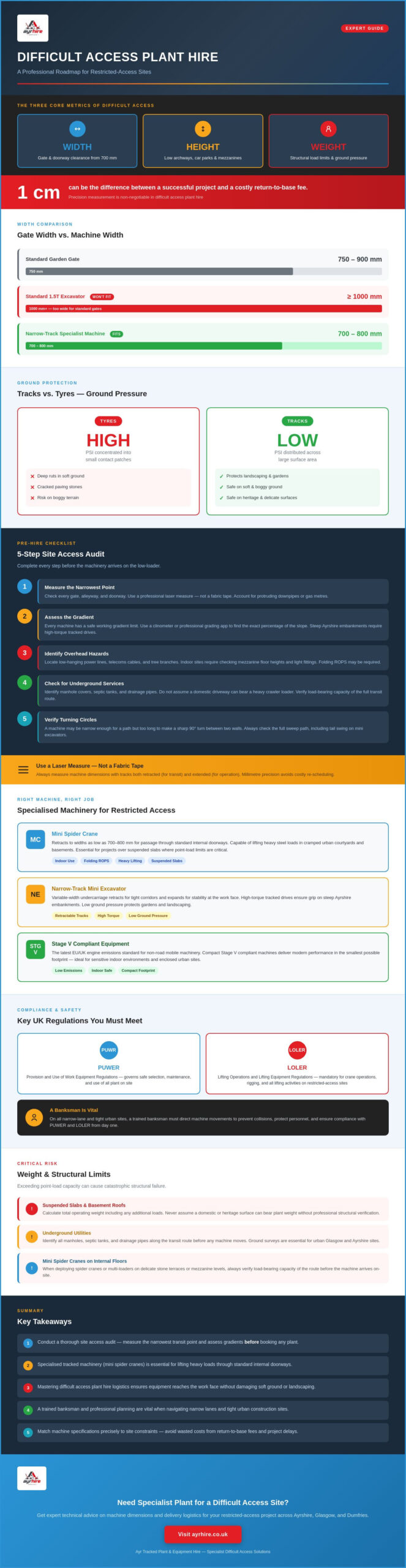
Difficult access isn’t just a tight squeeze. It’s a technical challenge where standard heavy equipment simply won’t fit or function. In the context of difficult access plant hire, we define these constraints by three core metrics: width, height, and weight. A single centimetre can be the difference between a successful project and a costly return-to-base fee. You must account for the physical path from the delivery point to the specific work face.
Width and Height Restrictions
Many projects in urban centres like Glasgow face immediate barriers at the site boundary. Standard garden gates often measure between 750mm and 900mm. If your machine is 1000mm wide, the job stops before it starts. Specialised narrow-track machinery is designed to retract to widths as low as 700mm to 800mm, allowing passage through internal doorways or narrow alleyways. You also need to account for “scrubbing” clearance. This is the extra space required for the machine to pivot and move without scraping walls. Low-headroom environments like underground car parks, archways, or indoor mezzanine levels require machines with folding ROPS to ensure safe entry and operation.
Ground Pressure and Delicate Surfaces
Terrain presents its own set of hurdles. The steep embankments of Ayrshire require high-torque tracked drives for stability and grip. Conversely, the soft, boggy ground often found in Dumfries demands low ground pressure to prevent the machine from sinking. Traditional tyres concentrate weight into small contact patches, which often leads to deep ruts or cracked paving stones. Tracked machinery distributes the machine’s mass across a much larger surface area. This reduces the PSI (pounds per square inch) significantly. It’s the only reliable way to protect expensive landscaping, heritage sites, or manicured gardens during transit.
Weight and Structural Limits
Weight isn’t only about the ground surface. Many urban sites involve working over suspended slabs, basement roofs, or underground utilities. Exceeding the point-load capacity of these structures can lead to catastrophic structural failure. Professional difficult access plant hire requires calculating the total operating weight, including any additional loads, to stay within safe structural limits. This is vital when deploying mini spider cranes or multi-loaders on internal floors or delicate stone terraces. Always verify the load-bearing capacity of the transit route before the machine arrives on-site.
How to Conduct a Site Access Audit
Precision is the foundation of a successful difficult access plant hire project. You cannot rely on a visual estimate or a rough guess. A site access audit is a methodical walkthrough that identifies every potential bottleneck before the machinery arrives on the low-loader. It’s about data, not assumptions. If you don’t measure it, you don’t know it.
Start by mapping the entire transit route from the kerbside to the work face. Follow these five steps for a comprehensive assessment:
- Measure the narrowest point: Check every gate, alleyway, and doorway. Don’t forget to account for protruding downpipes or gas meters.
- Assess the gradient: Tracks provide excellent traction, but every machine has a safe working limit. Use a clinometer or a professional grading app to find the exact percentage of the slope.
- Identify overhead hazards: Look for low-hanging power lines, telecoms cables, and tree branches. Indoor sites require checking the height of mezzanine floors and light fittings.
- Check for underground services: Identify the location of manhole covers, septic tanks, and drainage pipes. Don’t assume a domestic driveway can support a heavy crawler loader.
- Verify turning circles: A machine might be narrow enough for a path but too long to make a sharp 90-degree turn between two walls.
Standard safety protocols, similar to the OSHA safety regulations for heavy equipment, emphasise the need for clear site assessments to prevent accidents. Following a structured audit ensures you comply with UK safety standards like PUWER and LOLER from day one.
Measuring for Narrow-Track Machinery
Ditch the fabric tape measure. Use a professional laser measure for millimetre-perfect accuracy. When checking dimensions for difficult access plant hire, you must measure the machine with its tracks retracted for the journey and extended for the work. For mini excavators, always account for the tail swing. If the rear of the machine overhangs the tracks, it needs extra room to rotate without hitting a boundary wall. If you’re unsure about your site’s specific requirements, our team at Ayr Tracked Plant & Equipment Hire can provide technical advice on machine dimensions.
Identifying Overhead Hazards
The “Look Up and Live” principle is a non-negotiable safety rule. Power lines are a primary risk for trailer-mounted cherry pickers and spider crane booms. You must maintain a safe exclusion zone. For outdoor work, tree canopy management is often necessary to prevent damage to the machine’s hydraulic lines or the operator’s cage. For indoor lifting, measure the highest point of the boom’s arc, not just the static height of the crane.
Choosing the Right Machinery for Restricted Spaces
Selecting the correct tool for difficult access plant hire is about matching mechanical capability to site constraints. Traditional wheeled plant often fails when confronted with the narrow gates or steep gradients identified in your site audit. Specialised tracked machinery provides the stability and compact footprint necessary to work where others can’t. It’s about working smarter, not harder. The right choice prevents site damage and keeps your project on schedule. For a broader overview of available options, our guide to specialist plant hire Scotland covers the full range of tracked equipment suited to complex Scottish sites.
Tracked Wood Chippers vs. Towed Units
Standard wood chippers are usually towed behind a 4×4 or van. This limits them to the roadside or firm, flat driveways. For arboriculture on the steep embankments of Ayrshire, FORST wood chipper hire offers a distinct mobility advantage. These tracked units navigate rough ground and woodland terrain with ease. They eliminate the exhausting need for teams to manually drag heavy timber across long distances to a waiting chipper. The wide track base ensures stability on slopes, significantly reducing the tipping risks associated with wheeled units on uneven turf.
Mini Spider Cranes for Specialist Lifting
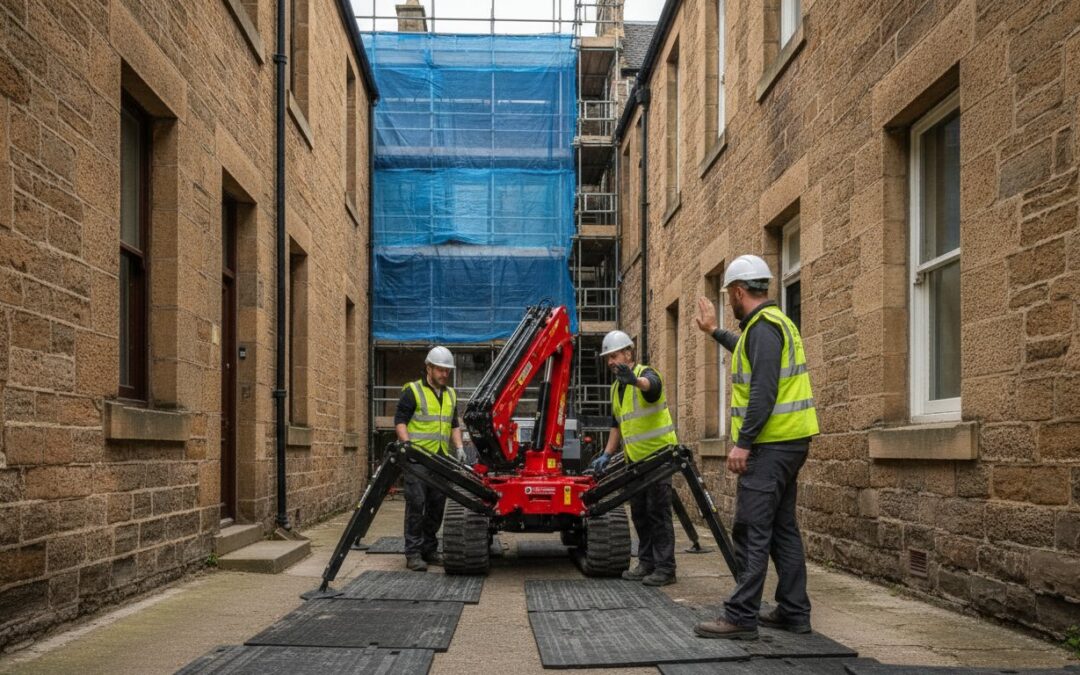
Lifting glass or steel inside a building or in a cramped courtyard requires a machine that can pass through a standard double door. The TMC25/BG250 mini spider crane is designed for exactly this. Its slim chassis allows it to enter confined urban spaces, while its versatile outrigger configurations provide a stable platform on stepped or uneven floors. When working in such restricted areas, following OSHA guidelines on confined space safety is a professional standard that ensures all personnel remain protected during complex lifts. We often integrate vacuum lifters with these cranes for safe, precise structural glass handling in tight city centre locations.
ALMA Crawler Multi-Loaders
Moving heavy materials across the varied Scottish terrain requires more than just raw power. ALMA crawler multi-loaders use advanced bi-levelling technology to keep the load bed horizontal even on 20-degree slopes. This is vital for traversing side-slopes where a standard dumper would lose its balance or drop its cargo. These machines are indispensable for narrow-access construction projects and large-scale landscaping where traditional equipment is too wide or unstable. They bridge the gap between manual labour and heavy earthmoving plant, ensuring materials reach the work face efficiently.
Finally, the KUBOTA mini excavator remains a staple for difficult access plant hire. It provides the maximum possible dig depth from a minimal footprint. With tracks that retract to pass through garden gates and extend for digging stability, it’s the ultimate problem-solver for domestic and light commercial groundwork. It delivers professional-grade performance without the need for site-wide demolition just to gain access.
Planning Logistics and Safety for Difficult Access
Logistics for difficult access plant hire start long before the machine reaches the site boundary. Navigating the narrow, winding lanes of Ayrshire with a plant trailer requires precise route planning. A single incorrectly parked vehicle or a low-hanging stone wall can block the entire delivery. You must coordinate the arrival to ensure there is sufficient space for the transport vehicle to offload safely without obstructing local traffic or creating a hazard on the public highway.
Once offloaded, the machine’s journey to the work face begins. A trained banksman is essential for these tight-access manoeuvres. They act as the operator’s second set of eyes, guiding the machine through narrow gaps and around blind corners. To prevent site damage, we recommend using track mats or heavy-duty plywood. This is critical for protecting soft turf or expensive block paving from the sheer forces of turning tracks. It ensures the site remains in the same condition as when you arrived.
Safety compliance is a non-negotiable legal requirement. Every piece of lifting equipment, such as our mini spider cranes, must meet LOLER (Lifting Operations and Lifting Equipment Regulations 1998) standards. General machinery must comply with PUWER (Provision and Use of Work Equipment Regulations 1998). As of June 2026, all specialised equipment in our fleet undergoes rigorous inspections to ensure total reliability and safety on your project.
Coordinating Deliveries in Glasgow and Urban Centres
Urban projects in Glasgow city centre present unique hurdles. You often need permits from the local council to place plant on public highways or pavements during the offloading process. Pedestrian safety is paramount. Use clear barriers and signage to manage foot traffic. Schedule your deliveries outside of peak congestion hours to avoid delays and minimise disruption to the local community. Successful urban delivery is about timing and professional communication.
This focus on timing and precision is a hallmark of all professional logistics; for instance, VP Smart Removals applies similar expertise to residential and commercial moves within restricted urban settings.
Operator Competence and Training
Ready to plan your next project? Contact our specialist team to discuss your site’s logistical requirements and secure the right machinery for the job.
Specialist Plant Hire Solutions from Ayr Hire
Ayr Hire provides the specific tools needed for the most challenging Scottish sites. We operate across Ayrshire, Dumfries & Galloway, and Glasgow. Our focus is simple. We provide reliable, high-performance machinery that fits where others can’t. We don’t just supply machines. We provide logistical solutions for contractors who cannot afford wasted hire costs or site damage. Our team understands the reality of local construction and landscaping projects.
Our fleet is a curated selection of niche equipment designed for technical capability. This includes KUBOTA mini excavators for narrow garden access and the FORST TR8 wood chipper for steep embankments. For complex lifting in urban centres, we provide the TMC25/BG250 mini spider crane and vacuum lifter hire. We also offer the ALMA crawler multi-loader for moving materials on 20-degree slopes and trailer mounted cherry pickers for high-access maintenance. Every machine is maintained to professional standards. They arrive on-site ready to work.
We offer flexible daily and weekly hire terms. This allows you to match equipment costs to your specific project timeline. You don’t pay for idle time. You get the tool you need for the exact duration you need it. Our service is built on transparency and reliability. We are a steady hand for demanding projects. To understand how flexible hire terms can protect your project margins, read our complete guide to flexible specialist plant hire Scotland and discover how clear daily pricing and local delivery work together.
Why Local Expertise Matters
Scottish site conditions are unique. Heavy rain can turn a firm Ayrshire field into a boggy mess in hours. Our team understands these regional impacts. We know which machines handle specific soil types best. This local knowledge prevents site damage and ensures your project stays on track. We offer rapid response for equipment support and technical advice. If you have a question, you speak to a specialist who knows the area. It’s a personal, no-nonsense approach to difficult access plant hire. We value long-term relationships over flashy marketing.
Getting a Quote for Your Project
An accurate quote depends on clear site data. When you contact us for difficult access plant hire, please provide the measurements from your site audit. Tell us the narrowest point of the transit route. Mention any steep gradients or overhead hazards. We highly recommend sending photos or short videos of your access challenges. This allows our technicians to verify clearances and recommend the exact tool for the job. It’s the most efficient way to ensure a successful delivery to the work face. Contact Ayr Hire today for a dependable partner in specialist plant rental.
Secure the Right Machinery for Your Site
Success in restricted environments relies on meticulous preparation. You’ve learned how to identify physical barriers, conduct a precise site audit, and select machinery that fits the work face. By prioritising tracked technology, you protect sensitive ground and ensure project efficiency. Professional difficult access plant hire isn’t just about the machine; it’s about the logistical plan that gets it there safely.
Ayr Hire provides the niche tools required for these complex site puzzles. We’ve served Ayrshire and Glasgow since we were founded, building a fleet that features specialists like the FORST TR8 wood chipper and Kubota mini excavators. Our equipment is specifically curated to handle the unique constraints of Scottish construction sites, from narrow urban alleyways to steep rural embankments. We understand the local conditions because we work in them every day.
Don’t let restricted access stall your progress or increase your costs. Contact Ayr Hire for expert difficult access plant hire solutions and get the exact tools you need for a damage-free delivery. We’re ready to help you get the job done with confidence and reliability.
Frequently Asked Questions
What is considered “narrow access” for plant machinery?
Narrow access typically refers to any opening between 700mm and 1000mm wide. This includes standard UK garden gates, side alleys, and internal doorways. Specialised machinery in this category is built with retractable tracks to navigate these tight bottlenecks before extending the track width for stable operation once the machine reaches the work face.
Can tracked wood chippers be used on steep slopes safely?
Yes, tracked wood chippers like the FORST TR8 are specifically designed for safe use on steep slopes and embankments. The wide track base provides a much lower centre of gravity than traditional towed units. This prevents tipping whilst the high-torque drive ensures steady traction on rough or slippery terrain common in rural Ayrshire.
How do I protect my driveway from heavy tracked equipment?
You should use heavy-duty track mats or thick plywood sheets to create a temporary path over your driveway. These materials distribute the machine’s weight and prevent the tracks from “scrubbing” or marking delicate surfaces like block paving or tarmac. It is a simple, effective way to ensure zero site damage during transit.
Do I need a special licence to hire a mini spider crane?
You don’t need a specific driving licence for difficult access plant hire on private land, but you must be competent. For commercial construction sites, operators usually require a CPCS or NPORS category card. All lifting operations must also comply with LOLER regulations to ensure safety and legal standing for the project.
What is the smallest width a mini digger can fit through?
The smallest mini diggers, such as our Kubota models, can retract their tracks to a width of approximately 700mm to 750mm. This allows them to pass through a standard UK internal doorway or a narrow side gate. Once through the gap, the tracks extend back to roughly 990mm to provide the necessary stability for digging.
How does a vacuum lifter attach to glass for difficult access lifting?
A vacuum lifter uses high-strength suction pads and a battery-powered vacuum pump to create a secure bond with the glass surface. It attaches to the hook of a mini spider crane, allowing for precise placement of heavy structural panes in confined urban areas. Integrated safety sensors monitor the vacuum pressure constantly during the lift.
Do you deliver plant to remote areas in Dumfries and Galloway?
We provide reliable delivery across the entire Dumfries and Galloway region, along with Ayrshire and Glasgow. Our transport team is experienced in navigating remote rural lanes and tight urban streets. We coordinate delivery times to suit your project schedule and ensure the machine reaches the work face promptly and safely.
Is it better to hire a tracked multi-loader or a standard dumper?
A tracked multi-loader is superior for difficult access plant hire on uneven or sloping ground. Machines like the ALMA multi-loader feature bi-levelling technology that keeps the load horizontal on gradients up to 20 degrees. Standard wheeled dumpers are efficient on flat ground but lack the stability and low ground pressure of tracked units.