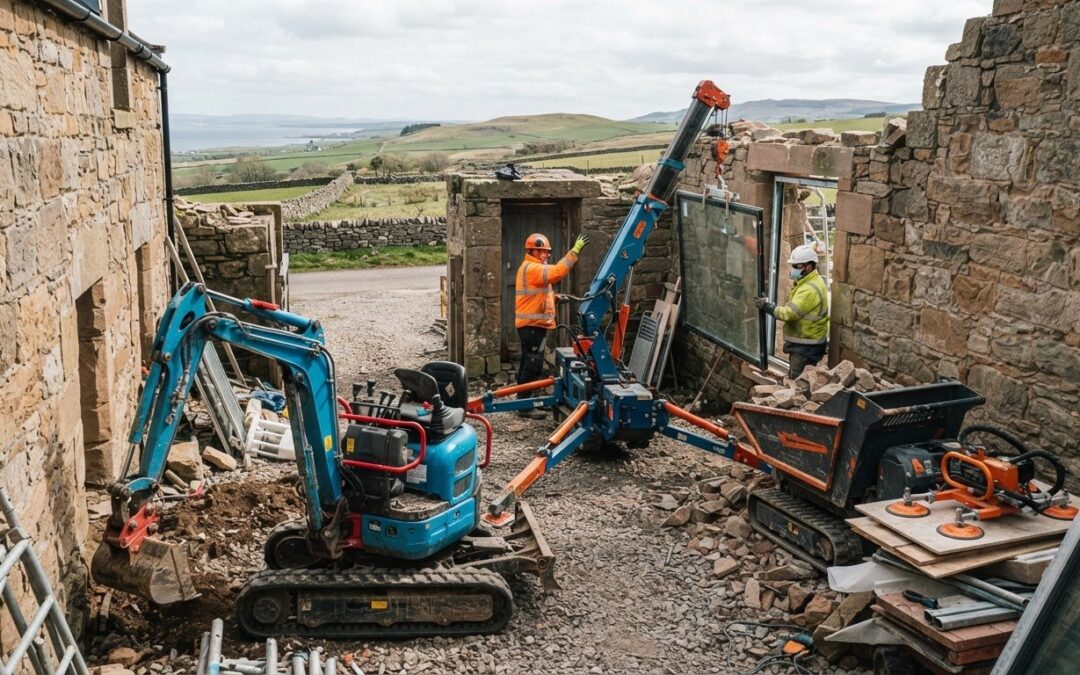
The smallest machine isn’t automatically the best choice for a confined building site. The right machinery for building in tight spaces Ayrshire projects need depends on the route in, the ground underfoot and the task or load. A machine that fits through the entrance still needs enough capacity and room to work safely.
Focusing only on dimensions can leave important questions unanswered: can the machine travel across the ground, reach the work area and handle the job without disrupting the programme? Match access, load and task from the outset to narrow down suitable options.
This guide compares compact machinery for excavation, carrying and lifting, and explains what to check before arranging a hire. Use the practical prompts to measure access, assess site conditions and share job details with a local supplier. Ayr Tracked Plant & Equipment Hire offers tracked plant and lifting equipment across South Ayrshire, North Ayrshire, East Ayrshire, Dumfries & Galloway and Glasgow, including mini excavators, a mini spider crane, crawler multi-loaders and vacuum lifters. Confirm current specifications, availability and arrangements for your site and hire period.
Key Takeaways
- Measure the full route to the workface, including width, height clearance, turning space, gradients and surface conditions.
- Use the machinery for building in tight spaces Ayrshire guide to compare excavation, carrying and lifting options against the job you need done.
- Confirm machine dimensions, load capacity and reach with the hire provider rather than estimating from appearance.
- Prepare site details in advance, including delivery access, unloading space and how work areas will be kept separate from other activity.
- Shortlist Ayr Hire’s relevant tracked machinery and lifting categories, then check suitability, availability and arrangements for your location.
Building in Tight Spaces Ayrshire: Start with the Site
The machine needs to reach the workface, not just the site entrance. A clear gate can lead to a narrow internal route, a tight turn or ground that may not suit the planned equipment. Assess the full route and the working area before choosing machinery for a building project in Ayrshire.
Restricted access means a constraint along the route to the work area or within the working area itself. It could be limited width, low overhead clearance, restricted turning space, a steep gradient or a surface that may not support the machine safely. Both the delivery route and working area matter: equipment must be unloaded, moved into position and given enough room to carry out the task.
- Route width: Check gates, doorways and the narrowest points along internal routes.
- Height clearance: Look for low ceilings, overhead services, branches or other obstructions.
- Turning space: Note corners, parked vehicles and places where the machine may need to change direction.
- Gradients and levels: Record slopes, steps, kerbs and changes in level.
- Surface conditions: Describe the ground, any soft or uneven areas, and concerns about protecting the surface.
What makes a building site difficult to access?
A narrow gate may be manageable, but a tight turn just beyond it could prevent access to the workface. Doorways, internal corridors, parked vehicles and limited turning areas can all affect the route. Check overhead services and low ceilings, too. Steps and changes in level may also rule out a route or require further assessment. Measure the route and take clear photographs from several points. These details help the hire provider assess suitability against the actual site, rather than relying on a general description.
Which site details should Ayrshire customers record?
For a useful local enquiry, include the site postcode and describe the full route from the unloading point to the work area. Explain the task, the materials to be handled and the load involved. Flag any ground protection concerns, such as a surface that could be damaged or may need assessment before equipment travels across it. Photos of access points, turns and the work area can clarify details that measurements alone might miss.
Also state whether the project is in South Ayrshire, North Ayrshire, East Ayrshire, Dumfries & Galloway or Glasgow. If excavation is being considered, Compact excavators include designs intended for confined spaces, but the category alone doesn’t confirm that a particular machine will suit your route. Share the site information first, then confirm the machine’s dimensions and other relevant details with the hire provider.
Compare compact machinery for restricted building access
Start with the task, then compare how each machine can reach and work in the available space. The categories below are options to discuss, not automatic recommendations. Dimensions, capacity and suitability depend on the specific machine and site, so confirm them with the hire provider before deciding.
| Task | Machine category | Access questions | Details to confirm with the hire provider |
|---|---|---|---|
| Excavation or groundworks | KUBOTA mini excavator | Can it pass through the narrowest point and manoeuvre at the dig area? Are there overhead obstructions? | Machine dimensions, working reach, ground conditions and suitability for the planned excavation. |
| Moving materials around site | ALMA crawler multi-loader | Is the route passable, including any slopes, turns and surface changes? | Load requirements, machine dimensions, ground conditions and any surface protection needs. |
| Lifting suitable glass or stone | TMC25/BG250 mini spider crane or vacuum lifter | Can the machine reach the lift position and be set up in the available space? | Material, load, lift plan, machine configuration and operating requirements. |
| Reaching an elevated work area | Trailer-mounted cherry picker | Can the unit and its towing vehicle reach the site, and is there room to position it? | Access and set-up requirements, working position and suitability for the task. |
When might a mini excavator or tracked multi-loader fit the task?
A KUBOTA mini excavator is an option to discuss for restricted groundworks, whilst an ALMA crawler multi-loader may be relevant for moving materials around a site. For either, describe the route and the work area, not just the entrance. Ask the provider to check machine dimensions against your measurements, and explain the load, travel distance and ground conditions. Don’t assume a tracked machine will suit every surface.
When should a mini spider crane or vacuum lifter be considered?
The TMC25/BG250 mini spider crane is a specialist lifting option to consider where the task and site layout call for it. A vacuum lifter may suit particular glass or stone handling work. Before choosing either, give the provider the material and load details, the required lift and available set-up space. Confirm the proposed configuration and operating requirements. Compact size alone doesn’t establish that equipment can be used safely or effectively at a particular site.
Include site-specific hazards and planned controls in the conversation. The Health and Safety Executive’s UK construction health and safety regulations resource provides construction safety guidance to consult when planning work around plant and site activity. For a local shortlist, review Ayr Hire’s specialist machinery categories and discuss which, if any, match the task and access constraints.
Choose machinery by task, load and ground conditions, not by size alone
A compact machine can still be the wrong choice. Match each option to the work it must do, the material involved, the distance it must travel and the space available to operate. For machinery for building in tight spaces Ayrshire projects, treat listed equipment categories as a starting point, not proof that a specific machine will suit the site.
Separate what’s known from what needs checking. Ayr Hire lists a KUBOTA mini excavator, an ALMA crawler multi-loader, a TMC25/BG250 mini spider crane and vacuum lifters. Exact dimensions, capacities, working reach and suitability depend on the machine and site. Don’t estimate a load limit or capability from appearance. Ask the hire provider to confirm the relevant details for your job.
| Task | Potential advantage | Trade-off and checks |
|---|---|---|
| Excavation | A mini excavator is a category to discuss for groundworks where access is restricted. | Confirm the digging requirements, working area, machine dimensions and ground suitability. |
| Moving materials | A crawler multi-loader may be worth discussing for carrying materials around site. | Confirm the load, travel path, unloading point and conditions along the full route. |
| Specialist lifting | A mini spider crane or vacuum lifter may suit particular lifting or material-handling tasks. | Confirm the item, lift and placement requirements, set-up space, configuration and operating arrangements. |
How do you match the machine to the building task?
For excavation, describe the work area and digging requirements, then ask the provider to review them alongside route constraints. For materials handling, specify what must be moved, the path it must travel and where it needs to be unloaded. For lifting, explain the material and where it must be placed. These details make a useful comparison possible without assuming that one machine can cover every task.
Why do ground conditions change the comparison?
Record slopes, soft ground, thresholds and finished surfaces that could be vulnerable to damage. Tracks alone don’t confirm suitability for every surface or gradient. Ask the provider to advise on ground pressure, any protection needed and safe operating conditions for the proposed machine. Site planning and coordination also matter. The Construction (Design and Management) Regulations 2015 provide a framework for managing health and safety on construction projects.
The best shortlist balances capability with access and ground conditions. To compare relevant categories against your task, review Ayr Hire’s specialist hire options, then confirm machine details and site suitability directly with the provider.
Plan a safe machinery hire for a tight Ayrshire site
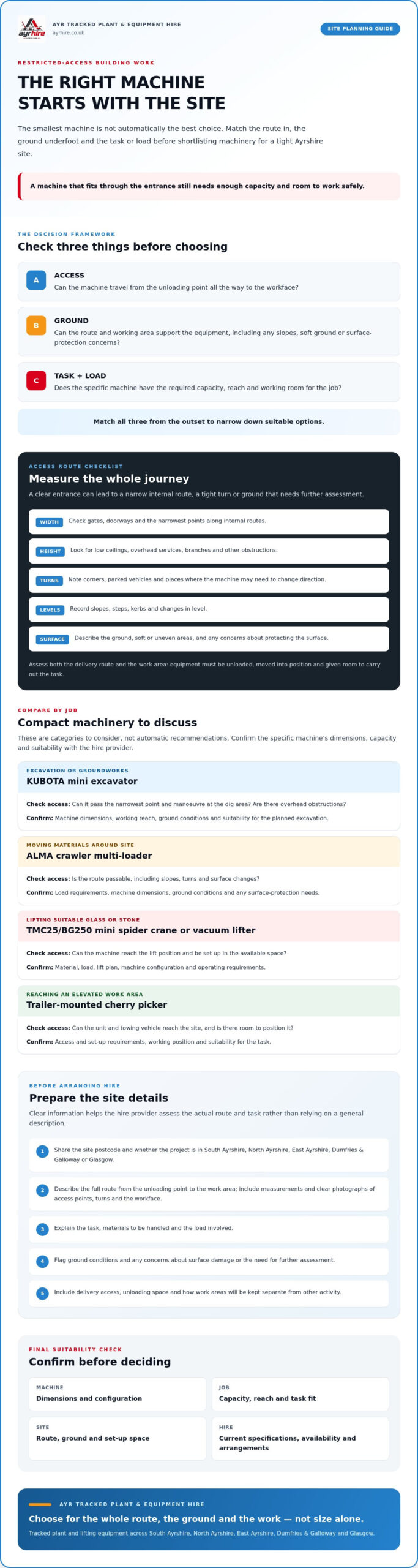
A workable hire plan covers the job, the route, delivery and how the machine will operate alongside other site activity. Use this sequence to turn your measurements and task details into a clear suitability check before confirming a hire.
- Define the task. State what needs excavating, carrying or lifting, where the work will happen and what material or load is involved. Include the required reach or travel distance where relevant.
- Measure the access. Record the tightest points on the route and any turns, slopes, thresholds or overhead restrictions. Check the working area as well as the way in.
- Document the site. Share the postcode, route and work-area photographs, surface conditions, unloading space and any restrictions. Note where other trades, vehicles or pedestrians will be active.
- Confirm suitability. Ask the hire provider to check the machine’s dimensions and relevant capacity against the job and site information. Confirm any requirements for ground protection, set-up and safe operation.
What should you confirm before delivery?
Check that the delivery vehicle can reach the agreed unloading point and that there’s enough space to unload without blocking access or interfering with other work. Agree who the site contact is, when delivery is planned and how access restrictions will be managed. Confirm current availability and delivery arrangements for the project location directly with the provider. Don’t assume a machine can be delivered or unloaded simply because it can fit through the site entrance.
What safety and operating details need checking?
Before the hire begins, establish who may operate the equipment and what instruction or demonstrated competence is required for that machine. Ask what inspection, maintenance and handover information will be provided, and make sure the site team knows how the work area will be separated from other activity. Check current Health and Safety Executive guidance and applicable requirements with a competent professional. The right arrangements depend on the machine, task and site.
A short site briefing can help coordinate delivery, set-up and work activity. Tell the relevant site team when and where the machinery will operate, identify shared routes and agree how changes to access or other work will be communicated. If conditions differ from what was described, pause and resolve the suitability question before proceeding.
For machinery for building in tight spaces Ayrshire projects, a well-prepared enquiry gives the provider practical information to assess without treating any machine as suitable by default. Discuss your site and machinery hire requirements with Ayr Hire, including the task, access route, ground conditions and preferred timing, then confirm current availability and arrangements for your location.
Arrange specialist machinery hire for building work in Ayrshire
Shortlist machinery by four practical factors: the access route, the task, the load and the ground. A machine may suit one part of the job but not the full route or work area. Use your measurements and site notes to discuss options, then confirm specifications and suitability with the hire provider.
Ayr Hire’s specialist categories include KUBOTA mini excavators, TMC25/BG250 mini spider cranes, ALMA crawler multi-loaders and vacuum lifters. These are options to discuss, not automatic recommendations. The right choice depends on the work involved and the machine’s confirmed dimensions, capacity and operating requirements. Check availability and hire arrangements for your location and planned dates.
What information helps Ayr Hire assess a project?
Give the provider enough detail to compare the job with relevant machinery, rather than simply asking for the smallest option. Include:
- Project location: Provide the site postcode and say whether it’s in South Ayrshire, North Ayrshire, East Ayrshire, Dumfries & Galloway or Glasgow.
- Access information: Share photographs and measurements for the route from the unloading point to the work area. Flag tight turns, overhead restrictions, slopes and changes in level.
- Task and load: Describe the work, the material to be excavated, carried or lifted, and any load or placement requirements.
- Ground conditions: Note soft or uneven areas, sensitive surfaces, thresholds and any concerns about protection.
Ask which machine category might suit the work, what specifications need checking, and what delivery arrangement may be possible for the site. Confirm current availability and the hire term that fits your programme. Ayr Hire offers daily or weekly hire terms, subject to confirmation for each enquiry.
Where can you explore related specialist hire options?
For a broader overview, look for Ayr Hire’s specialist plant hire Ayrshire guide. A focused follow-up may also be useful if you’re considering mini spider crane hire in North Ayrshire or want to learn more through an ALMA multi-loader hire guide. These topics can help you prepare questions, but they don’t replace a site-specific check. Confirm the machine’s dimensions, capacity and suitability for your task directly with the provider.
When enquiring with Ayr Hire, share your location, intended task, load details, access measurements and photographs. Clear information gives the provider a practical basis for discussing suitable categories, delivery arrangements and hire terms.
Make your next hire decision with confidence
The right machinery for building in tight spaces Ayrshire sites need is chosen by more than its size. Start with the access route, then match the machine to the task, load and ground conditions. Confirm dimensions, capacity and operating requirements with the hire provider before arranging the hire.
Ayr Hire specialises in tracked plant and lifting equipment hire, with local coverage across South Ayrshire, North Ayrshire, East Ayrshire, Dumfries & Galloway and Glasgow. Options to discuss include mini excavators, mini spider cranes, tracked multi-loaders and vacuum lifters. The right category depends on your project details, so share the work involved and any site constraints when you enquire.
Have your postcode, access measurements, photographs and task details ready. This gives the provider a clearer basis to discuss suitability, availability and delivery arrangements for your location.
Discuss your site access and machinery requirements with Ayr Hire. With a practical plan and the right information, you can take the next step towards a well-matched hire.
Frequently Asked Questions
Can tracked machinery work on every narrow building site?
No. Tracks alone don’t confirm that a machine can pass through an entrance or operate safely on the ground. Check the full route, including turning space, overhead clearance, gradients and surface conditions. Share measurements and photographs with the hire provider, then confirm the specific machine’s dimensions and suitability before arranging delivery. A route that appears wide enough at the entrance may still have a tight turn or another restriction further in.
How do I choose between a mini excavator and a tracked multi-loader?
Start with the task. A mini excavator is a category to discuss for groundworks, whilst a tracked multi-loader may be relevant when materials need moving around site. Compare the job, load, travel path, access dimensions and ground conditions. Don’t select by size alone. Give the hire provider these details and ask them to confirm whether the specific equipment and site conditions match your requirements.
Is a mini spider crane suitable for lifting in a confined space?
It may be an option for a specialist lifting task, but suitability depends on the access route, set-up area, load, reach and ground conditions. Tell the hire provider what material needs lifting and where it must be placed. Confirm the machine configuration, operating requirements and lift planning before booking. Don’t assume a compact crane can reach the intended position or lift a particular load safely without checking its specifications.
What should I measure before hiring machinery for tight access?
Measure the narrowest point on the route, available height, turning space and entrance to the working area. Note slopes, steps, thresholds, overhead obstructions and changes in surface. Include the unloading area and route from the delivery point to the workface. Send clear photographs and measurements to the provider so they can compare them with the specific machine. These details help assess access, but don’t replace confirmation of suitability.
Do I need an operator with hired construction machinery?
Operator arrangements depend on the machine, hire terms and work involved. Before confirming a hire, ask who will operate the equipment, what competence or instruction is required and what the hire includes. Don’t assume an operator is provided or that every site worker can use the machine. Check current requirements with a competent professional and agree the operating arrangements with the hire provider before delivery.
Can vacuum lifters be used for every glass or stone installation?
No. Suitability depends on the material’s surface, dimensions, weight and orientation, as well as site conditions. The vacuum lifter must match the handling task and be used in line with its instructions and applicable safety requirements. Give the hire provider accurate material and lift details, including where the item needs to be placed. Confirm the equipment configuration and operating arrangements before delivery.
Does Ayr Hire cover building sites outside Ayr?
Ayr Hire lists coverage across South Ayrshire, North Ayrshire, East Ayrshire, Dumfries & Galloway and Glasgow. Confirm availability and delivery arrangements for your project postcode before making plans. For a useful enquiry, provide the site location, access details, task and preferred hire period. This helps the team discuss which equipment categories and arrangements may be relevant. Check current availability and terms for each enquiry.