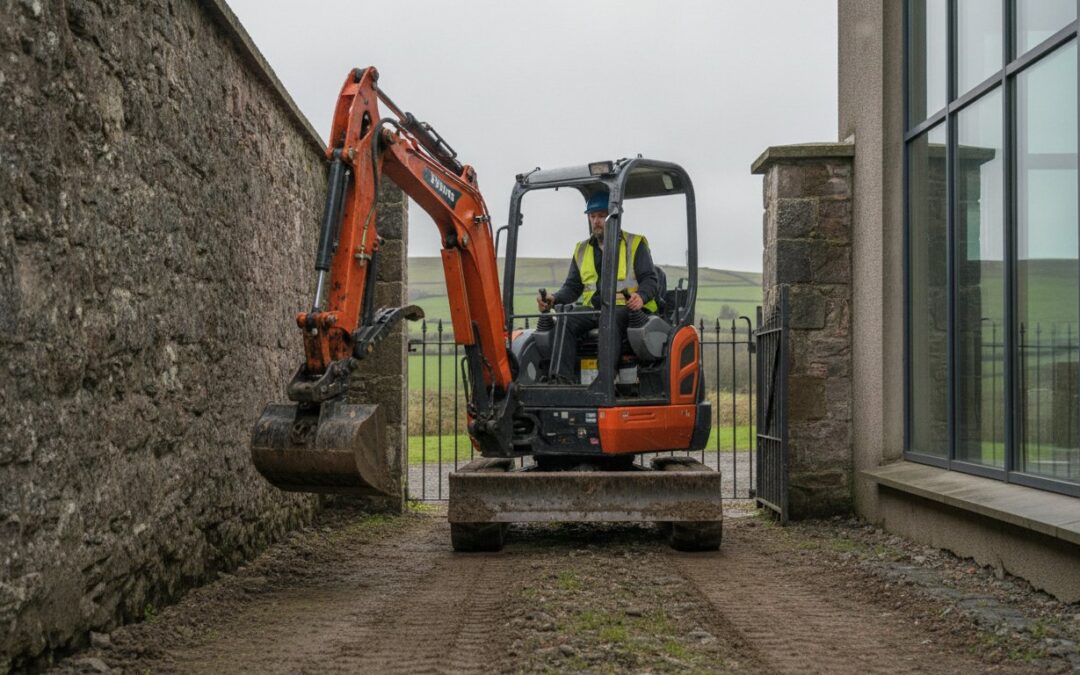
Will your 1.8-tonne digger actually fit through that 750mm side gate, or are you about to pay for a machine that spends the day sitting on the pavement? Getting the logistics wrong doesn’t just cost money; it stalls your entire project. Finding reliable mini excavator hire Scotland requires a focus on site-readiness, especially when navigating narrow alleyways or the unpredictable mud and clay of local ground conditions.
You already know that restricted access and confusion over digging depths can turn a simple job into a logistical nightmare. It is a common headache for contractors and homeowners alike. This guide provides the professional blueprint for site success. We will help you master the process of selecting, preparing for, and hiring the right equipment to ensure your project stays on track and under your control.
We detail how to match Kubota models to your specific task and how to comply with the latest 2025 safety regulations regarding isolation devices. From Ayrshire to Glasgow, you will learn how to secure the correct machine size and organise a delivery that works for your schedule.
Key Takeaways
- Select the correct machine size by measuring your site’s narrowest access point and identifying obstacles like overhanging branches.
- Protect your site and team by locating underground services and maintaining a one-metre safety radius from the excavator’s swing.
- Optimise your budget for mini excavator hire Scotland by selecting daily or weekly rates that match your project’s actual timeline.
- Ensure professional results by using Kubota’s precision controls for delicate work near foundations and on challenging Scottish slopes.
- Guarantee a smooth project start by confirming delivery requirements for sites across Ayrshire, Glasgow, and Dumfries & Galloway.
What is a Mini Excavator and Which Size Do You Need?
What is a Mini Excavator? It’s a compact tracked vehicle, typically weighing under 5 tonnes, engineered for precision digging, trenching, and levelling in restricted spaces. These machines provide the hydraulic power of heavy plant but within a footprint that respects the boundaries of residential and urban sites. When you organise mini excavator hire Scotland, choosing the right weight class prevents site damage and avoids overpaying for unused capacity.
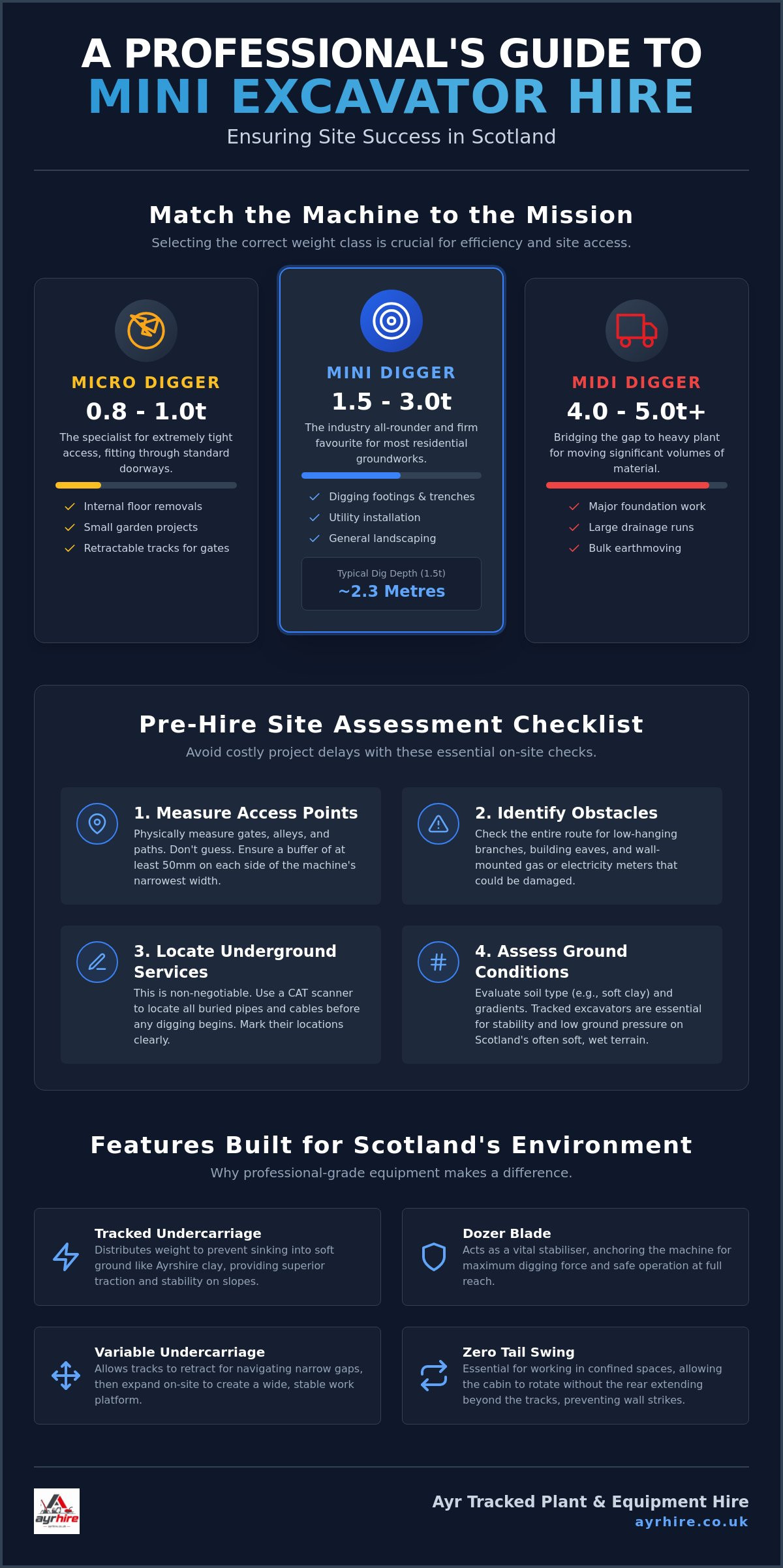
- The Micro Digger (0.8t – 1t): These are the specialists for tight access. They often feature retractable tracks, allowing them to pass through a standard 750mm doorway or garden gate. They’re perfect for internal floor removals or small garden projects.
- The Mini Digger (1.5t – 3t): This is the industry’s “all-rounder.” It’s the standard choice for digging footings, installing utilities, and general landscaping. It offers a deeper dig depth and more breakout force than micro models.
- The Midi Digger (4t – 5t+): These machines bridge the gap to heavy earthmoving equipment. They’re used for larger drainage runs, major foundation work, or sites where you need to move significant volumes of material quickly.
Understanding Weight Classes and Digging Depth
In the Scottish plant hire market, 1.5-tonne units are the firm favourite for residential groundworks. They’re powerful enough to handle tough soil but light enough to be transported easily. You must calculate your maximum required depth before booking. A 1.5t machine typically digs to about 2.3 metres. If your trench needs to be deeper, you’ll need to step up to a 3-tonne or 5-tonne model to ensure the boom can reach. The reach of a Kubota mini excavator for domestic use ensures that operators can safely deposit spoil far enough from the excavation to maintain trench integrity and prevent collapse.
The Advantage of Tracked Machinery in Scotland
Wheeled machinery often struggles on the wet, soft surfaces common across the country. Tracks are essential for mini excavator hire Scotland because they distribute the machine’s weight over a larger area. This prevents the unit from sinking into soft Ayrshire clay or turning a garden into a mud pit. The dozer blade is another critical component. It isn’t just for backfilling; it acts as a vital stabiliser, anchoring the machine whilst you work at full reach. Many professional-grade Kubota models also feature variable undercarriages. You can retract the tracks to enter a narrow alleyway and then expand them once you’re in the work area to create a stable, safe platform.
How to Assess Your Site for Mini Excavator Hire
Before booking your mini excavator hire Scotland, you must walk the route from the delivery point to the dig site. Don’t rely on guesswork. Measure the narrowest point of access. This is usually a garden gate, a gap between a house and a fence, or a narrow alleyway. You must also check for overhanging obstacles. Low branches, building eaves, and gas meters can easily be damaged by a moving machine. If you’re unsure which machine fits your gate, consult our technical specifications for exact dimensions.
Identifying underground services is non-negotiable. Hitting a water pipe, gas main, or electric cable is a costly and dangerous mistake. You must use a CAT scanner to locate all buried utilities before the bucket touches the soil. This is a standard requirement for site success. Additionally, evaluate your ground gradients. The rolling terrain in Dumfries and Galloway or the Highlands often requires tracked machines for better traction. Tracked excavators provide the stability needed for hilly ground that wheeled alternatives cannot match.
Measuring for Narrow Access
Always allow for a 50mm “buffer” on either side of the machine. If a gate is 800mm wide, a machine with a 750mm width is your limit. Many Kubota models feature retractable tracks. This allows the machine to shrink its footprint to fit through a standard doorway and then expand for stability once it reaches the work area. You must also assess the “tail swing” of the excavator cabin. This is how far the rear of the machine extends beyond the tracks when rotating. In tight alleyways, a zero-tail-swing model is essential to avoid hitting walls or fences. For a detailed walkthrough of these preparation steps in the wider Glasgow area, our Kubota mini digger hire Paisley site preparation checklist covers every essential check from underground utility identification to ground stability assessment.
Ground Protection and Site Stability
Protecting the existing environment is as important as the excavation itself. Decorative driveways or soft lawns need protection from track marks. Use bog mats or thick plywood to create a temporary road for the machine. This distributes the weight and prevents surface damage. Adhering to guidance on Operating Safely in the Scottish Environment ensures your site remains compliant and secure.
- Identify “made ground”: Soil that has been previously disturbed or backfilled is less stable than virgin soil. It increases the risk of the machine tipping during deep digs.
- Prepare a level pad: For deep excavations, create a flat, compacted area for the excavator to sit on. This prevents the machine from sliding or tilting whilst working at full reach.
- Check overhead clearance: Always look up for power lines. Maintain a safe distance as dictated by local safety regulations to prevent electrical arcing.
By conducting a thorough site assessment, you eliminate the surprises that cause project delays. A well-prepared site is a safe site.
Step-by-Step Guide to Organising Your Digger Rental
Securing mini excavator hire Scotland is a straightforward process when you follow a methodical checklist. It’s about more than just the machine. You must coordinate logistics, attachments, and protection to keep your site moving. A professional approach to hiring ensures that the equipment arrives ready for work and your project stays on schedule.
Step 1: Define the timeline. Daily rates are perfect for weekend garden projects. Weekly hire is the professional standard for site developments. It provides a buffer for weather delays common in the west of Scotland. Plan your work programme to maximise machine uptime and avoid paying for a digger that sits idle.
Step 2: Verify your delivery zone. We cover Ayrshire, Glasgow, and Dumfries & Galloway. Providing a precise postcode and a description of the drop-off point prevents delivery delays. Ensure there’s enough space for a delivery vehicle to offload the machine safely near your site entrance.
Step 3: Customise the machine. Standard digging buckets are usually included, but specific tasks need specific tools. Think about the width of the trenches you’re digging or if you need to level a large area. Ordering everything at once saves on separate delivery charges later.
Step 4: Sort your cover. Most professional hire agreements require Hired-in Plant Insurance. This covers the full replacement value of the machine in the event of theft or major damage. Check your existing business policy or arrange temporary cover before the delivery driver arrives on-site.
Selecting the Right Attachments
Standard digging buckets are the workhorse for general excavation and earthmoving. Trenching buckets are much narrower, designed specifically for laying pipes or cables without moving excess soil. Ditching buckets (or grading buckets) feature a wide, flat edge for finishing surfaces or clearing shallow drains. For removing old concrete patios or driveways, a hydraulic breaker is essential. It turns hours of manual sledgehammer work into minutes of effortless demolition. For moving heavy materials after digging, consider ALMA multi-loader hire Glasgow to keep your site organised and productive.
Co-ordinating with Other Tracked Plant
Complex sites often require more than one machine to maintain efficiency. Pairing a mini excavator with a tracked wood chipper is the most effective way to manage site clearance. See our guide on FORST wood chipper hire for clearing vegetation before you dig. Organising a multi-machine delivery to a single site in Scotland simplifies your logistics. It ensures all equipment arrives simultaneously, allowing your crew to start work immediately. This approach reduces transport fees and minimises the number of delivery vehicles entering your site.
Operating Safely in the Scottish Environment
Safe operation is the foundation of site success. When you arrange mini excavator hire Scotland, you must account for the specific challenges of our climate and terrain. Rain, mud, and steep gradients change the machine’s behaviour. Maintaining a professional standard of safety protects your team and prevents damage to the equipment. It starts with a strict “one-metre rule.” No site personnel should ever enter the swing radius of the excavator whilst it is in operation. Clear communication between the operator and ground staff is essential to avoid accidents.
Daily checks are a non-negotiable part of the routine. Before you start the engine, inspect the hydraulic hoses for leaks or fraying. Check the track tension and look for any debris lodged in the undercarriage. Ensure fuel and oil levels are sufficient for the day’s work. At the end of every shift, follow a proper shut-down procedure. Lower the dozer blade and the boom until the bucket rests firmly on the ground. This provides maximum stability and prevents the machine from shifting overnight, especially on soft or uneven ground.
Managing wet weather requires extra caution. Scottish turf becomes slippery quickly, reducing traction for even the best tracked machines. If you are working on a slope, always operate with the tracks facing up and down the gradient rather than across it. This significantly reduces the risk of a rollover. If the ground becomes too saturated, stop work until conditions improve or use additional ground protection to maintain stability.
Licencing and Legal Requirements
There is often confusion regarding the legalities of operating plant. On private land, you do not legally require a formal operator’s licence. However, if the machine needs to be driven on a public road, the operator must hold a valid UK driving licence and the machine must be taxed and insured for road use. Whilst no formal licence is required on private property, basic competency is essential for safety. We recommend that every operator undergoes a thorough site induction. This ensures they understand the specific hazards of the location, such as the position of underground services previously identified in your site assessment.
Refuelling and Maintenance on Remote Sites
Logistics become more complex on remote sites in Dumfries & Galloway or the Highlands. Always use clean white diesel to refuel your machine. Storing fuel securely on-site is vital to prevent contamination or theft. Use a bunded fuel tank to comply with environmental regulations and prevent spills into the soil. Maintenance is equally important. Heavy clay common in Ayrshire can pack into the tracks and rollers. If left to dry, it can cause the machine to “throw a track,” leading to expensive downtime. Clean the undercarriage at the end of each day. If you encounter a mechanical issue beyond basic adjustments, contact our support team immediately for professional assistance.
Why Kubota Mini Excavators are the Professional Standard
Kubota is the worldwide market leader for a reason. Their machinery is the benchmark for mini excavator hire Scotland, offering a combination of durability and technical sophistication that other brands struggle to match. For contractors in Glasgow and across the central belt, these machines provide the reliability needed to meet strict project deadlines. They start first time. They work hard. They don’t quit when the ground conditions get tough.
- Reliability: Kubota engines are engineered for heavy-duty cycles. They are the most trusted name in compact plant because they minimise downtime on-site.
- Precision Controls: The hydraulic systems are exceptionally smooth. This allows for the delicate, incremental movements required when excavating near building foundations or live utility lines.
- Operator Comfort: Long shifts require an ergonomic workspace. Kubota cabins feature intuitive layouts and adjustable seating to reduce operator fatigue and maintain high productivity levels.
- Environmental Standards: Modern Kubota units utilise low-emission engines that meet Stage V requirements. This ensures your site remains compliant with the latest environmental regulations.
Ayr Hire’s Commitment to Practical Readiness
We don’t just supply equipment. We provide site-ready solutions. Every machine in our fleet undergoes a rigorous inspection and maintenance programme before it leaves our yard. This ensures your Kubota arrives in peak condition, ready to work from the moment it’s offloaded. Our local expertise spans South Ayrshire, East Ayrshire, and North Ayrshire. We understand the regional geography. We know the challenges of narrow-access sites. Hiring from a specialist means you get a partner who can advise on the best machine for a tight garden or a restricted urban driveway. For projects specifically in South Ayrshire, our dedicated guide to mini excavator hire Ayr covers the full technical specifications and Kubota model capabilities for local groundworks. We focus on the details so you can focus on the dig.
Booking Your Mini Excavator in Scotland
Organising your equipment should be the easiest part of your project. We provide a transparent, no-nonsense service for mini excavator hire Scotland. Whether you need a micro digger for a quick weekend task or a 3-tonne unit for a month-long development, we can help. Our team provides fast, accurate quotes for both daily and weekly hire terms. We understand that construction timelines are fluid. That is why we offer flexible delivery slots designed to align with your crew’s arrival. We get the machine to you when you need it, where you need it.
Ready to start your project? Contact Ayr Hire for Kubota mini digger rental today. We provide the tools you need for total site success.
Secure Your Site Success with Professional Plant Hire
Successful excavation depends on precise preparation. You now have the blueprint for measuring narrow access, selecting the correct Kubota weight class, and managing the unpredictable ground conditions of the west of Scotland. These steps ensure your site remains safe and your project stays on schedule. By following a methodical site assessment and choosing professional-grade machinery, you eliminate the risks of downtime and property damage.
When you are ready to organise mini excavator hire Scotland, choose a partner that understands local logistics. We are specialists in narrow-access Kubota machinery and offer flexible daily and weekly hire terms across Ayrshire and Glasgow. Our expert local knowledge of regional site conditions ensures you get the right equipment delivered exactly where you need it. Book your Kubota Mini Excavator Hire with Ayr Hire today to keep your groundworks moving forward.
Don’t let restricted access or soft clay stall your progress. With the right tools and a professional plan, you can tackle any digging task with absolute confidence.
Frequently Asked Questions
Do I need a special licence for mini excavator hire in Scotland?
No, you do not need a special licence to operate a mini excavator on private land. However, basic competency is essential for the safety of everyone on-site. If you intend to use the machine on a public highway, the operator must hold a valid UK driving licence and the machine must be road-legal, taxed, and insured for road use.
Will a mini digger fit through a standard garden gate?
Micro diggers are specifically designed for this purpose. Most 0.8-tonne micro models feature retractable tracks that shrink the machine’s width to approximately 700mm to 750mm. This allows them to pass through a standard garden gate or even an internal doorway with ease. Always measure your narrowest access point before booking.
What happens if the excavator gets stuck in soft ground?
Stop operating immediately to prevent the tracks from sinking further into the mud. Use the hydraulic power of the boom and bucket to gently push or pull the machine towards firmer ground. To prevent this on soft Scottish clay, always use bog mats or thick plywood to distribute the machine’s weight more effectively.
Can I hire a mini excavator for just one day in Ayrshire?
Yes, we offer flexible daily hire terms for projects across Ayrshire. This is ideal for smaller residential tasks that do not require a full week’s rental. You can organise mini excavator hire Scotland for short durations to keep your costs aligned with your project’s specific timeline and budget requirements.
Are fuel and insurance included in the hire price?
Fuel and insurance are typically separate from the base hire rate. We deliver our machines with a full tank of white diesel and expect them to be returned full. You must also arrange Hired-in Plant Insurance to cover the equipment against theft or accidental damage whilst it is on your site.
How much space does a 1.5-tonne mini digger need to operate safely?
You must account for both the machine’s width and its full tail swing radius. For a 1.5-tonne model, this means having enough clearance for the rear of the cabin to rotate without striking walls, fences, or obstacles. Always maintain a strict one-metre safety zone for all site personnel during operation.
What is the maximum digging depth of a Kubota mini excavator?
Digging depth varies by the weight class of the machine. A standard 1.5-tonne Kubota typically reaches a maximum depth of approximately 2.3 metres. If your project requires deeper trenching for foundations or drainage, you may need to step up to a 3-tonne or 5-tonne midi excavator to reach the required depth safely.
Do you deliver mini excavators to Glasgow and Dumfries & Galloway?
We provide reliable delivery services across Glasgow, Ayrshire, and Dumfries & Galloway. Our transport team is experienced in navigating both busy urban sites and remote rural locations. We coordinate delivery slots to match your project schedule, ensuring the equipment arrives exactly when your crew is ready to begin work.