A standard doorway is often the only thing standing between a successful installation and a total site shutdown. You’ve likely faced the frustration of Glasgow city centre logistics, where narrow lanes and historic stone make traditional crane hire impossible or far too expensive. It’s a common struggle. Small footprint. High capacity. Zero damage. Attempting to force the wrong gear into tight spots leads to structural damage and spiralling costs. Finding professional restricted access lifting solutions Glasgow requires a shift in strategy. You need equipment that prioritises a compact footprint without sacrificing lifting power.
We agree that site access shouldn’t dictate your project’s success. This guide provides the technical roadmap to navigate Glasgow’s most restricted sites using mini spider cranes, vacuum lifters, and specialist tracked plant. You’ll learn how to identify the exact machine for clearances under 800mm and understand the £172 daily permit fees required by the local authority. We will also cover the safety standards necessary for structural glass and steel work. By the end, you’ll have the clarity to choose a reliable local hire partner who can get the job done safely and efficiently.
Key Takeaways
- Understand why tracked machinery like the ALMA Crawler Multi-Loader is essential for maintaining stability on Glasgow’s varied and often uneven site terrain.
- Learn how to navigate restricted access lifting solutions Glasgow specifically for tenement renovations and city centre shopfronts with narrow entry points.
- Discover the benefits of using vacuum lifters alongside mini spider cranes for the safe installation of structural glass and cladding.
- Follow a professional site survey checklist to accurately calculate total lift weight and account for every logistical pinch point.
- Explore the advantages of local, flexible hire terms that allow you to scale equipment use based on your specific project duration.
Navigating Glasgow’s Unique Restricted Access Challenges
Glasgow presents a unique set of logistical hurdles. From the tight sandstone lanes of the West End to the bustling commercial hubs of the city centre, space is a luxury. In this environment, restricted access isn’t just a minor inconvenience. It’s the primary barrier to project completion. We define restricted access as any site where narrow entries, low ceilings, or weight-sensitive floors prevent the use of standard machinery. These constraints are standard in Glasgow tenement backyards and historic building renovations. Finding reliable restricted access lifting solutions Glasgow means looking beyond the usual heavy plant. Small footprint. High capacity. Zero damage. That’s the requirement.
Traditional lifting methods often fail in the city’s dense urban fabric. A standard crane (machine) requires significant outrigger space and overhead clearance that Glasgow’s narrow lanes simply don’t provide. If you can’t get the machine to the lifting point, the project stalls. You need equipment that manoeuvres through gaps where others get stuck.
The Problem with Standard Plant in Urban Sites
Physical dimensions are the first hurdle. A standard HIAB or mobile crane is too wide for the average Glasgow courtyard entry. Even if the width fits, the weight often doesn’t. Old Glasgow pavements and basement ceilings are frequently unreinforced. High ground pressure from heavy tyres can cause catastrophic structural failure. Noise and emissions are also critical factors. In the city centre, strict environmental regulations and proximity to residents make loud, diesel-heavy plant a liability. You need quieter, more compact alternatives that respect the local environment and structural integrity.
Identifying Your Specific Access Constraints
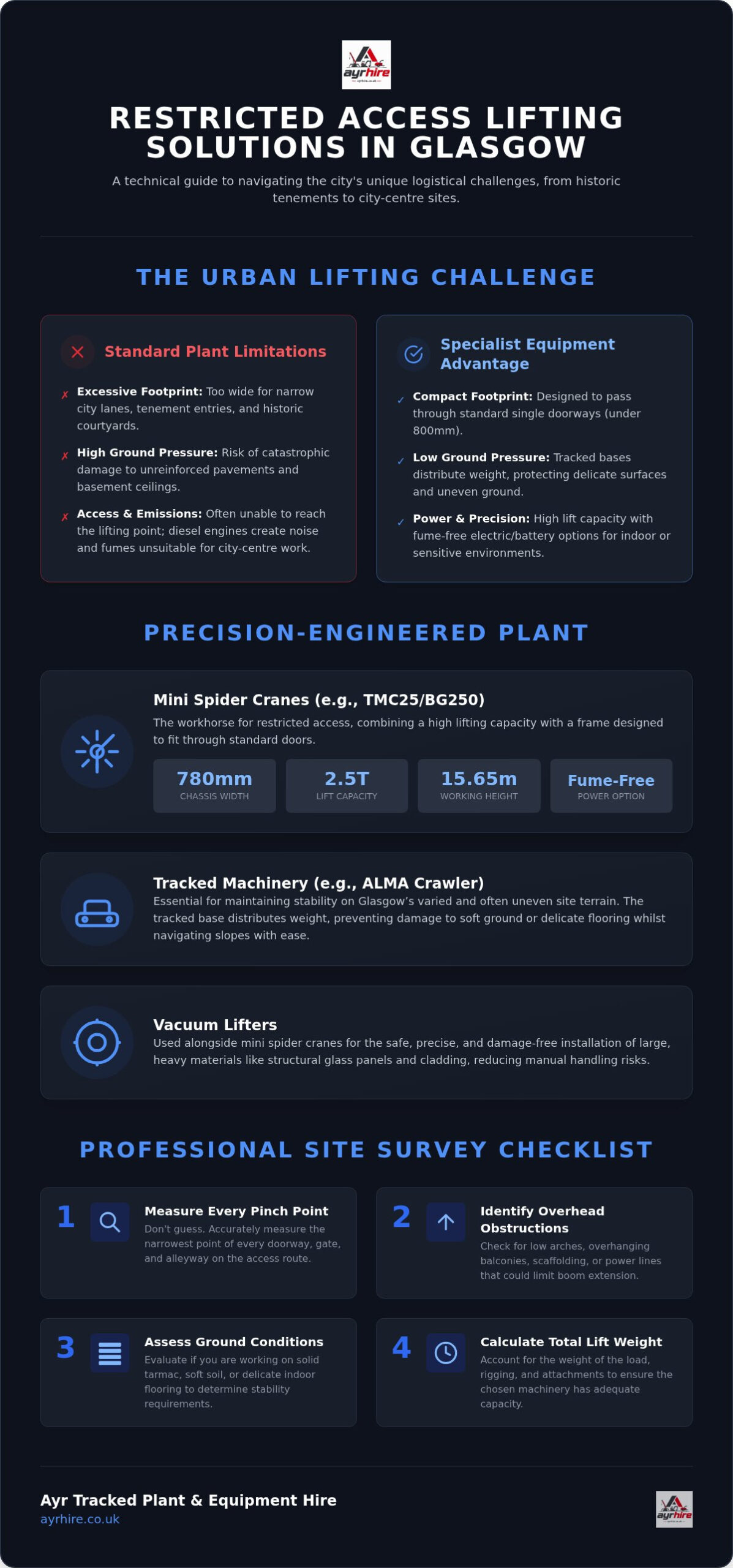
Successful projects start with precise measurements. Don’t guess the clearance. Measure the narrowest point of every doorway, gate, and alleyway on the route. For example, the TMC25/BG250 mini spider crane features a 780mm wide chassis. This is specifically designed to pass through a standard single door. Identifying these bottlenecks early ensures you choose the right restricted access lifting solutions Glasgow for the specific site.
Consider these common constraints during your site survey:
- Overhead obstructions: Check for low arches, scaffolding, or overhead power lines that limit boom extension.
- Ground conditions: Evaluate whether you’re working on tarmac, soft soil, or delicate indoor flooring. Tracked machinery is often the best choice for stability.
- Internal pinch points: Low ceilings or tight corners inside historic buildings can stop a lift before it starts.
A methodical approach to these constraints prevents costly delays. It avoids damage to the city’s architectural heritage whilst keeping the project on schedule.
Specialist Equipment: Mini Spider Cranes and Vacuum Lifters
Solving site access requires more than just small machines; it requires precision-engineered plant designed for the tightest gaps. Choosing the right restricted access lifting solutions Glasgow relies on selecting machinery that balances raw power with a minimal footprint. In the dense urban environment of the city, the ability to move through a standard single doorway is often the difference between a project moving forward or grinding to a halt. We focus on two primary categories of equipment to overcome these hurdles: mini spider cranes and vacuum lifters.
Mini Spider Cranes: Power in a Compact Frame
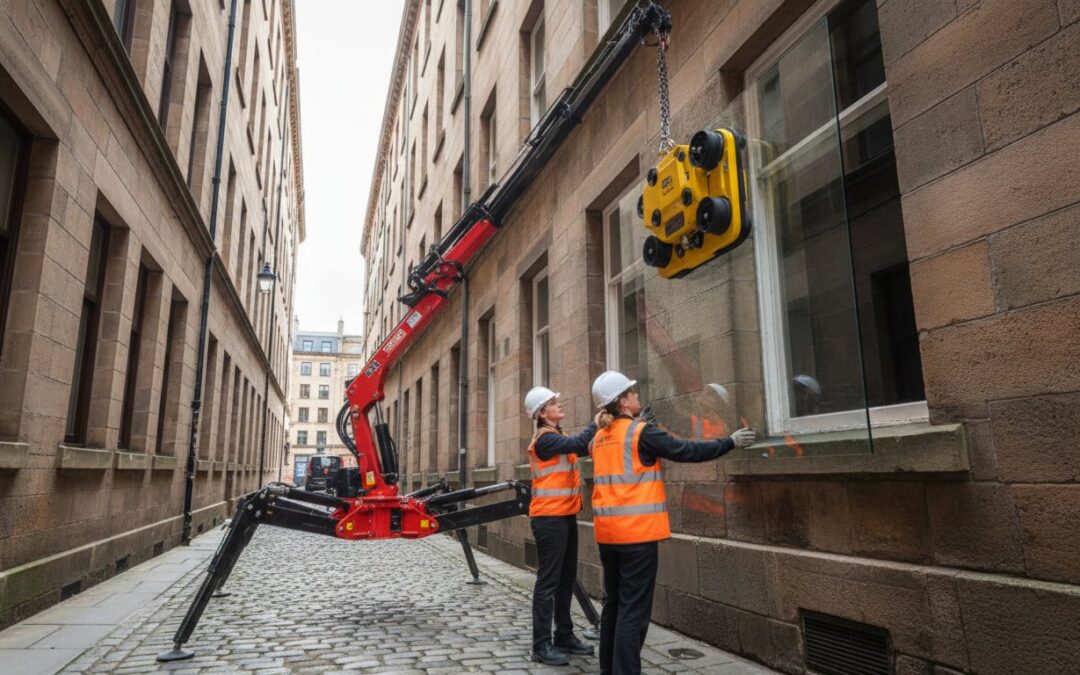
The TMC25/BG250 mini spider crane is the workhorse of restricted access lifting. It’s built for versatility. With a chassis width of only 780mm, this machine travels through standard doors and narrow alleyways with ease. Despite its small size, it boasts a 2.5-tonne lifting capacity and a working height of up to 15.65m. This makes it ideal for steel beam placement in tenement renovations or machinery moving in internal courtyards. Small footprint. High capacity. Total control.
Stability is managed through a flexible outrigger system. These “spider legs” can be positioned at various angles to navigate uneven ground or avoid obstacles like low walls and steps. For indoor projects or food-standard environments, electric and battery power options ensure fume-free operation. For projects across the city, you can explore our specialist lifting plant to see which machine fits your specific clearance requirements.
Vacuum Lifters for Structural Glazing
Safe glass installation requires specialist handling. Vacuum lifter hire is essential for structural glazing and cladding projects where manual handling is impossible and traditional slings are too risky. These lifters provide a secure, non-marking grip on smooth surfaces, allowing for millimetre-perfect placement. Adhering to UK lifting operations guidance is essential when operating within these confined environments, ensuring every lift is planned and executed safely.
Integrating a vacuum lifter with a mini spider crane creates a complete lifting solution for Glasgow shopfronts and office developments. We offer a range of capacities to suit different panel sizes:
- Woods MRT 4/8: A versatile choice with a 400kg capacity.
- P11104 Woods In-line: Designed for narrow panels with a 320kg capacity.
- Hydraulica Kappel 1200: For heavy-duty structural glass up to 1200kg.
These machines feature dual-circuit vacuum systems for maximum safety. If one circuit fails, the other maintains the hold, protecting both the glass and the site team. Using the right tool for the job reduces risk and significantly speeds up the installation process.
The Tracked Advantage for Confined and Rough Terrain Sites
Site access in Glasgow is rarely a matter of simple geometry. Beyond narrow entries, you often face soft ground, steep inclines, and unreinforced surfaces. Tracks outperform wheels in these conditions. They distribute weight across a larger surface area, preventing machinery from sinking into soft tenement backyards or damaging historic stonework. This stability is the foundation of reliable restricted access lifting solutions Glasgow. When traditional vehicles fail to gain traction, tracked plant ensures the job continues without delay.
ALMA Multi-Loaders: Moving Materials Where Vans Can’t Go
The ALMA Crawler Multi-Loader is a critical partner to the mini spider crane. Whilst the crane handles the vertical lift, the ALMA manages the horizontal transport. It features a narrow chassis designed to navigate through tight site entries. Its standout feature is self-levelling technology. This allows the platform to remain horizontal even when traversing slopes or uneven debris. It moves heavy payloads like glass panels, steel beams, or other plant equipment across challenging terrain with ease. It’s a steady hand for complex material handling.
Stability on Challenging Ground
Effective planning and organising lifting operations requires a deep understanding of ground pressure. High-pressure tyres can crack old Glasgow pavements or damage basement ceilings. Tracked machinery reduces this risk by spreading the load. This is particularly important for indoor projects where floor loading limits are strict. Using non-marking tracks allows these machines to operate on finished floors without leaving a trace.
In many cases, the combination of tracked carriers and lifting gear is the only way to reach a site. We have seen this in action when providing specialist plant hire Ayrshire for projects with steep, muddy access routes. The tracks provide the necessary grip whilst the low centre of gravity maintains load stability. This synergy between different types of tracked plant creates a comprehensive access strategy. It removes the guesswork from site logistics. It ensures your materials arrive at the lifting point safely and on time.
A Step-by-Step Guide to Planning a Restricted Access Lift
Planning is the most critical stage of any lifting operation. In dense urban environments, assumptions lead to accidents or expensive delays. Implementing professional restricted access lifting solutions Glasgow starts long before the machinery arrives on site. You must account for every millimetre of clearance and every kilogramme of weight. Success depends on a methodical approach that covers technical capacity, site safety, and local logistics. A well-prepared lift plan reduces site downtime and ensures compliance with all safety regulations.
Site Survey and Risk Assessment
A thorough site survey identifies the “pinch points” that could stop a project. In Glasgow city centre, you must check for underground services or historic voids that might not be visible on standard maps. Old basement vaults are common and can be particularly sensitive to ground pressure. You need to map the exact path of travel from the kerbside to the final lifting position. This includes measuring the narrowest doorway or gate along the route. If you’re using the TMC25/BG250, you know the 780mm width fits a standard door, but you still need to account for turning circles and overhead scaffolding. Public safety is paramount. Identify exclusion zones and ensure you have the necessary barriers to keep pedestrians away from the lifting area whilst the crane is in operation.
Technical Verification and Logistics
Calculating the “Total Lift Weight” is your next priority. This isn’t just the weight of the material. You must include the weight of all lifting gear, such as slings, shackles, and vacuum lifters. Once you have this total, verify it against the “Load Chart” of your chosen crane. Capacity drops significantly as the boom extends or the radius increases. Never operate at the absolute limit of the machine. Ensure your operator holds the correct CPCS or A66 certification for spider cranes. This is a legal requirement under LOLER regulations to ensure competency and safety.
Logistics in Glasgow require careful timing. You must navigate the Low Emission Zone (LEZ) and avoid peak traffic on busy thoroughfares like the A8 or M8 corridors. Remember that a crane permit for building operations in Glasgow costs £172.00 per day for the first week. This fee is non-refundable, so your timing must be precise to avoid wasted costs. Coordination is key. Ensure the site is ready for the “tracking in” of equipment and that there is sufficient space for full outrigger deployment at the lift site. If you’re ready to start your project, you can book your specialist plant hire today to secure your preferred dates and equipment.
Expert Restricted Access Hire from Ayr Tracked Plant & Equipment Hire
Successful projects in the West of Scotland require more than just the right machinery. They require a hire partner who understands the specific logistical hurdles of the region. Ayr Tracked Plant & Equipment Hire provides professional restricted access lifting solutions Glasgow with a focus on practical readiness and technical reliability. We serve Glasgow, Ayrshire, and Dumfries & Galloway with a “get the job done” attitude. Our team identifies the exact machine needed for your site constraints. We don’t use hyperbolic sales language. We focus on the utilitarian needs of your project. Reliable machinery. Expert advice. Local accountability.
Our Specialist Lifting Fleet
Our inventory is curated to handle the most challenging site entries. We offer specialist lifting solutions Scotland that include the TMC25/BG250 mini spider crane and high-capacity vacuum lifters. These machines are maintained to professional standards at Ayr Tracked Plant & Equipment Hire to ensure consistent performance. For horizontal material transport, our ALMA multi-loader hire Glasgow provides the stability required for heavy loads on uneven ground. Every piece of plant in our fleet is chosen for its compact footprint and high lifting capacity. Small dimensions. High power. Professional results.
We provide flexible hire terms to suit your project timeline. Whether you need a machine for a single day or a multi-week installation, we adapt to your schedule. This flexibility is essential for local tradesmen managing unpredictable site conditions. Our equipment is ready to work the moment it arrives. No unnecessary downtime. Just efficient lifting.
Why Choose a Local Specialist Over a National Giant?
Choosing a local specialist offers distinct advantages for Glasgow sites. National hire companies often lack granular knowledge of local regulations or the specific layout of Glasgow’s narrowest lanes. We understand the requirements of the city’s Low Emission Zone (LEZ) and the permit processes for busy thoroughfares. Our response times are faster. Transport costs are lower. Ayr Tracked Plant & Equipment Hire provides a personalised service that national giants cannot match. We value long-term relationships and consistent performance. When you call us, you speak to an expert who knows the machinery and the local terrain. We provide the steady hand necessary to support your project from start to finish.
Securing Success for Your Next Restricted Access Project
Navigating Glasgow’s architectural heritage requires a shift from standard plant to specialist machinery. You’ve seen how compact tools like the TMC25/BG250 mini spider crane and vacuum lifters overcome narrow entries and weight-sensitive floors. Success depends on a combination of precise site surveys and the right tracked equipment to maintain stability on unpredictable ground. By prioritising a “tracked-first” mindset, you protect both the structure and your project budget.
Choosing a local partner ensures you receive the practical readiness and regional expertise that national suppliers often lack. We provide specialist TMC25/BG250 spider cranes with local Glasgow and Ayrshire delivery to keep your site moving. Our flexible daily and weekly hire terms are designed to adapt to your project’s specific timeline and logistical needs. When you need dependable restricted access lifting solutions Glasgow, we are here to help you get the job done safely and efficiently.
Ready to move your materials through the tightest gaps? Contact Ayr Hire for a Restricted Access Quote and let’s discuss your site requirements today.
Frequently Asked Questions
What is the narrowest opening a mini spider crane can fit through?
A mini spider crane like the TMC25/BG250 can pass through an opening as narrow as 780mm. This compact chassis allows the machine to travel through a standard single doorway or a narrow garden gate. It’s the ideal choice for projects where internal courtyard access is required. You should always measure the narrowest point of your access route, including door frames or protruding masonry, to ensure safe passage for the machine.
Do I need a special licence to hire a mini crane in Glasgow?
You typically need a CPCS A66 category licence or an equivalent certification to operate a mini crane yourself. This ensures the operator understands the stability requirements and load charts essential for safe lifting. If you don’t have a qualified operator, we can discuss providing one with the machine. Adhering to these standards is a legal requirement under LOLER regulations to maintain safety on all Glasgow construction sites.
Can vacuum lifters be used in the rain on Glasgow sites?
Vacuum lifters are best used on dry, clean surfaces to ensure a secure suction seal. Whilst some models have dual-circuit safety systems, wet glass or heavy rain can compromise the grip between the pads and the material. For safety on Glasgow sites, we recommend postponing structural glass installation during heavy downpours. Always wipe the glass panels dry before attaching the lifter to maintain the integrity of the vacuum hold throughout the lift.
How much weight can an ALMA multi-loader carry on a slope?
The ALMA Crawler Multi-Loader is designed to maintain a level platform on slopes, but its payload capacity can vary depending on the angle of the incline. It’s engineered to transport heavy materials like glass or steel beams across uneven terrain where standard vans cannot go. You must consult the specific load chart for the gradient you are working on. This ensures the machine remains stable whilst navigating the steep tenement backyards common in Glasgow.
What is the difference between a mini spider crane and a standard crawler crane?
The main difference lies in the stability system and footprint. A mini spider crane uses four stabilising outriggers, or “spider legs”, to level itself on uneven ground or over obstacles. A standard crawler crane relies on its heavy tracks and counterweights for stability. This makes spider cranes much lighter and more suitable for weight-sensitive floors. They provide the most versatile restricted access lifting solutions Glasgow projects require when working in confined urban spaces.
Are your machines compliant with Glasgow’s Low Emission Zone (LEZ)?
Yes, our equipment is compliant with Glasgow’s Low Emission Zone (LEZ) requirements for transport and operation. Many of our specialist machines, including mini spider cranes, offer electric or battery power options for indoor use. This allows you to work in the city centre without worrying about emissions or noise complaints. Choosing LEZ-compliant plant ensures your project avoids fines and meets the environmental standards set by the local authority for 2026.
How far in advance do I need to book restricted access plant hire?
We recommend booking your restricted access plant hire at least one to two weeks in advance. This is particularly important if you need to secure a crane permit from Glasgow City Council, which can take time to process. Early booking ensures the specific machine you need, such as the TMC25 crane or an ALMA loader, is available for your project dates. We offer flexible daily and weekly terms to suit your project’s timeline.
Do you provide operators with the equipment hire?
We offer both operated and non-operated hire options for our equipment. If you require a professional to manage the lift, we can provide an experienced operator who understands the complexities of restricted access lifting solutions Glasgow sites often present. For non-operated hire, you must provide proof of the operator’s valid certification. This flexibility allows local tradesmen to choose the level of support that best fits their budget and on-site expertise.