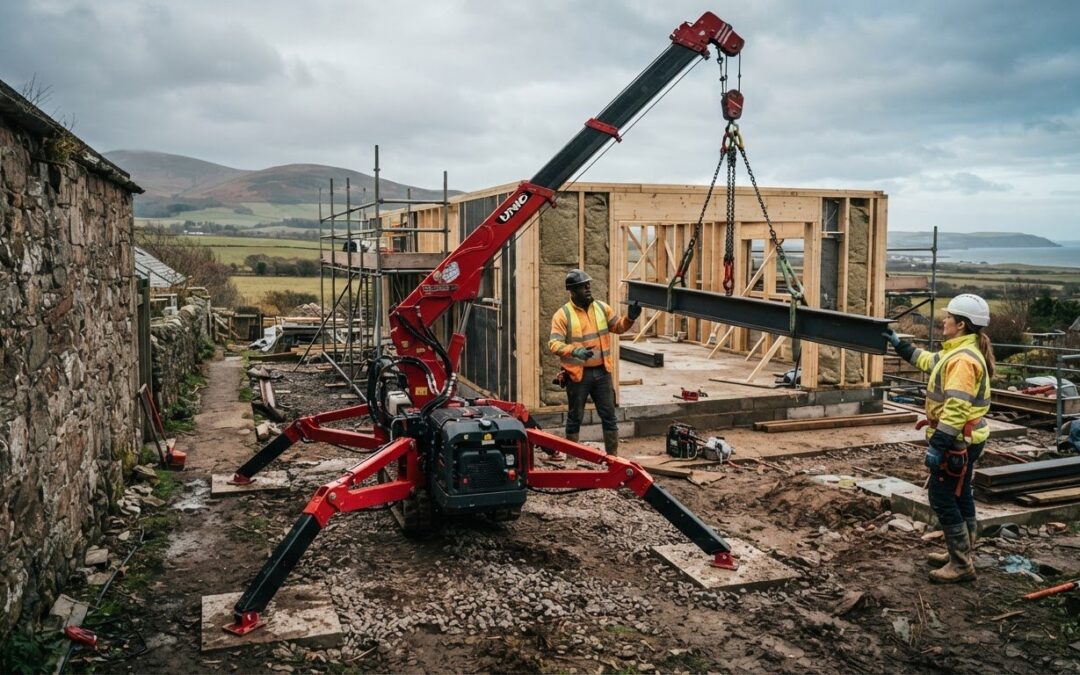
The biggest crane isn’t always the practical choice for a steel lift. If your South Ayrshire site has restricted access or little room around the structure, a spider crane for steel erection South Ayrshire may be worth assessing. But compact size alone doesn’t confirm suitability. The load, working radius, set-up space and ground conditions all matter.
It can be difficult to judge whether a mini crane can place your steel safely, or whether access and set-up could affect the programme. This guide explains what to check when considering the TMC25/BG250 mini spider crane available to hire from Ayr Tracked Plant & Equipment Hire. You’ll find the lift, access and ground details to gather before making an enquiry, while leaving lift planning to the competent people responsible for your project.
Key Takeaways
- Assess whether a spider crane for steel erection South Ayrshire fits the site access, working space and planned lift.
- Check the load, working radius and lift height together against the current load chart for the proposed crane configuration.
- Compare lifting options against the actual site constraints, including set-up space and coordination needs.
- Gather lift, access, ground and programme details before preparing a hire enquiry.
- Ask Ayr Hire about the TMC25/BG250 and confirm its specification, configuration, availability and delivery arrangements for your site.
When can a spider crane help with steel erection in South Ayrshire?
A mini spider crane is a compact crane that may be considered when a conventional lifting set-up is difficult to position. For steel erection, the question isn’t just whether the crane can reach the structure. The planned lift, crane configuration, access route and set-up area all need to be assessed together.
Quotable definition: “A compact crane’s size may make it worth assessing for a constrained site, but only the lift plan and site checks can confirm whether it’s suitable for the steel lift.”
Steel erection involves positioning members as part of a structure, such as the columns and beams that form a steel frame. Placing a steel member is different from moving materials around a site. Each task has its own load, route, lifting points and placement requirements, so suitability for one task doesn’t confirm suitability for another.
What makes a spider crane relevant to steelwork?
Restricted access, limited working space and indoor work can prompt contractors to assess a spider crane. Its compact format may be helpful when larger equipment is difficult to bring close to the work area. That’s a possibility to investigate, not a guarantee that the crane will fit or complete the lift.
Check the full access route, including entrances, turns and overhead restrictions. Then identify where the crane could stand and whether there’s enough room to deploy its outriggers in the required configuration. When describing the work, specify the steel members to be lifted, such as beams or columns, and where they need to go. Confirm any proposed lift against the crane’s current specification and load chart rather than assuming the equipment is suitable.
Which South Ayrshire sites might warrant an assessment?
A building extension with a narrow approach, refurbishment within an existing structure or a constrained urban site may justify comparing compact lifting options. These are examples to assess, not assumptions about a particular South Ayrshire project. The practical questions are whether the crane can reach the proposed set-up area and whether that area can accommodate it safely.
Before requesting a hire, consider the route from the delivery point to the work area, the available set-up footprint and the position where each steel member needs to be placed. Indoor lifts may raise further questions about access and clearance. Record pinch points and obstructions so they can be discussed before choosing equipment.
For a spider crane for steel erection South Ayrshire, begin with the actual lift and site conditions. A compact crane may be worth investigating, but the project’s competent lift planner must establish whether the proposed equipment and set-up are suitable for the task.
Check load, reach and ground conditions before choosing a spider crane
A crane’s suitability can’t be judged by a headline capacity alone. For each steel lift, consider the load, working radius and lift height together, using the load chart for the exact crane and configuration proposed. A change in crane position or set-up can affect the assessment, so don’t assume a capacity figure applies to different arrangements.
How should steel load and working radius be assessed?
List each component’s verified weight, lifting points and intended movement from pick-up to final placement. Measure the planned crane position in relation to both points, and record the height the component must reach. A competent lift planner should check these details against the current load chart for the precise crane configuration. If a weight or measurement is uncertain, resolve it before selecting equipment.
For a spider crane for steel erection South Ayrshire, share the project details with the hire contact, but keep the equipment suitability assessment within the project’s competent lift-planning process. The Lifting Operations and Lifting Equipment Regulations (LOLER) provide the UK framework for lifting equipment and operations. Check the requirements that apply to your work.
Can the site support crane set-up?
Check the access route, including clear width and headroom, then assess the proposed set-up area. Record the surface condition and the space available for the crane’s stabilisers. Slopes, voids, buried services and nearby structures can all affect set-up considerations. Don’t assume the ground is suitable from a visual check alone. The project team must arrange the appropriate site-specific assessment.
| Project requirement | Evidence to gather | Who should confirm it |
|---|---|---|
| Steel load and handling | Verified component weights, lifting points and movement sequence | Project team and competent lift planner |
| Reach and height | Crane position, pick and placement points, required lift height | Competent lift planner, using the current load chart |
| Crane access and set-up | Route clearance, surface condition and stabiliser space | Site team, with crane configuration checked for the task |
| Ground and obstructions | Information on slopes, voids, buried services and nearby structures | Relevant competent project personnel |
Bring these details together before making a hire enquiry. Ayr Hire’s TMC25/BG250 mini spider crane is an option to discuss, with its specification, load chart, configuration and suitability to be confirmed for the specific lift. You can discuss the mini spider crane hire option with your site information to hand.
Spider crane or another lifting method for steel erection?
Choose the lifting method by assessing the actual lift, rather than starting with a preferred machine. A mini spider crane may be worth considering when the route is restricted or the available set-up area is limited. A larger crane, telehandler or manual method may also be considered, but each option needs its own suitability check against the steel, structure and site conditions.
Equipment choice depends on the complete lift plan, not access alone. A machine that can reach the work area still needs to meet the lift requirements and fit the available set-up space. The plan also needs to account for how the steel will be handled and how the lift will fit alongside other site activity.
When might a compact spider crane be worth assessing?
Consider one if a narrow access route or restricted work area makes equipment positioning a key challenge. Compact dimensions may make a spider crane an option to investigate, but they don’t confirm that it can enter the site, deploy its outriggers or complete a particular lift. Compare the crane’s confirmed configuration with the access route, work area and planned sequence. For broader hire context, see the mini spider crane hire guide for North Ayrshire.
When should the project team consider another method?
Consider another approach if the lift falls outside the crane’s confirmed configuration, or if the reach, load, ground conditions or set-up space can’t be verified. A larger crane may suit a different lift profile, while a telehandler or manual handling proposal would need its own assessment of the task, route and risks. For wider project requirements involving lorry-mounted or tracked equipment across the UK, learn more about Bewlake Lift & Haul Ltd. No method is automatically the better choice. Compare each option against the same requirements and planned steel placement.
Coordination matters too. Consider where the equipment will stand, how components will arrive at the pick point and whether the proposed sequence works alongside other site operations. The US Occupational Safety and Health Administration’s site-specific erection plan resource offers a planning reference for site preparation. It isn’t UK guidance, so use it as supplementary reading, not as a substitute for the project’s applicable UK requirements or competent lift planning.
For a spider crane for steel erection South Ayrshire, compare the TMC25/BG250 with other methods only after clarifying the lift and site constraints. Ayr Hire can discuss the crane as a hire option, but the project team must establish whether its confirmed specification and configuration suit the work. If they don’t, reconsider the method before arranging equipment.
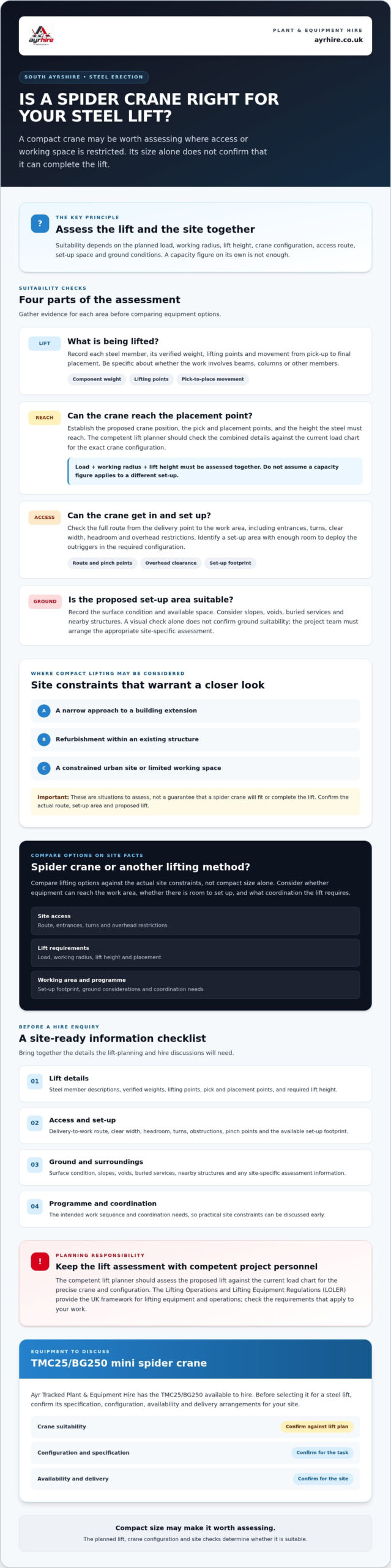
Plan a safe steel erection lift with a site-ready checklist
A clear hire enquiry starts with reliable project information. Gather the details before selecting equipment, then have the proposed lift reviewed by the competent people responsible for planning and carrying it out. Legal duties depend on the work and hire arrangement, so confirm which requirements apply to your project. Check current guidance on LOLER, PUWER and relevant HSE material rather than relying on assumptions.
What information should be ready before the hire enquiry?
- Pin down the site. Give the location and share access photographs, measured clearances and any restrictions on delivery or movement around the site.
- Mark the proposed set-up area. Show where the crane may stand and note the available space, ground information, obstructions and any known services.
- Describe each lift. Provide verified component weights, lifting points, pick-up and placement positions, required height and working radius. Explain how each member will be handled and positioned.
- Set out the programme. Share the planned dates, working hours, lift sequence and site restrictions. This helps identify what needs to be confirmed before equipment is arranged.
Keep measurements and weights traceable to project information. If a detail is unknown, flag it for confirmation instead of estimating. Accurate information gives the hire provider a clearer basis for discussing the equipment option, while the project’s competent lift planner remains responsible for assessing the proposed operation.
Who should coordinate the lift and site checks?
The contractor should identify who is responsible for the overall site arrangements and ensure the lift is planned by a competent person. The lift planner develops the task-specific plan. The crane operator, where involved, needs clear information about the intended set-up and sequence. Relevant site personnel should coordinate access, communication arrangements and exclusion zones. Confirm responsibilities for the actual contract and operation.
The plan should explain how instructions will be communicated, how people will be kept clear of the lifting area and how the steel will move through each stage. Check that the crane’s confirmed specification and configuration match the planned work. For wider equipment context, see Ayr Hire’s specialist lifting solutions across Scotland.
Once the information is assembled, share it early when asking about a spider crane for steel erection South Ayrshire. You can discuss the TMC25/BG250 mini spider crane hire option with Ayr Hire. Confirm the current specification, availability and delivery arrangements for your site, and keep suitability decisions within the project’s lift-planning process.
Arrange spider crane hire for steel erection in South Ayrshire
Ayr Hire’s TMC25/BG250 mini spider crane is an option to discuss for a steel erection project. A useful enquiry gives the hire provider enough information to consider the request, including the South Ayrshire site location, proposed dates, access conditions and lift details prepared by your project team.
Availability, configuration, delivery arrangements and suitability all need to be confirmed for the specific site. Ayr Hire offers daily or weekly hire terms, so share the expected programme and ask which hire period can be considered. An initial discussion isn’t approval of the lift or confirmation that the crane will suit it.
What happens after you contact a local hire provider?
Explain what the job involves and raise practical constraints early. The provider can discuss the equipment and hire arrangements using the information supplied, while the project’s competent lift planner assesses whether the proposed crane and configuration suit the operation. For wider local context, see this guide to specialist plant hire in Ayrshire.
Before making contact, organise the details into a concise project brief. Include the site location, proposed hire dates, access information and relevant load and lift details. If something is still unverified, say so. Clear questions make it easier to identify what needs checking before a booking is agreed.
What should you confirm before booking?
Check the current TMC25/BG250 specification and load-chart information with the project lift planner, who should confirm whether the proposed configuration suits the lift. Discuss delivery and collection arrangements, the agreed hire period and any site access requirements directly with Ayr Hire. Confirm availability for your requested dates rather than assuming it.
Also clarify who is responsible for providing an operator and planning the lift. Don’t assume either is included in the hire arrangement. Confirm responsibilities and relevant arrangements before committing, so the site team knows what needs to be in place for the planned work.
Once your lift and site information is ready, make a clear enquiry about a spider crane for steel erection South Ayrshire. Contact Ayr Hire to discuss the TMC25/BG250 hire option, your proposed dates and the details that need confirmation.
Move your steel erection enquiry forward
A compact crane is a practical choice only when the planned lift and site conditions support it. Check the load, reach, configuration and set-up requirements with the project’s competent lift planner before settling on equipment. A well-prepared enquiry can also bring access, delivery and programme details that need confirmation to the surface.
If you’re assessing a spider crane for steel erection South Ayrshire, Ayr Hire’s TMC25/BG250 mini spider crane is an option to discuss. Ayr Hire’s local coverage includes South Ayrshire, North Ayrshire, East Ayrshire, Dumfries & Galloway and Glasgow, with daily or weekly hire terms. Confirm the crane’s current specification, availability, delivery arrangements and suitable hire period for your project.
Bring your site and lift details together, then contact Ayr Hire to discuss your steel erection requirements and the TMC25/BG250 hire option.
Frequently Asked Questions
Can a spider crane be used for steel erection?
Yes, a spider crane may be suitable for some steel erection lifts, but suitability depends on the component, lift plan and site conditions. For a spider crane for steel erection South Ayrshire, the project team should check the verified load, working radius, lift height, crane configuration and set-up area. A compact crane isn’t automatically suitable just because it can access the site. Have the proposed lift assessed before arranging equipment.
How do I know whether a spider crane can lift my steel beams?
Ask the competent lift planner to check the beam’s verified weight, lifting points and intended movement against the crane’s current load chart. They’ll need the planned crane position, working radius and lift height, as capacity can vary with configuration and set-up. Don’t rely on a general capacity figure or assume a crane can handle every beam. Confirm the exact crane specification and chart before deciding whether it suits the lift.
What site conditions should I check before hiring a spider crane?
Check the full access route, including clear width, headroom, turns and obstructions. At the proposed set-up area, record the surface condition and available room for stabilisers. Identify slopes, voids, buried services and nearby structures for assessment by the relevant competent project personnel. Ground suitability can’t be confirmed from appearance alone. Share accurate site information and photographs with the hire provider, and make sure the project team assesses the set-up for the planned operation.
Is a spider crane suitable for a restricted-access site in South Ayrshire?
It may be worth assessing when a restricted route or tight working area makes equipment access difficult. A compact format doesn’t guarantee that a crane can reach the set-up area, deploy its stabilisers or complete the steel lift. Check route clearances and set-up space against the specific crane configuration, then have the load and lift requirements assessed. For South Ayrshire projects, confirm delivery arrangements and availability for the exact site before booking.
Do I need a lift plan for spider crane steel erection?
Lifting operations need proper planning by a competent person, with supervision and safe execution appropriate to the task. The specific requirements depend on the work and circumstances, so check which duties apply to your project. LOLER and PUWER may be relevant to lifting equipment and its use. Consult current HSE guidance and your project’s competent advisers. A hire provider can discuss equipment, but shouldn’t be treated as a substitute for the project’s lift-planning process.
Who can hire a TMC25/BG250 mini spider crane in South Ayrshire?
Contractors and project teams planning a suitable lift can enquire with Ayr Hire about its TMC25/BG250 mini spider crane. Ayr Hire’s local coverage includes South Ayrshire, North Ayrshire, East Ayrshire, Dumfries & Galloway and Glasgow. Daily or weekly hire terms are available, subject to confirmation for the specific project. Ask about availability and delivery for your dates, and have the crane’s suitability checked against the planned lift before booking.
What information should I provide when enquiring about spider crane hire?
Provide the site location, proposed hire dates, access details and photographs, plus the planned set-up area and any known ground concerns. Include verified component weights, lifting points, pick and placement positions, lift heights and working radii. Explain the programme and any site restrictions. If operator provision or delivery requirements are unclear, ask directly rather than assuming they’re included. Ayr Hire can then discuss the TMC25/BG250 hire option with your project information to hand.