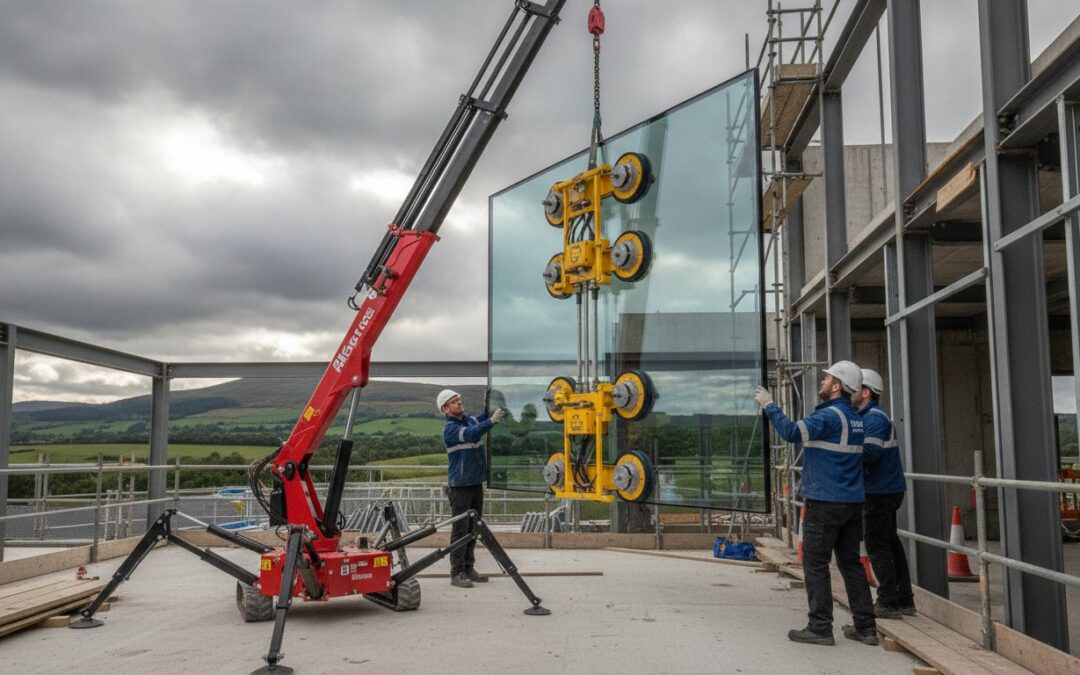
A single hairline fracture in a specialist glass panel can derail your entire project timeline and budget in seconds. Manual handling of heavy glazing or cladding isn’t just risky; it’s often impossible under current HSE and LOLER safety standards. You need precision and mechanical reliability, not just muscle. Securing the right vacuum lifter hire Ayrshire ensures your installation remains safe and compliant, even on the most challenging coastal or rural sites across Scotland.
We understand that site access in Ayrshire often presents unique hurdles. Whether you’re dealing with narrow lanes or restrictive coastal winds, the goal is a seamless, zero-breakage workflow. This guide explains how to select the correct lifting equipment for your specific load requirements while meeting the BS EN 13155:2020 standards. You’ll discover how to integrate vacuum lifters with tracked machinery to overcome difficult terrain and maintain a steady, professional pace on-site.
Key Takeaways
- Learn how to maintain full compliance with LOLER and PUWER regulations while eliminating the risks associated with manual glass handling.
- Find the ideal equipment for your project by understanding Safe Working Load (SWL) and dual-circuit safety features.
- Optimise your workflow with vacuum lifter hire Ayrshire, offering specialised solutions for difficult coastal and rural site access.
- Reduce on-site labour requirements and improve installation precision compared to traditional slinging and manual methods.
- Discover the efficiency gains of combining vacuum lifters with mini spider cranes for complex glazing in restricted spaces.
Professional Vacuum Lifter Hire in Ayrshire: Safe Lifting Solutions
Modern construction projects in South and North Ayrshire have evolved. Large-scale structural glass and heavy composite panels are now standard in both residential and commercial builds. These materials provide stunning aesthetics but present significant logistical challenges. Transitioning from high-risk manual handling to professional vacuum lifter hire Ayrshire isn’t just a safety choice; it’s a productivity requirement. Mechanical lifting ensures that your installation phase remains on schedule and fully compliant with current safety regulations.
The physics behind how vacuum lifters work relies on creating a secure seal that can hold hundreds of kilogrammes with absolute precision. This technology is vital when handling expensive materials such as:
- Structural glazing units and curtain walling.
- Insulated composite cladding panels.
- Large-format polished stone or metal sheets.
- Bespoke architectural glass for coastal renovations.
Why Manual Handling is a Risk for Glass
Manual glass carrying is a leading cause of site injuries and costly breakages. The physical strain on installers is immense, especially when navigating uneven ground or scaffolding. A single moment of fatigue or a sudden gust of wind can result in a dropped pane. The financial consequences are often double-edged. You lose the material cost and face a stalled project while waiting weeks for a bespoke replacement. Vacuum lifters eliminate these variables. They offer a stable, mechanical grip that remains consistent throughout the day, regardless of worker fatigue.
The Benefits of Local Hire in Scotland
Hiring locally in Scotland offers more than just convenience. It provides a direct link to experts who understand the local landscape. Whether you’re working on a coastal renovation in Prestwick or a new-build unit in Glasgow, local knowledge matters. We provide flexible terms that suit the unpredictable nature of Scottish weather. Our association with Structural Glass Design Ltd means we bring industry-leading glass handling knowledge to every hire.
Choosing a local partner reduces transport costs and your project’s carbon footprint. If a technical issue arises, a local specialist can provide rapid support or equipment replacement. This “no-nonsense” approach ensures you aren’t just another account number for a faceless national chain. You get reliable gear and technical support that keeps your Ayrshire project moving forward without unnecessary fuss.
Understanding Vacuum Lifting Equipment: Capacity and Specifications
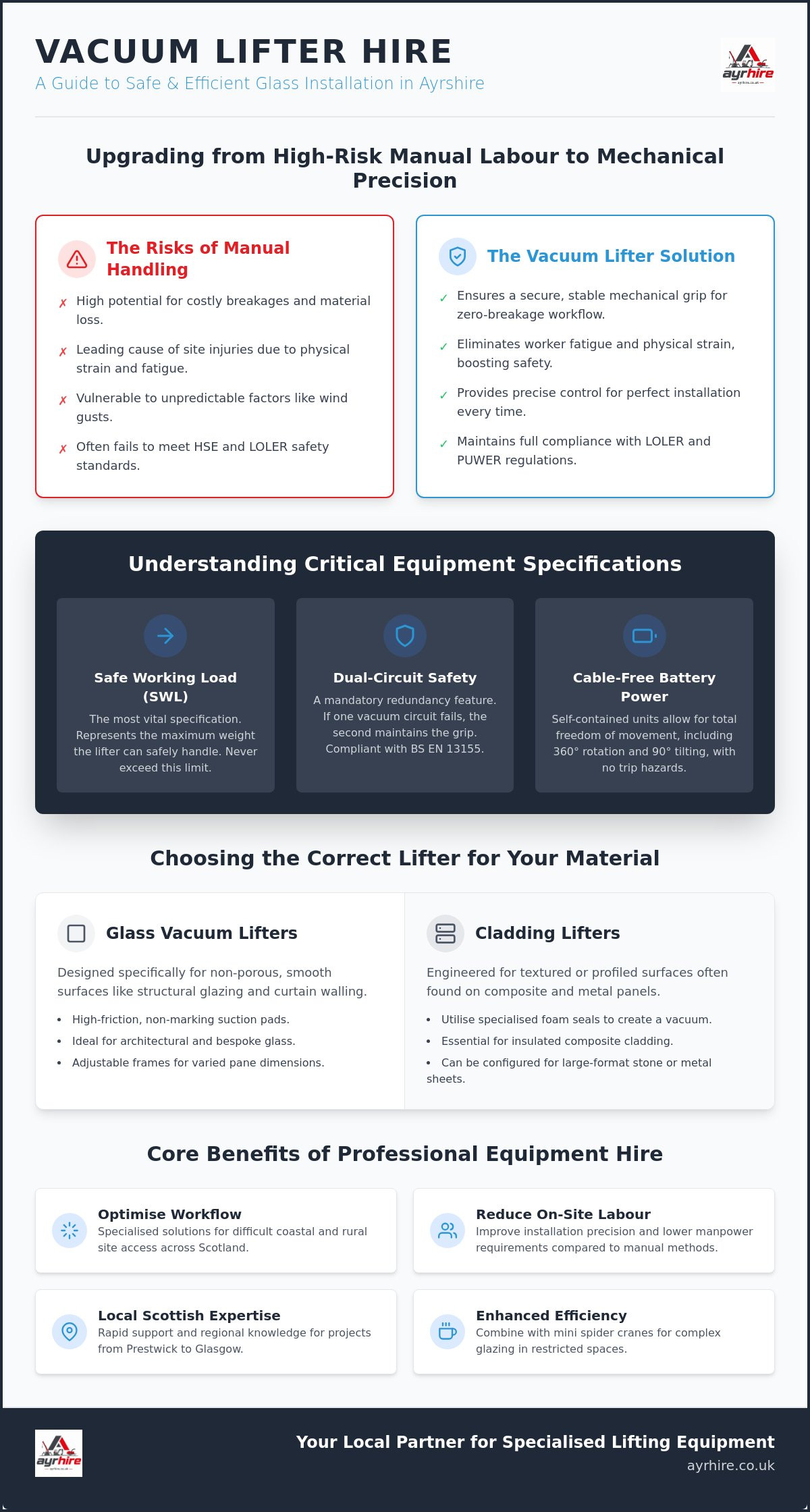
Selecting equipment for vacuum lifter hire Ayrshire begins with one critical number: the Safe Working Load (SWL). This figure represents the maximum weight the machine can safely handle. It’s the most vital specification on any data sheet. Exceeding the SWL isn’t just a technical error; it’s a major safety breach that can lead to catastrophic equipment failure. Modern standards demand dual-circuit vacuum systems for all site work. If one circuit loses pressure, the second maintains the grip. This redundancy is a core requirement of UK lifting safety regulations and BS EN 13155 compliance. It provides the essential fallback needed when suspended loads are positioned over active construction zones.
Battery-powered units have transformed how we operate on unpowered sites. There are no trailing cables to trip over or snag on scaffolding. These units are entirely self-contained. They allow for 360-degree rotation and 90-degree tilting without the restriction of power cords. Using professional vacuum lifter hire Ayrshire allows your team to move panes with total freedom. Adjustable frames and modular suction pads further enhance this flexibility. You can reconfigure the arms to suit the specific width or height of the load, ensuring the centre of gravity remains stable during the lift.
Glass Vacuum Lifters vs. Cladding Lifters
Not all suction pads are equal. Standard glass lifters use high-friction, non-marking pads designed for non-porous, smooth surfaces. Cladding lifters are different. They often require specialised foam seals to grip the textured or profiled surfaces of composite panels. If your project involves curved glass or overhead roof glazing, you need a frame configuration that supports that specific geometry. Choosing the wrong pad type can lead to vacuum loss. If you are unsure which configuration fits your project, our specialist plant hire team can provide expert guidance on the right setup.
Battery Power and Suction Reliability
Modern battery systems are built for endurance. They provide consistent suction for a full working day. Operators monitor safety through integrated vacuum gauges and audible warning systems. If vacuum levels drop below the safe threshold, the alarm triggers immediately. This gives the team sufficient time to lower the load safely. Reliability is paramount when working with slightly dirty or porous surfaces common on busy sites. Regular maintenance and testing ensure these systems never falter whilst under load. This “no-nonsense” reliability is what keeps your Ayrshire site safe and productive.
Comparing Lifting Methods: Why Hire a Vacuum Lifter?
Traditional slinging methods rely on straps, ropes, or chains to secure a load. Whilst effective for bulkier materials, these methods are often unsuitable for architectural glass and composite cladding. Slings create pressure points on the edges of the material. This increases the risk of chips, cracks, or surface scratches. In contrast, vacuum lifter hire Ayrshire provides a non-marring, face-fixed grip. By distributing the weight across multiple suction pads, the equipment ensures the integrity of the pane remains intact throughout the entire lift. It’s a cleaner, more professional approach that eliminates the “guesswork” often associated with manual rigging.
The reduction in labour requirements is immediate. Handling a 300kg structural glass unit manually might require a crew of six or more people. This creates a crowded, high-risk work zone. Using a mechanical lifter often reduces the necessary personnel to just two installers and an operator. This shift significantly lowers your site’s overheads and simplifies logistics. The HSE guidance on vacuum lifter safety emphasises that mechanical aids should be prioritised to reduce the physical burden on workers. By automating the heavy lifting, you allow your skilled tradespeople to focus on the technical aspects of the install. For a broader overview of how precision vacuum lifters and compact tracked machinery work together across complex Scottish projects, our guide to specialist lifting solutions Scotland covers the latest compliance considerations and equipment strategies for 2026.
Speed of Installation on Site
Time is a critical factor on any Ayrshire build. Using manual suction cups is slow and physically draining. Each pane requires significant effort to position and hold. Vacuum lifters allow for rapid, repetitive cycles. You can move from the delivery stillage to the final fixing point in a fraction of the time. This efficiency helps site managers meet tight deadlines, especially on high-profile commercial projects. It also reduces the “fatigue factor.” A tired crew is more likely to make errors. Mechanical lifting keeps the team fresh and focused until the final pane is secured.
Precision and Finishing Quality
Achieving a millimetre-perfect finish is difficult when fighting against the weight of the glass. Vacuum lifters provide the stability needed for fine-tuning. Operators can rotate or tilt the load with precision, ensuring it seats perfectly within the frame. This level of control is essential for complex “under-hook” or “overhang” lifts where access is restricted. It prevents accidental frame damage and ensures the final result meets the highest structural glass design standards. You get a better finish with less effort. It’s a reliable solution for contractors who value quality and efficiency in equal measure.
Site Preparation and Safety Protocols for Ayrshire Projects
Safe installation starts long before the equipment arrives on-site. For professional vacuum lifter hire Ayrshire, site preparation is the foundation of a successful lift. You must conduct a thorough ground assessment to ensure the primary lifting machine, such as a crane or telehandler, has a stable platform. Check for overhead obstructions and establish clear exclusion zones. Every piece of equipment we supply comes with a current LOLER certificate. Under UK law, lifting equipment must undergo a thorough examination at least every 12 months to remain compliant and safe for operation.
Effective communication is non-negotiable on a busy construction site. The glazing team and the crane operator must use standardised hand signals or radio contact. This ensures the load is positioned without sudden movements that could compromise the vacuum seal. If you need assistance planning a complex lift, you can contact our Ayrshire plant hire specialists for technical advice. We help you coordinate the logistics to ensure a “no-nonsense” transition from delivery to installation.
Managing Coastal Winds and Weather Factors
Coastal towns like Ayr, Prestwick, and Troon present unique meteorological challenges. High winds are the primary threat to glazing safety. A large glass pane acts as a sail, catching gusts that can pull the lifting machine off balance or swing the load into the building structure. Even on a clear day, the “sail effect” can create dangerous lateral forces that are difficult to control manually. The maximum recommended wind speed for operating a vacuum lifter is 18mph. Always use a handheld anemometer to monitor conditions at the exact height of the lift, rather than relying on ground-level forecasts.
Access Challenges in Rural and Urban Ayrshire
Navigating narrow access is a common hurdle in historic Ayrshire town centres and remote farmsteads. Site managers must coordinate delivery and collection to avoid blocking busy roads or residential areas. Ground stability is equally critical. Soft verges or unmade tracks in rural locations require outrigger mats to distribute the weight of the primary machine. We specialise in narrow-access solutions, ensuring our equipment reaches the point of work without disrupting the surrounding area. Proper planning prevents delays and ensures the equipment is ready to work the moment it hits the site. For projects requiring high-level access alongside ground-level lifting, our team can also advise on cherry picker hire Dumfries and surrounding regions to complement your overall equipment strategy.
Ayr Hire: Your Local Partner for Specialized Lifting Equipment
Ayr Tracked Plant & Equipment Hire operates with a clear, utilitarian philosophy: provide the right tools for the job without unnecessary complexity. When you choose vacuum lifter hire Ayrshire through us, you’re gaining more than just a piece of machinery. You’re accessing a deep well of technical expertise. Our close association with Structural Glass Design Ltd ensures we understand the nuances of glass handling from a contractor’s perspective. We don’t just supply gear; we provide solutions that have been tested on real-world projects.
National hire chains often rely on distant call centres and rigid logistics. We offer a different experience. As a local specialist, we take personal accountability for every hire. We know the sites in Ayr, Kilmarnock, and beyond. This regional commitment means we’re better equipped to handle the logistical challenges that often stall construction projects. We focus on practical readiness and reliable performance, ensuring our equipment is on-site and ready to work exactly when you need it.
Flexible Rental Terms: Daily and Weekly Hire
Glazing projects vary in scale. A single-pane replacement in a residential property doesn’t require the same hire structure as a commercial curtain wall installation. We offer flexible daily and weekly terms to reflect this. This approach ensures you only pay for the equipment when it’s actively adding value to your site. Our pricing is transparent. You won’t find the hidden surcharges or administrative fees common amongst larger, faceless competitors. Short-term hire provides a cost-effective route for rapid repairs, whilst our weekly rates support larger development timelines.
Integrated Lifting Solutions
The true value of our service lies in the synergy of our fleet. A vacuum lifter is most effective when paired with the right primary lifting machine. We frequently coordinate mini spider crane hire North Ayrshire alongside our lifters to solve complex glazing challenges in restricted spaces. For sites where material transport is difficult, our ALMA multi-loader hire Glasgow provides the necessary mobility across uneven ground. This allows you to move heavy panes from the delivery point to the installation zone with minimal manual effort.
By choosing our specialist plant hire Ayrshire, you streamline your supply chain. You deal with one point of contact for multiple pieces of high-spec machinery. This integrated approach reduces the risk of equipment mismatch and simplifies site coordination. It’s a “get the job done” attitude that prioritises your project’s efficiency. Contact our Ayr-based team today to discuss your project requirements and secure the exact tools needed for a safe, professional installation.
Secure Your Next Installation with Precision
Precision lifting is the standard for modern Ayrshire construction. Mechanical suction eliminates the high-risk variables of manual glass handling. It ensures your project meets BS EN 13155 safety standards whilst keeping your team productive and injury-free. By choosing vacuum lifter hire Ayrshire, you benefit from local technical support and flexible terms that national chains simply can’t match. We understand the specific challenges of Scottish sites and provide the exact specifications required for a successful lift.
Our fleet is designed for the toughest conditions. We specialise in narrow access and integrated solutions, often pairing lifters with our spider cranes to solve complex logistical hurdles. Whether you’re working on a coastal renovation or a large-scale commercial unit, we provide the steady hand your project requires. Our relationship with Structural Glass Design Ltd means you get expert advice backed by years of trade experience. We offer flexible daily or weekly hire to suit your specific timeline.
Contact Ayr Hire today for vacuum lifter availability and rates. We’re ready to support your next project with reliable equipment and a no-nonsense service. Let’s get the job done safely and efficiently.
Frequently Asked Questions
What is the maximum weight a glass vacuum lifter can handle?
The maximum capacity depends entirely on the specific model and the number of suction pads in use. Standard units for architectural glazing typically handle between 320kg and 400kg. High-capacity machines are available for larger structural projects, with some units capable of lifting loads exceeding 1200kg. Always check the Safe Working Load (SWL) stated on the machine’s data plate before you begin any lifting operation.
Do I need a special qualification to operate a hired vacuum lifter?
Operators must be competent and adequately trained to use vacuum lifting equipment safely. Whilst there isn’t a single “vacuum lifter licence,” site managers usually require proof of training or a relevant plant operator qualification, such as CPCS or NPORS. It’s your responsibility to ensure that the person operating the machine understands the controls, safety protocols, and the specific requirements of the dual-circuit system.
Can vacuum lifters be used in the rain or wet weather?
Vacuum lifters shouldn’t be used on wet surfaces or during rainfall. Water acts as a lubricant between the rubber suction pad and the material, which can cause the load to slip even if the gauge shows a high vacuum level. For a secure vacuum lifter hire Ayrshire experience, always ensure the glass or cladding is completely dry and free from debris before attempting to create a seal.
What happens if the power fails whilst the glass is being lifted?
Modern lifters feature dual-circuit technology and non-return valves to prevent immediate vacuum loss during a power failure. These systems include vacuum reserve tanks that hold the load securely for a limited period. If power is lost or vacuum levels drop, an audible alarm sounds immediately. This gives the operator sufficient time to lower the load safely to the ground or a stable platform.
Can I use a vacuum lifter for textured cladding or stone panels?
Yes, but you must use a lifter specifically designed for porous or textured materials. These units utilise specialised foam-seal pads that conform to irregular surfaces, unlike the standard flat pads used for glass. Standard glass lifters won’t maintain a seal on profiled cladding or stone. Always specify the material type when booking your equipment to ensure the correct pad configuration is provided for your site.
How much space is required for a vacuum lifter to operate on-site?
The required operating space is dictated by the dimensions of the load and the reach of the primary lifting machine. You need enough clearance for the lifter to rotate and tilt the pane without striking scaffolding or the building’s structure. On restricted Ayrshire sites, using a compact attachment with a mini spider crane is often the most efficient way to manage narrow-access glazing installations.
Does the hire include the crane or telehandler needed to hook the lifter?
The vacuum lifter is a standalone below-the-hook attachment and doesn’t include the primary lifting machine. You’ll need to provide a suitable crane, telehandler, or loader with the correct lifting capacity. We can provide integrated solutions where the lifter is hired alongside our specialized tracked machinery, ensuring that all components are fully compatible and ready for immediate use on your project.
Are your vacuum lifters LOLER tested and certified?
Every vacuum lifter we supply is LOLER tested and accompanied by a current certificate of thorough examination. UK safety regulations require that lifting accessories are inspected by a competent person every six months. We maintain strict service records to ensure all equipment meets these professional standards. This documentation is essential for site inductions and demonstrates full compliance with national health and safety requirements.