What if the difficulty isn’t lifting a heavy material, but keeping it steady and accurately positioned? Knowing when to use a vacuum lifter for construction starts with the load itself. Its surface, weight and shape all affect whether suction lifting is a practical way to move it with control.
A vacuum lifter isn’t right for every load or site. Surface texture and condition, dust, access, reach and the lifting arrangement all affect suitability. Assess these details when planning the lift and comparing suction lifting with manual handling or another method.
This guide explains which construction tasks and materials may suit a vacuum lifter, what to assess before choosing equipment and how to plan around site conditions. It also compares vacuum lifting with other handling methods to help you make an informed choice. Ayr Tracked Plant & Equipment Hire provides vacuum lifter hire on daily and weekly terms for projects across South Ayrshire, North Ayrshire, East Ayrshire, Dumfries & Galloway and Glasgow.
Key Takeaways
- Learn when to use a vacuum lifter for construction by assessing the load’s surface, shape and handling needs.
- Understand the basic lifting sequence and why equipment instructions and the site lift plan matter.
- Compare vacuum lifting with manual handling, mechanical clamps and crane-based methods to identify which may suit the task.
- Use a practical planning sequence to assess access, the lift route, placement, communication and exclusion areas.
- See how details about the load, site access and programme help shape vacuum lifter hire for projects in South Ayrshire, North Ayrshire, East Ayrshire, Dumfries & Galloway and Glasgow.
When to Use a Vacuum Lifter on a Construction Site
Vacuum lifters use suction to grip and move compatible loads. They can help when a large or awkward construction material needs controlled positioning and is difficult to guide accurately by hand. Don’t judge suitability by appearance alone. The load, contact surface, lifting equipment and site conditions must all suit the planned operation.
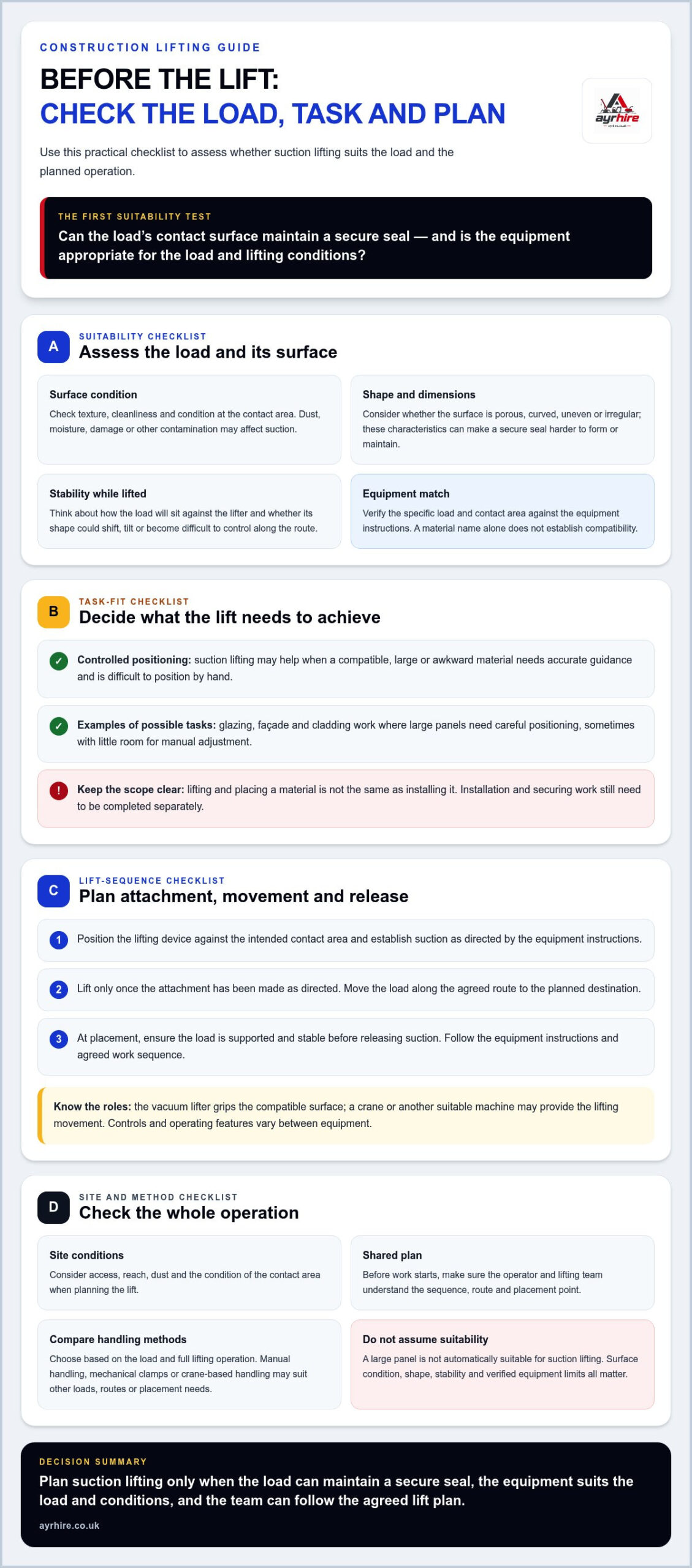
A load is suitable for vacuum lifting only when its surface can maintain a secure seal and the equipment is appropriate for the load and lifting conditions. Use this as the first practical test before planning a lift around suction equipment.
Construction tasks where vacuum lifting can help
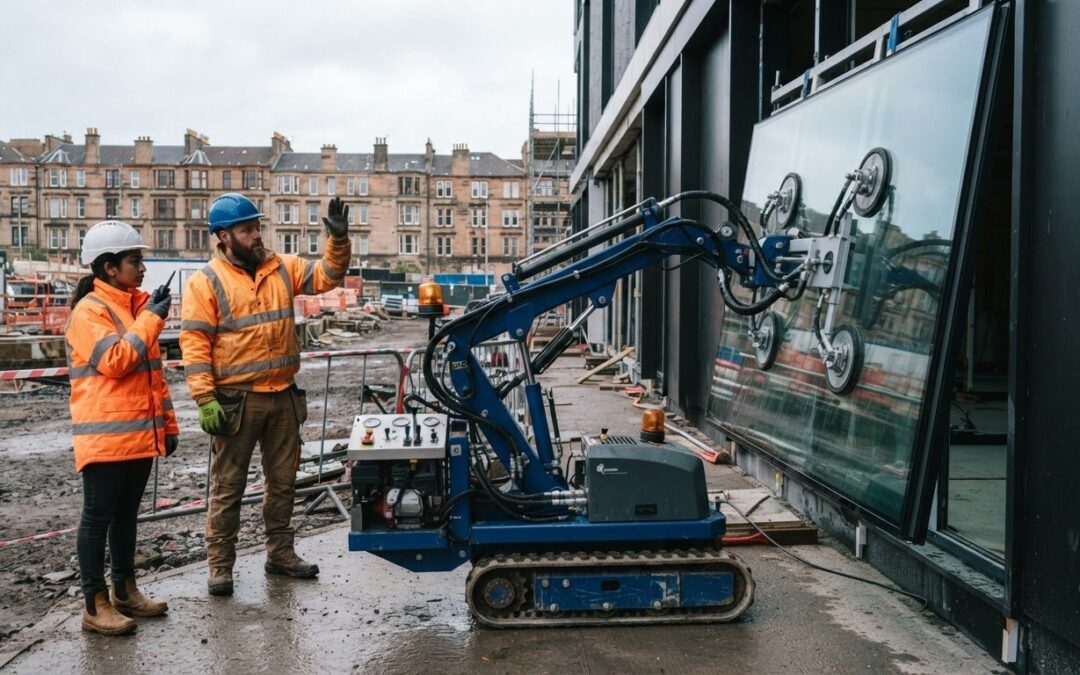
Glazing, façade and cladding work can involve positioning large panels precisely, sometimes with little room to adjust the load by hand. A compatible vacuum lifter can help the team control a panel as it moves towards its intended position. These are examples of tasks that may suit vacuum lifting, not a complete list.
Controlled handling may also help when a load is cumbersome, difficult to grip or awkward to guide manually. However, lifting and placing a material is not the same as installing it. The lifter supports movement and positioning; the planned installation and securing work still needs to be completed separately.
What makes a load suitable for suction lifting?
Assess the material and contact surface before selecting equipment. Consider the surface condition, shape and dimensions, and whether the load is stable when lifted. Check that the equipment suits the specific load and contact area. A material name alone doesn’t establish compatibility, so verify items such as glass or panels against the equipment instructions.
Porous or uneven surfaces can make it harder to form or maintain a seal. Damage, dust, moisture or other contamination at the contact area may also affect suction. Even a surface that looks clean needs to be assessed for its condition and suitability.
Suction works by creating a pressure difference between the cup and the surface. For a simple explanation of how suction cups work, see Wikipedia’s overview. On site, though, the principle is only part of the decision. The load and equipment must be suitable, and site conditions must allow the lift to proceed as planned.
In short, consider when to use a vacuum lifter for construction when a compatible load needs controlled movement or positioning and other handling options make that task difficult. Next, assess how the lifter will attach to the load and how the lift will be carried out.
How a Construction Vacuum Lifter Handles a Load
Understanding the basic sequence helps show when to use a vacuum lifter for construction and how it fits into a planned lift. The vacuum lifting device attaches to the load; a crane or another suitable machine may provide the lifting movement. These have different roles: the carrier supports and moves the device, while the lifter grips the compatible surface.
From attachment to placement: the basic lifting sequence
The operator positions the lifting device against the intended contact area, then establishes suction in accordance with the equipment instructions. The load is lifted only once the attachment has been made as directed. It can then be moved along the agreed route and positioned at the planned destination.
At the placement point, the load must be supported and stable before the operator releases the suction. Release should follow the equipment instructions and the agreed work sequence. It isn’t simply an automatic final step: the team needs to know when the load is secure and safe to detach from the lifter.
Controls and operating features vary between equipment. Don’t assume every vacuum lifter attaches, signals or releases in the same way. Operators should follow the instructions for the specific equipment and the site lift plan. The HSE guidance on safe operating procedures is a useful reference when planning safe use.
Why surface condition and load stability matter
A secure attachment depends on the contact between the device and the load. Surface texture, cleanliness and shape all matter. Dust or other contamination may interfere with the seal, while a curved, uneven or irregular surface may not suit the lifting device. Assess the actual load rather than assuming suitability from its general material type.
Stability matters throughout the lift, not just when the device attaches. Consider how the load will sit against the lifter, whether its shape could shift as it moves, and how it will behave along the planned route. If it tilts, moves unexpectedly or becomes difficult to control, the planned lift may no longer be suitable. Follow the equipment instructions and site arrangements rather than relying on a general capacity or performance assumption.
Before work starts, make sure the operator and lifting team understand the sequence, route and placement point. For defined construction tasks, Ayr Hire provides vacuum lifter hire on daily and weekly terms.
Vacuum Lifter or Another Construction Handling Method?
The right handling method depends on the load and the full lifting operation, not preference alone. A vacuum lifter may suit a compatible surface and a task requiring controlled positioning. Manual handling, mechanical clamps or crane-based handling may be more appropriate for other loads, access routes or placement needs. A large panel isn’t automatically suitable for suction lifting: surface condition, shape, stability and the equipment’s verified limits all matter.
| Method | Load or surface fit | Access | Control needs | Limitations |
|---|---|---|---|---|
| Manual handling | Smaller, manageable loads that can be gripped safely | Useful where equipment access is restricted | Team coordination and a clear handling plan | Awkward dimensions or precise positioning can make handling difficult |
| Vacuum lifter | Loads with a compatible contact surface and stable shape | Depends on the carrier, route and space to position the load | Follow equipment instructions and the agreed lift plan | Surface suitability and equipment capacity must be verified |
| Mechanical clamps | Loads with suitable edges or gripping points | Depends on clamp design and room to engage the load | Correct engagement and controlled movement are essential | May not suit loads without compatible gripping points; limits need verification |
| Crane-based handling | Loads suited to the selected lifting arrangement and attachment | Depends on reach, setup space and the planned route | Requires a coordinated lifting operation | Capacity, reach and attachment suitability must be verified for the task |
When vacuum lifting may be preferable to manual handling
Consider suction lifting when a load’s dimensions, weight distribution or required placement make direct handling difficult. Mechanical assistance can reduce direct manual handling, but it doesn’t remove every handling task or site risk. The operator and team still need to plan the lift and use the equipment appropriately. The HSE vacuum lifting guidance can inform that planning.
When another lifting method may fit the task better
Reassess the method if the surface can’t support a secure attachment, the load’s shape creates instability or site access prevents the planned movement. Clamps depend on suitable gripping points; crane-based handling depends on the complete lifting arrangement. Compare the load, access, travel path and final placement together when choosing a method.
Use the equipment instructions and verified specifications to establish capacity and method limits. Ayr Hire provides vacuum lifter hire for defined lifting tasks.
What to Check Before Using a Vacuum Lifter on Site
A sound lift plan starts with the load and the job, not with a machine choice. Check the load and its contact surface first, because equipment can only be selected once you know what it must lift and where it must travel. Work through these checks to identify practical requirements before the lift begins.
Plan the load, route and landing point
- Assess the load. Record its material, dimensions, condition and intended orientation. Note the surface where the lifter will attach, including unevenness, damage or contamination. Use the equipment instructions to establish compatibility and permitted limits rather than relying on appearance or assumptions.
- Check access. Consider how the lifting equipment will reach the load and whether there’s enough room to position it. Account for constraints that could affect setup or movement, such as narrow openings, restricted working space or changing ground conditions.
- Map the lift route. Identify obstructions, overhead hazards and the route the load will follow. Consider whether people, other work or site traffic could enter the area during the lift, and resolve conflicts before lifting starts.
- Agree the landing point. Confirm where the load will be placed, its required orientation and how it will be supported on arrival. Prepare the landing area and work sequence so the load isn’t left suspended while the team gets ready.
Prepare the team and control site risks
Decide who will operate the equipment, direct the lift and observe the route under the project’s arrangements. Agree how instructions will be passed between team members and what signal or action will pause the operation if visibility or communication is lost. Set suitable exclusion controls and keep people clear of suspended loads. Mechanical assistance doesn’t remove the need for coordinated work or attention to site risks.
Before use, read the instructions for the specific lifting equipment and follow the site lift plan. For further planning context, consult the HSE guidance on vacuum lifting equipment. Requirements can depend on the equipment and operation, so use current official guidance for regulatory detail rather than relying on a general checklist.
Bring these checks together before choosing or positioning equipment. If the load, access, route or placement changes, pause and review the plan rather than proceeding on assumptions. For a defined construction task, Ayr Hire provides vacuum lifter hire, with equipment planning centred on the load and site requirements.
Arrange Vacuum Lifter Hire for Your Construction Project
Once you’ve assessed whether suction lifting suits the task, gather the practical details that will shape equipment planning. A clear picture of the load, site and programme helps match vacuum lifter hire to the work rather than treating the equipment as a one-size-fits-all solution.
Project details to prepare for a hire enquiry
Before discussing the hire, bring together the key information about the lift:
- The load: Note the material, dimensions, approximate weight, surface condition and intended orientation. Include any features that could affect where the lifting device can make contact.
- The site: Describe access to the load and working area, including restricted spaces or other constraints around positioning the lifting equipment.
- The lift: Explain the planned route, any obstacles and the final placement point. Include relevant site arrangements that could affect how the task is carried out.
- The programme: Share when the task is scheduled and how long the equipment is expected to be needed. This helps frame the hire around the project plan.
These details make the discussion about suitability and planning more useful. Equipment selection still needs to follow the instructions and verified specifications for the load and lifting operation.
Local vacuum lifter hire across Ayrshire and beyond
Ayr Hire provides vacuum lifter hire for construction projects across South Ayrshire, North Ayrshire, East Ayrshire, Dumfries & Galloway and Glasgow. Daily and weekly hire terms are available, providing access to specialist lifting equipment for a defined task.
If you’re weighing up when to use a vacuum lifter for construction, bring together details of the load, surface, access and programme first. This gives equipment planning a clear starting point and keeps it connected to the conditions on site.
Find out about vacuum lifter hire from Ayr Hire for your construction project.
Plan Your Next Lift with Confidence
Knowing when to use a vacuum lifter for construction comes down to matching a compatible load and surface with suitable equipment and site conditions. Check the load, access, route and landing point before selecting a lifting method. Compare suction lifting with manual handling, clamps or crane-based handling based on the task, not assumption.
A well-planned lift also depends on clear communication, appropriate site controls and following the equipment instructions. These checks help your team make an informed choice and prepare for controlled material handling.
Ayr Hire provides vacuum lifter hire across South Ayrshire, North Ayrshire, East Ayrshire, Dumfries & Galloway and Glasgow, on daily and weekly terms. Share details about your load, surface, access and programme to plan equipment for the task.
Discuss vacuum lifter hire for your construction project with Ayr Hire.
Frequently Asked Questions
When should you use a vacuum lifter on a construction site?
Use one when a compatible load needs controlled lifting and positioning, particularly if its size or shape makes direct manual handling awkward. Deciding when to use a vacuum lifter for construction means considering the load’s surface, condition and stability, as well as equipment suitability and site access. Glazing, façade and cladding work may involve suitable panels, but don’t assume a material or task is compatible without checking the equipment instructions.
Can a vacuum lifter handle every type of glass or panel?
No. Glass or panel type alone doesn’t establish suitability. The surface must allow the lifting device to attach securely, and the load’s dimensions, condition, shape and stability must suit the equipment. Texture, damage, dust or other contamination can affect attachment. Check the instructions and verified specifications for the specific equipment against the actual load before planning the lift. Don’t assume that a lifter suitable for one panel will suit another.
Is a vacuum lifter safer than manual handling?
A vacuum lifter can reduce direct manual handling and help with controlled positioning, but it isn’t automatically safer in every situation. The load, attachment surface, equipment, route and site conditions all affect the risks. Mechanical assistance still needs appropriate planning, communication and operation. Follow the site lift plan and equipment instructions, and make sure the team understands its roles and how the load will be moved and placed.
What should you check before using a vacuum lifter?
Assess the load’s material, dimensions, condition, surface and stability, then check that the specific equipment is suitable. Plan access, the lift route, overhead clearance and the landing point. Agree the work sequence, team roles and communication, and set appropriate controls to keep people clear of the lifting area. Read the equipment instructions and consult current HSE vacuum-lifting guidance as part of planning the operation.
Can a vacuum lifter be used with a crane?
Yes, a vacuum lifting device may be used with a crane if the complete arrangement suits the planned lift. The lifter attaches to the load; the crane provides the lifting movement. Check compatibility between the equipment and the load, along with the crane arrangement, access, route and placement plan. Follow the relevant equipment instructions and site lift plan. Don’t assume every vacuum lifter can be used with every crane.
When is a vacuum lifter not the right choice?
Reassess the method if the surface can’t maintain a secure attachment, the load is unstable, or its shape or condition isn’t suitable for the equipment. Site constraints may also make it impractical to position or move the load as planned. In those cases, compare another handling method against the load, access, route and final placement. Base the decision on verified equipment specifications, not the load’s size alone.
Where can I hire a vacuum lifter in Ayrshire?
Ayr Hire provides vacuum lifter hire across South Ayrshire, North Ayrshire and East Ayrshire, as well as Dumfries & Galloway and Glasgow. Daily and weekly hire terms are available. For a useful project discussion, prepare details of the load, contact surface, access, lift route and programme. These help shape equipment planning around the task and site conditions rather than assumptions about what the lifter can handle.