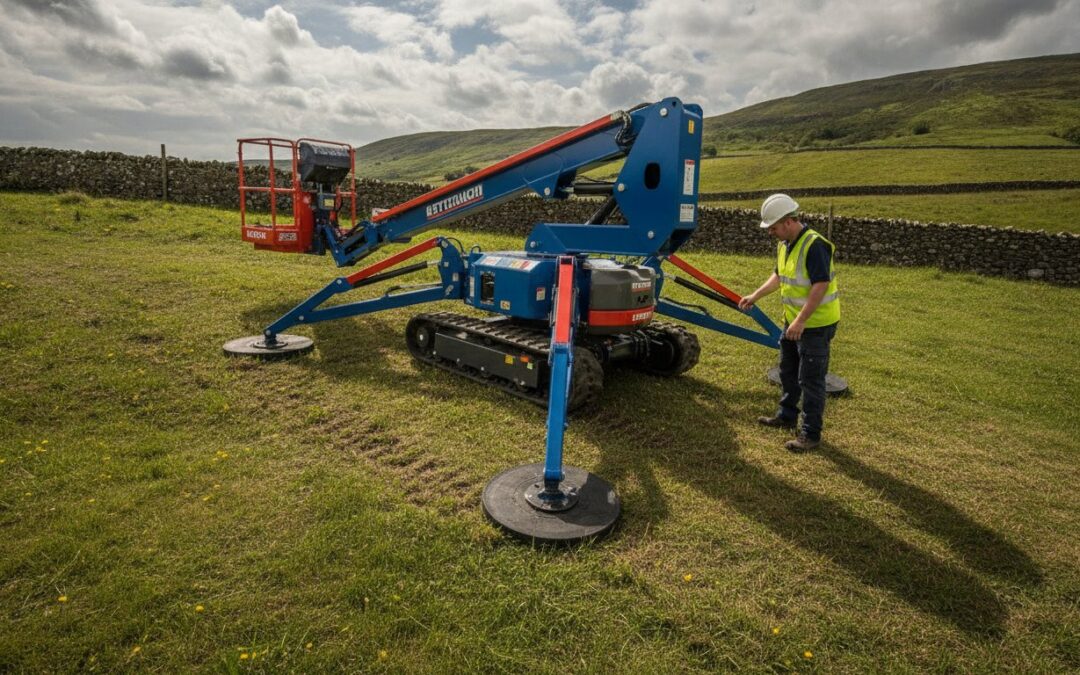
A single degree of tilt is often the only thing standing between a productive afternoon and a catastrophic site accident. If you’ve ever felt the machine shift whilst working on a slope, you know that fear. It’s a justified concern. In the 2024/2025 reporting year, falls from height accounted for 35 worker fatalities in Great Britain. When you’re operating a cherry picker on uneven ground, the margin for error is razor-thin. Precision isn’t just a preference; it’s a legal and physical necessity.
You likely understand that stability is your top priority, yet ground bearing capacity and gradeability ratings can still feel like a guessing game. We’re here to change that. This guide provides the technical clarity you need to master safety protocols and equipment selection for soft or sloping terrain. You’ll learn how to use outriggers correctly, interpret the latest EN 280:2026 standards, and identify whether a trailer-mounted unit or tracked machinery is the best fit for your specific site. We’ll cover everything from slope limits to the essential stability checks required to keep your project moving safely.
Key Takeaways
- Learn how to distinguish between climbing gradeability and safe operational limits whilst identifying common Scottish ground hazards like peat or soft clay.
- Discover why trailer-mounted cherry pickers or tracked spider lifts are the superior choices for managing stability on steep inclines.
- Master the correct outrigger deployment sequence and positioning tactics required for safely operating a cherry picker on uneven ground.
- Understand how tilted terrain impacts your Safe Working Load (SWL) and how to manage boom swing to maintain a stable centre of gravity.
- Access professional guidance on selecting the right machinery for complex site access across Ayrshire, Glasgow, and Dumfries & Galloway.
Assessing Ground Conditions and Slope Gradient
Safe operation starts before the engine turns over. When operating a cherry picker on uneven ground, your first task is a thorough site survey. You aren’t just looking for flat spots; you’re assessing the structural integrity of the earth beneath the wheels. A surface that looks solid can often hide instabilities that lead to machine tilt once the boom is extended.
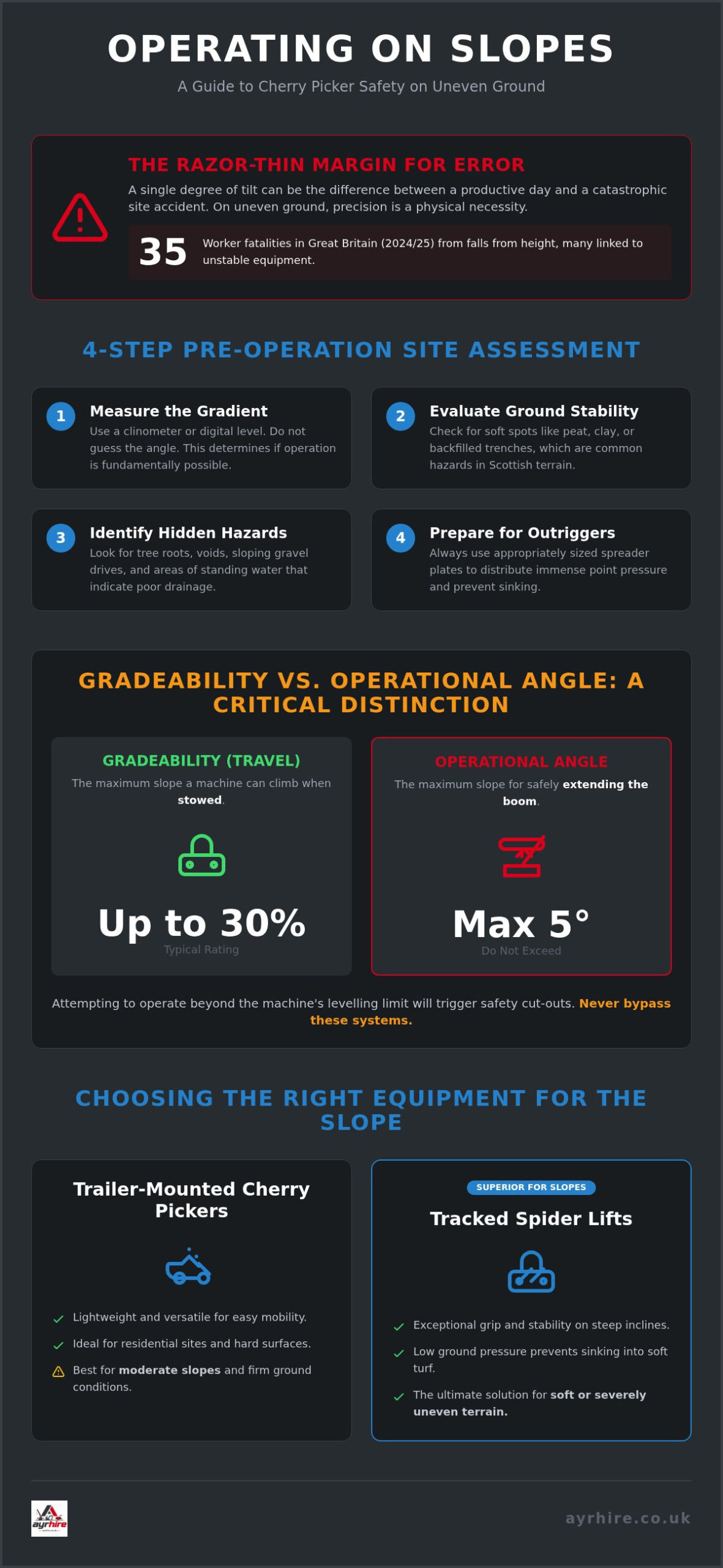
Gradeability is the percentage of rise over run. It’s a technical specification that dictates the steepest incline a machine can handle. However, many operators confuse climbing ability with operational limits. An Aerial work platform (AWP) might be rated to climb a 30% slope, but it likely won’t allow you to deploy the boom on anything over 5 degrees. Understanding this distinction is the difference between a successful job and a site accident.
The Difference Between Travel and Operation Slopes
Gradeability ratings apply only to the machine in its stowed position. Once you attempt to lift the basket, the centre of gravity shifts. If the slope exceeds the hydraulic ram’s stroke, the machine cannot level itself. Don’t attempt to level a machine beyond its mechanical limits; the sensors will usually cut power to the lift functions as a safety precaution. It’s a steady, physical limit you cannot bypass.
Evaluating Local Ground Stability
Scottish terrain presents unique challenges for access equipment. Heavy Ayrshire rain changes ground behaviour overnight, turning firm soil into a soft, unpredictable surface. You must identify “made ground” or recently backfilled trenches. These areas often lack the compaction required to support several tonnes of machinery. In rural sites, look for peat pockets, soft clay, or sub-surface voids that could collapse under load.
Watch for these common site hazards:
- Natural obstacles: Tree roots can create hidden air pockets or uneven leverage points.
- Residential surfaces: Gravel drives and sloping lawns often hide soft subsoil.
- Weather impacts: Standing water indicates poor drainage and low bearing capacity.
Don’t guess the angle of an incline. Use a clinometer or a reliable smartphone app for accurate gradient checks. Once the slope is measured, determine the ground bearing capacity to prevent outrigger sinkage. When operating a cherry picker on uneven ground, always use spreader plates. They’re essential for distributing the massive point pressure exerted by outriggers, ensuring the machine stays level throughout the lift.
Choosing the Right Access Equipment for Slopes
Selecting the correct machine is a logistical decision that dictates your safety margin. Not every platform is designed for an incline. When operating a cherry picker on uneven ground, the drive system and stabilisation method determine whether you can reach the work area safely. You must match the machine’s physical capabilities to the site’s specific gradient and soil type.
Consider these primary machine categories for sloped terrain:
- Trailer-mounted cherry pickers: These are versatile and lightweight. They’re perfect for moderate slopes where towing access is straightforward and ground pressure must be kept low.
- Tracked spider lifts: These provide the ultimate solution for steep inclines. Their wide tracks offer exceptional grip and low ground pressure, preventing the machine from sinking into soft turf.
- 4×4 Rough Terrain (RT) booms: These are built for the deep ruts of a construction site but often lack the precision levelling of outrigger-based machines on extreme angles.
Trailer-Mounted Units vs. Tracked Machinery
Choosing between these two often comes down to the specific site constraints in Glasgow or rural Ayrshire. Trailer-mounted units are highly mobile for local maintenance tasks and easy to position on residential drives. However, if the gradient is severe or the ground is particularly soft, you need specialist plant hire Ayrshire to provide a tracked solution. Tracked machines distribute weight over a larger footprint. This reduces the risk of the machine tilting due to ground compression whilst moving into position.
The Role of Outriggers and Stabilisers
Outriggers are your primary tool for chassis levelling. They compensate for uneven gradients by lifting the wheels or tracks off the ground entirely. This creates a level, solid foundation even on a hill. International guidelines, including OSHA safety standards for aerial lifts, emphasise the necessity of setting brakes and positioning outriggers on solid surfaces or spreader plates when working on inclines.
Modern hire fleets often feature automatic levelling systems. These use sensors to ensure the machine is perfectly horizontal before the boom is allowed to move. Look for “Full-Down” outrigger sensors in your hire specifications. These prevent operation unless all four legs are firmly deployed and carrying the machine’s load. If you’re unsure which unit fits your gradient, you can consult our hire specialists to ensure you have the right tool for the job.
Total machine mass is a critical factor. A heavy machine provides a stable base, but it also increases the point pressure on each outrigger foot. On soft Scottish terrain, a lighter trailer-mounted unit with large spreader plates is often safer than a heavy self-propelled boom that risks sliding. Always balance your required reach height against the ground’s ability to support the machine’s total weight.
Step-by-Step Guide to Setting Up on an Incline
Setting up correctly is the foundation of site safety. When operating a cherry picker on uneven ground, your setup sequence dictates the stability of the entire lift. Start by positioning the machine to face the slope. This orientation often provides the most balanced centre of gravity during the initial stabilisation phase. Avoid positioning the machine sideways across a gradient; this creates lateral stress that outriggers may struggle to compensate for.
- Deployment sequence: Lower the downhill outriggers first to create a firm anchor. Follow with the uphill legs.
- Levelling: Monitor the spirit level or digital display constantly. You must achieve a true 0-degree horizontal plane.
- Ground clearance: Ensure the tyres or tracks are sufficiently clear of the ground as per the manufacturer’s instructions.
Perform a final safety verification. Check each outrigger foot for firm contact. If the ground shows any signs of compression during the levelling process, stop immediately. You may need larger spreader plates or a different positioning strategy to ensure the machine doesn’t shift once the boom is extended. A visual inspection of the hydraulic cylinders for leaks is also a vital final step before uncoupling or starting work.
Correct Use of Spreader Plates
Spreader plates are essential for distributing point pressure. Never set outriggers directly on soil, grass, or tarmac. These surfaces can fail without warning under the weight of a loaded basket. Size your plates based on the machine’s mass and the specific ground conditions. For soft Scottish clay or peat, you’ll need significantly larger footprints to maintain stability. Ensure the outrigger foot is perfectly centred on the plate. An off-centre load can cause the plate to tip or slide, leading to a sudden loss of level.
Chocking and Braking Procedures
For trailer-mounted pickers, the braking system is your first line of defence. Set the handbrake whilst the machine is still coupled to the towing vehicle. This prevents the unit from shifting during unhitching. Heavy-duty wheel chocks are mandatory. Place them on the downhill side of the tyres to prevent any rolling movement. Following NIOSH aerial lift fall prevention standards means checking for hidden hazards like potholes or debris before you commit to a position. This redundancy ensures that if an outrigger loses pressure, the machine remains stationary and secure.
Critical Safety Protocols During Operation
Stability is not a static state. Once you begin moving the boom, the physics of your setup change instantly. When operating a cherry picker on uneven ground, the centre of gravity shifts with every centimetre of extension. You must adhere strictly to the Safe Working Load (SWL) specified for your unit. On an incline, a load that feels secure at a low height can quickly become a tipping hazard as the boom reaches its full lateral extent. Gravity pulls harder on the downhill side, increasing the leverage exerted on your outriggers.
Managing “Boom Swing” is your most frequent challenge. Rotating the basket toward the downhill side of a slope puts maximum stress on the downhill stabilisers. Always operate the controls with a light touch. Jerky movements or sudden stops create dynamic loads. These forces can momentarily exceed the machine’s stability threshold, leading to a structural failure or a tip-over. If the tilt alarm sounds whilst you are elevated, do not panic. Stop all movement. Retract the telescope first, then lower the boom vertically until the alarm ceases. Do not attempt to rotate the basket further until the machine is back in its stowed position.
Wind speed restrictions are even more critical on sloped terrain. A gust of wind provides a lateral force that, when combined with an existing tilt, can easily overcome the machine’s footprint. Most machines have a maximum wind speed rating of 12.5 m/s (roughly 28 mph), but on a slope, you should consider lowering your personal limit. Recognise the “No-Go” zone. If the ground gradient exceeds the manufacturer’s operational limit, the site is unsafe. There is no “workaround” for gravity. If you need a machine capable of handling steeper gradients, view our range of specialist access equipment to find a more suitable model.
Load Distribution and Platform Behaviour
Reaching “down-slope” is fundamentally different from reaching “up-slope.” When you extend the boom downhill, you are moving the weight away from the uphill anchors. This creates a massive amount of pressure on the downhill outrigger feet. Keep your movements slow and deliberate. High-speed adjustments on a tilt can cause the chassis to flex. This flexing may lead to the outriggers shifting on their spreader plates, compromising your entire foundation. Always monitor the ground around the outrigger pads for signs of fresh cracking or sinking whilst the boom is in motion.
Emergency Descent on Uneven Ground
Preparation for a mechanical failure is mandatory. Ensure the ground-based emergency controls are accessible and not blocked by site debris or vehicles. A second person must be present on the ground, and they must be fully trained in the emergency lowering sequence. In the event of a power failure, the priority is returning the boom to a stowed position. On a slope, this usually means retracting and lowering the boom directly onto the chassis. Avoid swinging the boom across the slope to reach the ground, as this rotation could increase the tilt angle during the descent.
Reliable Access Solutions in Ayrshire and Glasgow
Safe access requires more than just high-quality machinery. It demands an understanding of the specific environment. At Ayr Hire, we specialise in providing trailer-mounted cherry pickers designed for the unique challenges of the Scottish landscape. Whether you are working on a residential project in Glasgow or a commercial site in Ayr, we provide the tools necessary for stability and reach. Our fleet is curated for reliability, ensuring you have a steady hand for every task.
Safety is our baseline, not an afterthought. Every machine in our inventory undergoes rigorous LOLER inspections to ensure full compliance with current UK safety standards. We maintain our plant to the highest professional level. This commitment reduces the risk of mechanical failure whilst you are at height. When operating a cherry picker on uneven ground, you need total confidence in your equipment’s hydraulic integrity and sensor accuracy. Our well-maintained units provide that peace of mind.
Local Expertise for South and North Ayrshire
We serve a broad region including Glasgow, Ayr, and the wider South West Scotland area. National suppliers often lack the specific site knowledge required for Dumfries & Galloway’s diverse and often soft terrain. We understand the local soil conditions. This allow us to offer practical advice on machine selection and outrigger deployment. Our specialist lifting solutions Scotland support complex maintenance tasks where standard equipment often fails. We provide direct delivery to your site, ensuring your project stays on schedule without logistical friction.
Supporting Your Next Project
Local hire provides a level of personal accountability that national chains cannot match. We value long-term professional relationships. Our team is ready to help you navigate the technical specifications of our fleet, from gradeability ratings to weight limits. We offer flexible hire terms to suit your schedule. Whether you need a machine for a single day of gutter maintenance or a month-long construction phase, we have a rental plan that fits.
Preparation is the key to site safety. By choosing a local specialist, you gain access to machinery that is ready for the complexities of operating a cherry picker on uneven ground. We provide the spreader plates, technical data, and reliable transport needed for a successful lift. Don’t leave your site safety to chance. Contact Ayr Hire today for expert advice on cherry picker rental and secure the right equipment for your upcoming project.
Secure Your Site with Professional Access
Operating a cherry picker on uneven ground requires a disciplined approach to safety and physics. You’ve learned that stability depends on accurate ground assessment and the correct use of outriggers. Gravity is constant. Your setup must be too. Choosing the right machine is the first step toward a secure site. Whether you require a tracked spider lift for extreme gradients or a trailer-mounted unit for residential maintenance, the physics of the lift remain the same. Precision is your best defence against site accidents.
Ayr Hire provides the specialised plant you need to work with confidence across Ayrshire and Glasgow. We are local specialists committed to your project’s success. Our fleet consists of fully LOLER compliant machinery, ensuring every lift meets the highest professional standards. We offer flexible daily or weekly hire terms to match your specific timeline. We understand the logistical challenges of South West Scotland and provide the exact tools needed to overcome them. Don’t let difficult terrain stall your progress. Trust in reliable equipment and expert local knowledge to get the job done safely.
View our range of trailer-mounted cherry pickers and book your hire today.
Frequently Asked Questions
Can I use a cherry picker on a 10-degree slope?
Generally, the answer is no. Most Mobile Elevating Work Platforms (MEWPs) have a maximum operational tilt limit of between 3 and 5 degrees. A 10-degree slope represents a gradient of roughly 18%, which is far beyond the safe levelling capacity of standard outriggers. Operating a cherry picker on uneven ground requires staying strictly within the manufacturer’s limits. If the incline is too steep, the machine’s safety sensors will prevent the boom from lifting.
What happens if the ground is too soft for the outriggers?
If the ground cannot support the point pressure of an outrigger, the machine will sink or tilt during operation. This is a significant risk on wet Scottish clay or peat. You must use spreader plates to distribute the weight over a larger area. If the outriggers continue to sink despite using plates, you must stop the lift immediately. The site may require a different solution, such as a tracked machine or a lighter trailer-mounted unit.
Do I need a special licence to operate a cherry picker on uneven ground?
In the UK, you need to demonstrate competence through an IPAF PAL card or equivalent training. Whilst there isn’t a specific licence for slopes, standard training covers safe setup on inclines. Employers have a legal duty under PUWER and LOLER 1998 to ensure all operators are properly trained. Hiring from a specialist like Ayr Hire ensures you receive equipment that is fully LOLER compliant and safe for use in Ayrshire or Glasgow.
How do I know if my spreader plates are large enough?
Spreader plate size depends on the machine’s total mass and the ground bearing capacity. A standard professional rule is that the plate should be at least three times the area of the outrigger foot. On soft terrain like garden lawns or gravel drives, you’ll need significantly larger footprints. If you see any indentation into the plate’s surface, or if the soil around the plate is heaving, your plates are too small for the load.
Is it safer to use a tracked cherry picker instead of a trailer-mounted one?
Safety depends on matching the machine to the terrain. Tracked “spider” lifts are superior for steep gradients and soft ground because they distribute weight across a larger surface area. This reduces the risk of sinking into soft turf. However, trailer-mounted cherry pickers are excellent for moderate slopes and residential maintenance where access is narrow. Both are safe if operated within their specific gradeability limits. Ayr Hire specialists can advise on the best fit for your site.
What should I do if the cherry picker tilt alarm goes off?
Stop all movement immediately. The alarm indicates the machine has exceeded its safe horizontal threshold. You must retract the telescope first, then lower the boom vertically until the alarm ceases. Do not attempt to rotate or extend the boom further whilst the alarm is active. Once you are back in the stowed position, you must re-level the machine using the outriggers or relocate to a flatter area before attempting the lift again.
Can I tow a trailer-mounted cherry picker with a standard car?
This depends on the car’s maximum towing capacity and the weight of the specific unit. Most trailer-mounted pickers weigh between 1,200kg and 2,000kg. You must check your vehicle’s handbook and your driving licence categories; many standard cars are not rated for these loads. It’s often safer and more efficient to have Ayr Hire deliver the plant directly to your site in North or South Ayrshire to ensure the machine arrives ready for work.
Are outriggers always necessary on uneven ground?
Yes, if the machine is equipped with them. Outriggers are the only mechanical way to level the chassis on an incline to provide a stable, horizontal base. Attempting to operate a cherry picker on uneven ground without deploying stabilisers is a major safety breach. Even if the ground looks relatively flat, outriggers prevent the machine from rocking or shifting as the boom moves. Always ensure all sensors confirm the outriggers are firmly deployed before elevation.