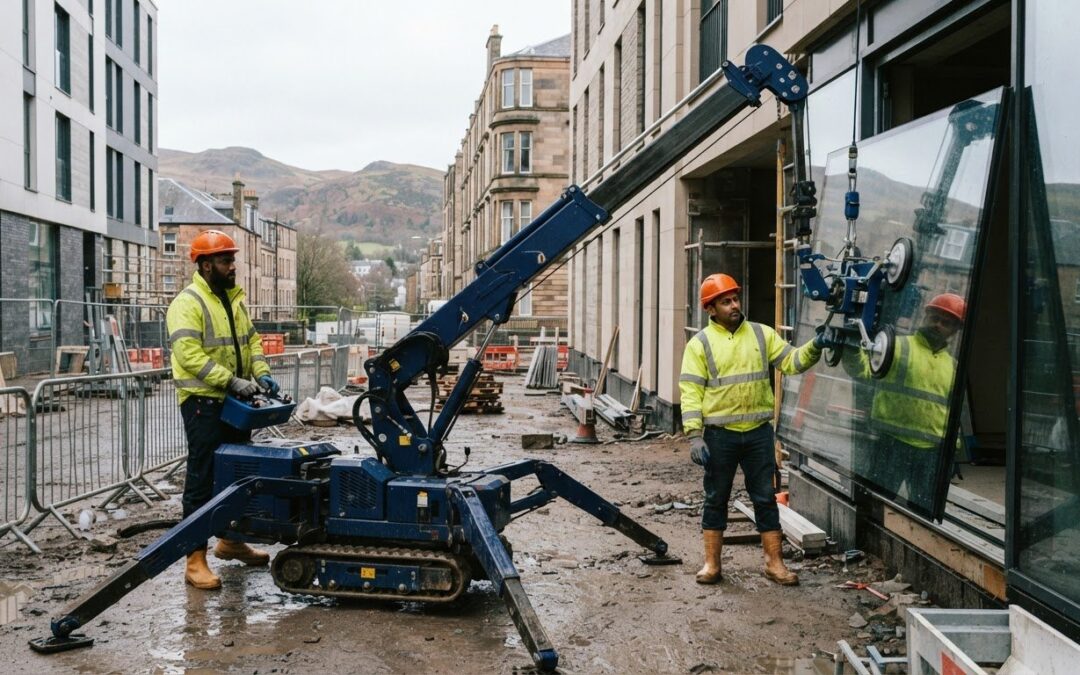
How do you lift large panes of glass safely when a Glasgow site has narrow access, uneven ground and Scottish weather to contend with? Choosing commercial glazing equipment hire Scotland projects can’t rely on lifting capacity alone. The machine must also suit the route in, the working area and the conditions on the day.
Those constraints are familiar to commercial glazing teams. A poor equipment match can complicate delivery, slow installation and increase risk. Careful planning, suitable tracked plant and the right vacuum lifting equipment help you prepare for the job without treating safety as an afterthought.
This guide explains how to assess site access, glass loads and ground conditions, and what to check when comparing equipment and weekly hire terms. It also covers the practical roles of mini spider cranes and vacuum lifters, alongside the LOLER and PUWER requirements that apply to lifting equipment. Ayr Tracked Plant & Equipment Hire brings specialist tracked plant and lifting equipment experience, with insight informed by its connection to a structural glass firm. The aim is straightforward: help you select equipment that fits the site and supports a carefully planned installation.
Key Takeaways
- Match the lifting plan to the glass, working space and ground conditions before choosing equipment.
- See how mini spider cranes and vacuum lifters can work together to handle glass on restricted sites.
- Use a site survey to check access routes, including the narrowest point, before arranging commercial glazing equipment hire Scotland.
- Understand what to check under LOLER and PUWER, including examination requirements for lifting equipment and accessories.
- Learn how Ayr Hire’s glazing industry roots and tracked plant experience can inform equipment choices across Glasgow, Ayrshire and Dumfries & Galloway.
Why Specialised Glazing Equipment is Essential for Scottish Sites
Commercial glass combines considerable weight with a fragile, exposed surface. A pane can be damaged by impact, twisting or uneven support, so moving it calls for controlled handling and accurate positioning. General-purpose plant may have lifting capacity, but that alone doesn’t make it suitable for placing glass close to a façade or through a restricted opening.
Specialist equipment brings the lift and the load together. A mini spider crane can position glass in confined areas, whilst a vacuum lifter holds a suitable pane through suction. The principle behind suction cups is explained in this overview of vacuum lifters. Equipment must still be matched to the glass, lift plan and site conditions. A poor match can increase the risk of breakage, rework and lost time.
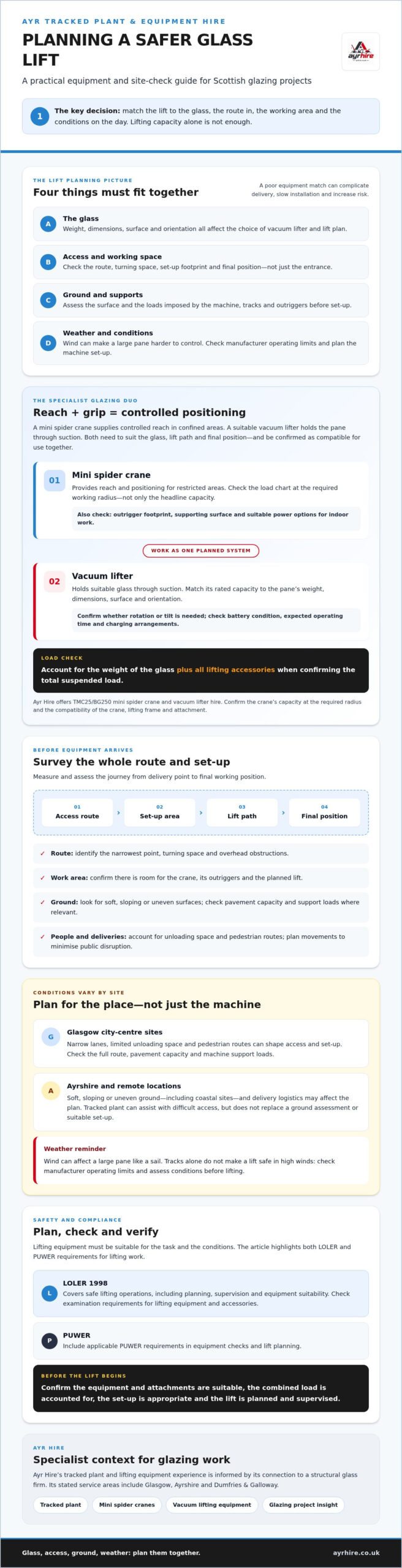
Scottish weather adds another variable. Wind can affect a large pane like a sail, making precise control more difficult. Tracked machinery may help with access over uneven ground, but tracks alone don’t make a lift safe in high winds. Check the equipment manufacturer’s operating limits, assess ground conditions and plan how the machine will be set up before lifting begins.
The Challenges of Urban Glazing in Glasgow
City-centre jobs can mean narrow lanes, limited unloading space and pedestrian routes that need to remain clear. Measure the full access route, not just the entrance: turning space, overhead obstructions and the final working position all matter. Before setting up, check pavement capacity and the load imposed by the machine and its supports. A compact spider crane may suit restricted access, but site-specific checks determine whether it can be positioned safely. Plan deliveries and lifting movements to minimise disruption to the public.
Reliability in Remote Ayrshire Locations
Outside urban centres, the challenge may be soft, sloping or uneven ground, including coastal sites. Tracked plant can assist with difficult access, but it doesn’t replace a ground assessment or suitable machine set-up. Identify the route, working area and any weak surfaces before equipment arrives. Hiring from a specialist serving Ayrshire may help reduce transport distance compared with sourcing equipment from further afield; confirm delivery arrangements and costs when planning. Early coordination helps account for logistical constraints and protect the programme.
For commercial glazing equipment hire Scotland projects, the practical choice is not simply the machine with the highest capacity. Match access, ground conditions, glass handling and weather limits to the planned lift. That’s the foundation for careful installation, fewer avoidable delays and a safer site.
The Core Glazing Duo: Mini Spider Cranes and Vacuum Lifters
A mini spider crane supplies controlled reach; a vacuum lifter grips suitable glass so it can be moved and positioned. Together, they address a key planning question: can the crane, lifting frame and glass-handling attachment work safely as one system? The combination must suit the pane, lift path and final position. Don’t assume that two compatible-looking components are approved for use together.
Ayr Hire offers the TMC25/BG250 mini spider crane and vacuum lifter hire. Before booking, confirm the crane’s capacity at the required radius, the lifting frame and attachment compatibility, and the total suspended load. The lift plan should account for the weight of the glass and all lifting accessories, not just the pane. The Lifting Operations and Lifting Equipment Regulations 1998 (LOLER) set requirements for safe lifting operations, including planning, supervision and equipment suitability.
Mini Spider Crane Specifications for Glaziers
Check the load chart at the working radius, not only the crane’s headline capacity. Confirm the outrigger footprint fits the set-up area, and assess the supporting surface for the loads imposed by the crane and its outriggers. For indoor work, ask which power options are available and suitable for ventilation-sensitive spaces. Don’t assume a particular model or power source fits without confirming its specification and site requirements.
Selecting the Right Vacuum Lifter
Match the lifter’s rated capacity to the pane’s weight, dimensions, surface and orientation. Confirm whether rotating or tilting functions are needed to align the glass accurately, and check that the attachment is suitable for the pane. Ask about battery condition, expected operating time and charging arrangements for the planned shift. If the lift assessment calls for a dual-circuit vacuum system, verify that the selected lifter provides it; don’t treat this feature as universal.
Before work starts, brief the lifting team on the sequence, communication and response to any loss of vacuum or change in conditions. Check the equipment’s instructions and examination records, and make sure the crane and lifter are within their limits throughout the lift. For contractors considering commercial glazing equipment hire Scotland, discussing the crane-and-lifter combination as a complete set-up can prevent a mismatch arriving on site. You can review Ayr Hire’s glazing lifting equipment as part of that planning.
Assessing Site Requirements: Access, Capacity, and Terrain
Choose the plant after surveying the full route and lift area, not from the glass weight alone. Record entrance widths, headroom, turning space, floor transitions and the position where the machine must work. In Glasgow or another busy city centre, check delivery access, pedestrian routes and any restrictions on setting up in the intended lifting area.
Then establish the total suspended load. Include the glass, frame, vacuum lifter and other lifting accessories, and compare that figure with the crane’s capacity at the planned radius. Check the load chart for the actual configuration. Before positioning a crane, identify underground services, basements, voids and other features that could affect the supporting ground. If ground capacity or service locations are unclear, resolve this before the lift.
Narrow Access and Tracked Solutions
Measure the narrowest point on the equipment route, including doorways, gates and corridors. Compare those dimensions with the machine’s transport configuration, and allow for turns and obstructions. The ALMA Crawler Multi-Loader may help move glass across a site, but confirm its load suitability and route requirements. Tracked plant can be useful where ground pressure is a concern; it doesn’t remove the need to assess the surface and loading.
Terrain Challenges in South Ayrshire and Beyond
Slopes, gravel, grass and unfinished ground each affect access and set-up. Check the crane manufacturer’s limits for gradients and levelling, and establish whether the planned surface can support the machine and its outriggers. Don’t assume a spider crane’s levelling capability makes every slope suitable. For a difficult route or soft ground, discuss the specific conditions with a specialist before selecting plant.
For commercial glazing equipment hire Scotland projects, a useful site survey records the access route, working position, ground conditions, service locations and lift configuration. Share those details with the hire provider so the equipment choice can be checked against the job. The Construction Plant-hire Association (CPA) is an industry resource for plant-hire guidance; its information can complement, but not replace, site-specific planning.
Where terrain and access are the main constraints, this guide to specialist tracked machinery hire offers further context on matching niche plant to challenging sites.
Safety Standards and Regulatory Compliance
Safe glazing lifts depend on more than a trained operator. Under the Lifting Operations and Lifting Equipment Regulations 1998 (LOLER), lifting equipment must be suitable for its intended load, marked with its safe working load and thoroughly examined by a competent person. Lifting accessories, often described as lifting tackle, require thorough examination every six months. Other lifting equipment is generally examined every 12 months. Check the examination status of each item, including the vacuum lifter and any accessories used in the lift.
LOLER also requires lifting operations to be planned by a competent person, appropriately supervised and carried out safely. The plan should cover the load, lifting configuration, route, site conditions, roles and communication. PUWER adds wider requirements for work equipment to be suitable, maintained and used by trained people. For spider crane operators, confirm what competence and training are appropriate for the specific machine and work. Don’t assume a particular card scheme alone establishes competence for every lift.
LOLER Inspections and Documentation
Before accepting delivery, check the equipment’s identification, safe working load markings and relevant thorough examination reports. Confirm that the records cover the equipment and accessories you’ll use, and ask the hire provider about any limitations or instructions. Keep a site log of pre-use checks, defects, actions taken and any changes to the lift plan. A daily check doesn’t replace a LOLER thorough examination.
For an overview of equipment and planning considerations, read about specialist lifting solutions in Scotland. For commercial glazing equipment hire Scotland, clarify documentation and responsibilities with the hire provider before the lift begins.
Safe Working Loads (SWL) and Wind Speeds
Never exceed the marked safe working load, even briefly to adjust a pane. Account for the glass, lifter, frame and other suspended accessories, and use the crane’s load chart for the actual radius and set-up. For high-level glazing, monitor wind conditions with a suitable anemometer where required by the lift plan or equipment instructions. Follow the manufacturer’s operating limits and stop if conditions make the lift unsafe.
Plan for problems before lifting: brief the team on emergency lowering arrangements, communication and a site-specific rescue procedure. Make sure everyone knows who can stop the lift and how to raise an alarm. To discuss equipment documentation and lifting requirements, contact Ayr Hire about glazing lifting equipment.
Why Ayr Hire is Scotland’s Choice for Glazing Equipment
Choosing a hire provider is about more than locating a machine. You need equipment that fits the job, clear information about hire terms and a team that understands the practical demands of getting specialist plant to site. Ayr Hire focuses on niche tracked plant and lifting equipment, serving Glasgow, Ayrshire and Dumfries & Galloway.
Ayr Hire is part of Structural Glass Design Ltd. That connection brings a direct link to the structural glass sector and its handling requirements. It informs a specialist approach to glazing equipment, rather than treating a glass lift as a standard materials-handling task. For contractors comparing commercial glazing equipment hire Scotland, this industry context can help frame the right questions about equipment suitability and the job plan.
Local Expertise, Professional Standards
Local knowledge can be useful when planning access, delivery and collection around Scottish site conditions. Share the site address, access limitations, planned hire period and lift requirements early, then confirm transport arrangements and timings with the provider. Ayr Hire offers flexible daily or weekly hire terms, giving project teams options to discuss around the programme. For projects in the area, explore mini spider crane hire in North Ayrshire.
A Comprehensive Glazing Inventory
The confirmed glazing-related options include TMC25/BG250 mini spider cranes and vacuum lifter hire. Ayr Hire also offers a trailer-mounted cherry picker for suitable high-level access tasks. Each machine has a defined role, so confirm availability, suitability, operating requirements and hire terms against the work planned. Don’t assume one item covers every part of an installation.
Before booking, provide the lift details and site constraints, and ask what equipment records and instructions will accompany the hire. Confirm delivery and collection arrangements, too, so they can be considered in the site programme. Equipment condition and documentation should be checked as part of the hiring process; don’t rely on broad claims of readiness without verifying what applies to the specific machine.
For a glazing lift in Glasgow, Ayrshire or Dumfries & Galloway, contact Ayr Hire to discuss your equipment requirements. A clear conversation about the load, access, site conditions and hire duration is a practical starting point for selecting specialist plant.
Plan Your Next Glass Lift with Confidence
A safe, efficient installation starts with a clear match between the site, the glass and the lifting equipment. Survey access and ground conditions before choosing plant, then confirm the crane and vacuum lifter are suitable as a complete lifting arrangement. Keep the lift plan, equipment records and site-specific controls at the centre of the job.
Ayr Hire specialises in tracked plant and glazing lifting equipment, with industry roots through its connection to Structural Glass Design Ltd. For commercial glazing equipment hire Scotland projects, that combination of specialist equipment knowledge and structural glass experience can help you ask the right questions before booking. Confirm the equipment’s current examination documentation and suitability for your planned lift directly with the hire provider.
Share your site access, load details, working conditions and hire period to discuss the options available for your project. Contact Ayr Hire for expert glazing equipment advice and take the next step towards a well-planned installation. With the right preparation and equipment, your team can approach the lift with greater confidence.
Frequently Asked Questions
What is the best equipment for installing glass in a narrow Glasgow shopfront?
A compact mini spider crane paired with a suitable vacuum lifter is often a practical option for a restricted shopfront, subject to the lift plan and site checks. Measure the narrowest access point, turning space and set-up area first. Then check the crane’s load capacity at the required radius, the vacuum lifter’s suitability for the pane and the support surface. Confirm pedestrian access and delivery arrangements before equipment arrives.
Do I need a special licence to operate a mini spider crane in Scotland?
There isn’t enough information to say that one particular licence applies to every mini spider crane operation. The operator must be appropriately trained for the equipment and task, and the lift must be planned and supervised by competent people. Site or employer rules may set additional requirements, including recognised operator training schemes. Check the project’s requirements with the relevant site manager and hire provider before arranging the lift.
How often does glazing lifting equipment need to be LOLER tested?
LOLER requires thorough examinations every six months for lifting accessories and equipment used to lift people, and every 12 months for other lifting equipment, unless a competent person’s examination scheme sets different intervals. The formal requirement is a thorough examination, not simply a “test”. Before use, check the examination report for the specific crane, vacuum lifter and accessories, and confirm that each item is suitable for the planned lift.
Can vacuum lifters be used in the rain on Scottish sites?
Don’t assume a vacuum lifter is suitable for use in rain. Check the manufacturer’s instructions for the specific lifter and assess whether the glass surface and suction pads can achieve and maintain a secure vacuum. Moisture, dirt or other surface conditions may affect grip. Follow the equipment’s operating limits and the lift plan, and pause the operation if the vacuum cannot be confirmed or weather conditions make the lift unsafe.
What is the maximum lifting capacity of a typical mini spider crane?
There’s no single maximum capacity that applies to all mini spider cranes. Capacity depends on the model, boom configuration, working radius and set-up, so the load chart is essential. The total suspended load includes the glass, vacuum lifter, frame and other accessories. For the TMC25/BG250, ask for the relevant load information and check it against the planned lift rather than relying on a headline figure.
Do you provide operators with your commercial glazing equipment hire?
Operator provision isn’t confirmed as part of Ayr Hire’s equipment-hire information, so check this directly when discussing your requirements. Ask whether the hire is equipment-only, what operator competence the site requires, and who will plan and supervise the lift. Ayr Hire serves South Ayrshire, North Ayrshire, East Ayrshire, Glasgow and Dumfries & Galloway. Confirm the equipment, delivery arrangements and any operator requirements for your location.
What happens if the ground is uneven or soft on my site?
Assess the route and crane set-up area before choosing equipment. Soft or uneven ground can affect stability and the support available beneath tracks and outriggers. Share details of slopes, surface materials, voids and known services with the hire provider, then check the machine’s operating instructions and set-up limits. Tracked plant may assist with difficult access, but it doesn’t remove the need to confirm ground suitability for the planned lift.
Can I hire a vacuum lifter for just a single day?
Daily hire terms are available, alongside weekly terms, but confirm that the vacuum lifter suited to your glass and project dates can be hired for a single day. Ask about delivery and collection timing, minimum hire conditions and what equipment documentation is supplied. For commercial glazing equipment hire Scotland, share the pane details, site access and planned lift so the selected lifter can be checked against the job.