
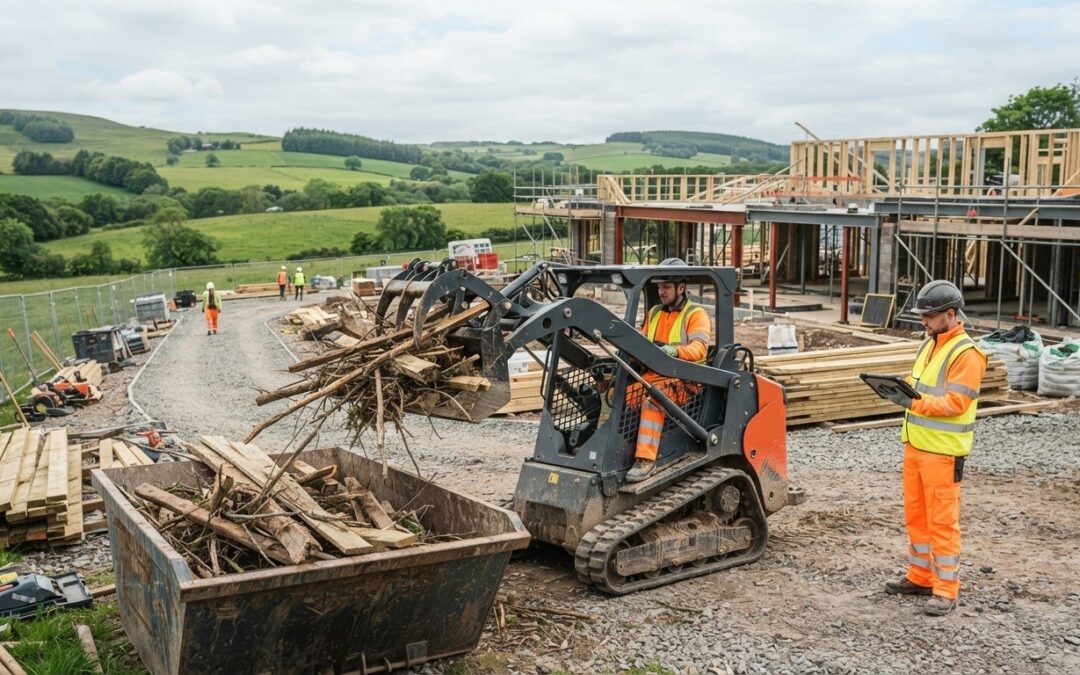
Fewer people carrying out physical tasks on site doesn’t necessarily mean fewer workers overall. Reducing manual labour on construction sites means using technology, machinery and better coordination to handle repetitive work more efficiently. The work and the skills needed may shift to planning, manufacturing, logistics and equipment operation.
It’s understandable to see automation as a way to cut labour, especially when physical tasks slow progress or put pressure on site teams. But the main benefit is often making better use of people’s time, not simply having fewer workers. This article explains how digital tools, modern construction methods and practical equipment can reduce manual tasks, where the work moves instead, and what that means for workforce planning. It also covers the limits: technology can change labour requirements without removing the need for skilled people.
Key Takeaways
- Separate the number of people needed on site from the workforce required across the full construction process when planning labour.
- Match technology and machinery to repetitive or physically demanding tasks, while planning for the skills needed to operate and support them.
- Improve labour efficiency by aligning people’s skills with tasks and coordinating work to limit downtime and trade clashes.
- Factor in early design decisions, sequencing and workforce training when assessing whether a lower-labour method suits a project.
Reduced on-site labour versus overall workforce requirements
Fewer workers on site don’t necessarily mean fewer workers across construction. Hiring adds capacity where the work is happening; technology changes how tasks are delivered. The overall result depends on which activities move off site and what skills the new process requires.
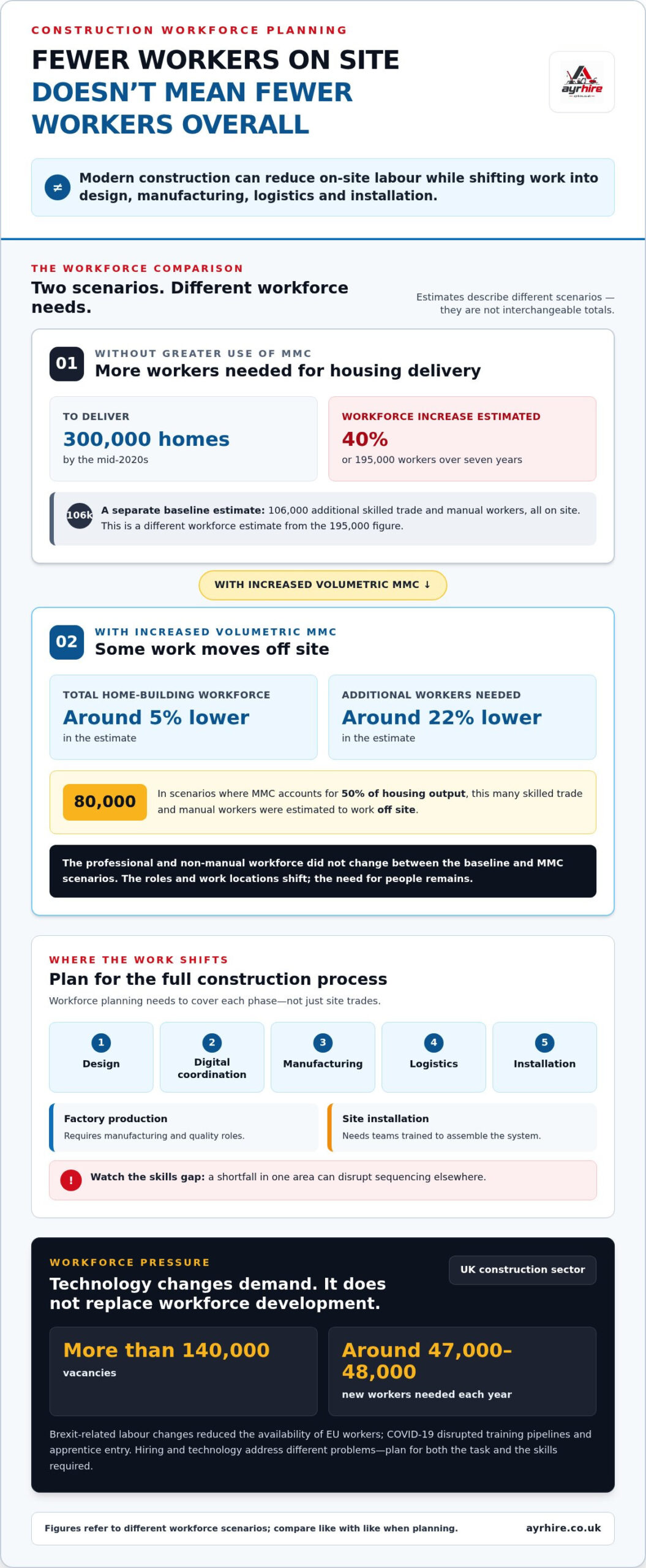
UK housing workforce estimates show the difference. Without greater use of modern methods of construction (MMC), delivering 300,000 homes by the mid-2020s would require a 40% workforce increase, or 195,000 workers over seven years. A separate baseline estimate projected 106,000 additional skilled trade and manual workers, all on site. These figures describe different workforce scenarios, not interchangeable totals.
With increased volumetric MMC, estimates put the total home-building workforce around 5% lower, and the additional workers needed around 22% lower. In scenarios where MMC accounted for 50% of housing output, 80,000 skilled trade and manual workers were estimated to work off site. The professional and non-manual workforce did not change between the baseline and MMC scenarios. Labour shifts towards design, digital coordination, manufacturing, logistics and installation. The construction industry still needs people, but their roles and work locations change.
That shift affects workforce planning. Project teams need to forecast the people and skills required at each phase, including production, transport and assembly, rather than counting site trades alone. For example, factory production requires manufacturing and quality roles, while site installation needs teams trained to assemble the system. A skills gap in one area can disrupt sequencing elsewhere.
Recruitment pressure makes that planning competitive. The UK construction sector has more than 140,000 vacancies, and needs around 47,000 to 48,000 new workers each year. Brexit-related labour changes reduced the availability of EU workers; COVID-19 disrupted training pipelines and apprentice entry. Technology can ease demand for some site tasks, but it doesn’t replace workforce development. Hiring and technology solve different problems, so compare the task, skills gap and delivery model before choosing.
Technology, automation and reducing manual labour
Automation helps when a task is repetitive, physically demanding or slows other trades. Digital schedules, prefabricated components and suitable machinery can reduce hand movements, repeated handling and waiting. On a housing construction project, coordinated deliveries can place materials nearer their point of use. That gives trades more time for skilled installation, rather than moving supplies across the site.
Digital tools support planning as well as physical work. A shared programme can show which work area is ready, which materials have arrived and where delays are forming. For example, a supervisor can compare daily output with planned milestones to spot a task falling behind. Teams can then adjust the sequence before another trade arrives and loses productive time.
Automation doesn’t have to mean a fully automated site. A small UK firm can start by identifying one recurring bottleneck, then trial a suitable tool or hired machine for that task. Compare the time required, operator skills, site access and coordination needs. This targeted approach limits commitment while showing whether the technology improves the project.
Practical equipment can also reduce repeated manual handling. For physical tasks where workers face strain, wearable devices such as industrial exoskeletons offer targeted support, with platforms like Ryggo helping companies match the right equipment to their needs. Similarly, a suitable lifting machine can move materials into position, while tracked plant can reach areas with difficult access. Choosing equipment for the specific task matters: unsuitable machinery can create access challenges or disrupt other trades. Plan its route, operating space and delivery sequence alongside the daily work plan.
A 10-minute morning huddle gives crews time to confirm work zones, deliveries and task order. Pair that discussion with a shared digital schedule, and workers can see changes before they reach the work area. For machinery-led tasks, tracked plant hire for construction work can be one practical option to consider alongside digital coordination.
Prefabrication can save labour time by reducing hand movements, repeated handling and waiting, leaving trades more time for skilled installation.
Labour efficiency versus labour reduction
Efficiency means getting more useful work from the available workforce. Labour reduction means using fewer people for a task. They’re not the same. On a housing project, a machine may move material faster, but workers still need to position it, check it and complete the installation. The gain comes from removing wasted effort, not simply cutting roles.
Start by matching skills to tasks. A trained machine operator can free tradespeople for detailed finishing, while an experienced installer focuses on work requiring specialist knowledge—such as technical static-control surface installations delivered by contractors like Epoxy Solutions™. Assigning people according to their abilities helps avoid errors and keeps production moving. The right method depends on the task, access and materials available at that stage.
Cross-training can also help teams respond to labour shortages. If a crew is waiting for materials, a worker with relevant training may support another suitable task rather than remain idle. For example, someone familiar with site preparation could assist with a related activity while deliveries are delayed. Clear responsibilities matter, so moving people doesn’t cause confusion or leave essential work uncovered.
Measure progress by completed work, not headcount alone. A supervisor can compare planned tasks with actual progress, then identify whether the constraint is labour, equipment, materials or sequencing. If workers are ready but materials haven’t arrived, adding people won’t solve the delay. Reordering tasks or coordinating a delivery may protect deadlines more effectively.
For each construction project, review labour demand across its phases. Identify tasks that need skilled trades, tasks suited to machinery and periods when teams might otherwise wait. This helps managers decide whether to recruit, reallocate workers or change the work method. The aim is a balanced workforce: enough people with the right skills, supported by equipment and planning that reduce avoidable manual effort without disrupting production.
What are the risks and limitations of reducing manual labour on construction sites?
Modern methods of construction require earlier decisions because components are manufactured before site installation. Changes made after production begins can affect specifications, sequencing and delivery arrangements. For example, a late design change may leave factory-made components unsuitable for the planned installation. Project teams need to coordinate design, production and logistics before work starts, rather than relying on site adjustments.
Technology also depends on the right skills and fit with the work system. Digital planning tools only help if teams keep schedules current and share changes with relevant trades. Mechanised equipment needs trained operators and suitable access. If a machine cannot reach the work area, or its operating space conflicts with deliveries, workers may face extra handling instead of less.
Workforce needs can shift rather than disappear. Modern methods of construction may reduce some site-based tasks while increasing demand for production, quality assurance, logistics and installation skills. A skills gap in one role can disrupt the wider process. For instance, a shortage of people trained to assemble a system can hold up installation, even when factory production and transport are ready.
Plan for interruptions before changing a work method. A machine breakdown, delayed component or missed delivery can affect several linked tasks. Keep the programme flexible enough to resequence suitable work, and assign responsibility for reporting problems promptly. Supervisors should compare actual progress with planned milestones and identify whether labour, equipment, materials or coordination caused the hold-up.
Not every task benefits from automation. Detailed finishing, irregular repairs and work in restricted spaces may still require direct trade skills. Assess the task, access route, operating area and operator capability before selecting equipment. For site clearance involving branches and woody material, hire a tracked wood chipper as a practical way to mechanise processing, while planning its route and work area alongside other site activities.
Ayr Tracked Plant & Equipment Hire: FORST TR8 8″ Tracked Wood Chipper
Ayr Tracked Plant & Equipment Hire offers the FORST TR8 8″ Tracked Wood Chipper for site work involving branches and woody material. It can mechanise chipping, helping teams reduce the manual effort involved in processing this material. Consider it when vegetation clearance forms part of the project and the work suits a wood chipper.
Other relevant options include a KUBOTA Mini Excavator / Digger for excavation, an ALMA Crawler Multi-Loader for moving materials, and Vacuum Lifter Hire for lifting work. The right choice depends on the task and site conditions. Matching equipment to the job can help reduce repeated physical handling, while letting skilled workers focus on tasks that need their expertise.
For equipment hire that supports your site plans, contact Ayr Tracked Plant & Equipment Hire or visit ayrhire.co.uk.
Put the right equipment into your next site plan
Choose a specific task before changing how your team works. Identify where repeated handling, difficult access or lifting creates extra effort, then match equipment to the job. This makes reducing manual labour on construction sites a practical planning decision, not simply a target to cut headcount.
For vegetation work, the FORST TR8 8″ Tracked Wood Chipper offers a hire option for processing branches and woody material. Ayr Tracked Plant & Equipment Hire also offers a KUBOTA Mini Excavator / Digger and a TMC25/BG250 Mini Spider Crane. Each answers a different site need, from digging to lifting.
Set out the task, working area and sequence in your project plan, then consider which equipment fits. A clear brief helps connect the site requirement with a suitable hire option.
Contact Ayr Tracked Plant & Equipment Hire to discuss equipment for your project. A well-matched tool can help your team approach the next task with greater clarity and control.
Frequently Asked Questions
What technologies reduce manual labour on construction sites?
Robotics, digital planning tools and mechanical handling equipment can reduce repetitive physical tasks. For example, robotic layout tools can mark positions from a digital plan, while lifting equipment can move materials into place. Prefabrication also shifts some work into controlled production settings. Choose technology based on the task, site layout and operator skills available, rather than adopting automation for its own sake.
How can construction automation and robotics improve productivity?
Automation can make repeated tasks more consistent and free workers to handle work requiring judgement or specialist skills. A robot carrying out repetitive operations, for instance, can keep a task moving while a supervisor checks quality and coordinates the next activity. Productivity still depends on how well the system fits the work sequence: setup, programming, materials and human oversight all affect whether automation reduces interruptions.
What is the cost of construction robots and labour-saving equipment in the UK?
There’s no single useful cost: it depends on the equipment, whether it’s hired or purchased, the hire period and any site-specific arrangements. Ayr Tracked Plant & Equipment Hire focuses on equipment hire, not robot sales. For relevant hire equipment across South Ayrshire, North Ayrshire, East Ayrshire, Dumfries & Galloway and Glasgow, the price depends on the equipment and hire requirements, and is given after a quote request.
What steps should a construction site take to identify and automate labour-intensive tasks?
Start by recording tasks that involve repeated handling, long waits or recurring bottlenecks. Observe the work directly, then identify the cause: the task itself, material supply, access or sequencing. Compare suitable technology against the whole workflow, including setup and operator training. Trial it on a defined work package, review the results with the crew, and adjust the method before wider use.