
The headline hire rate is only part of the contract. For contract plant rental in Scotland, all 76 suppliers in Scotland Excel’s vehicle and plant hire framework agreed to a minimum 12-month fixed-price period from the framework’s commencement. That framework term is not a universal minimum hire period for every project.
For contract plant rental in Scotland, the agreement sets out whether a deposit or advance payment applies, when charges are due and how the hire period is counted. Check the rate alongside its duration and what the hire covers, rather than treating it as a stand-alone figure. This distinction matters when a public framework is involved: its fixed-price period is not necessarily your booking duration. This guide explains payment terms, how to distinguish a framework lot from direct equipment hire, and which job details shape a quote, including the machine required, hire length, site access and delivery. You’ll have a clearer way to compare contract terms and plan equipment around the work.
Key Takeaways
- Read the hire agreement for how deposits, advance payments, hire dates and return arrangements are handled, not just the headline rate.
- Keep a framework’s fixed-price period separate from your project’s hire duration: Scotland Excel’s framework suppliers agreed to a minimum 12-month fixed-price period from its commencement.
- Understand how vehicle and plant hire lots group equipment and services so you can identify the right route for your procurement needs.
- Match the hire request to the job: equipment type, site access and expected hire duration all help shape a practical quote.
Deposits and rent in advance
First, separate residential tenancy rules from plant hire contracts. Scottish tenancy deposit limits do not set deposits for hired machinery. Plant rental agreements have their own payment terms, so read the quote and hire conditions before arranging payment.
For a Scottish residential tenancy, a landlord or letting agent can charge a deposit of up to two months’ rent. The deposit should be registered in a tenancy deposit scheme. This protects the deposit under the applicable rules. It is separate from an advance rent payment.
Landlords in Scotland can ask for up to six months’ rent in advance. In practice, one or two months’ rent in advance is common. These figures concern residential tenancies, not plant hire, so don’t use them to estimate an equipment deposit or rental payment.
For plant hire, check the contract’s payment schedule. Identify whether payment is due before delivery, at the start of the hire or at agreed intervals. Then note any deposit, what it covers and how its return is handled. These terms affect the amount needed before equipment reaches the site.
- Deposit: note the amount, payment date and stated purpose.
- Advance payment: check which hire period the payment covers.
- Return or deductions: read the conditions for returning any deposit.
- Changes: record how extensions or early returns affect charges.
For example, someone hiring a chipper should distinguish a refundable deposit from rent paid before delivery. The agreement should show whether an advance payment covers the first hire period and explain how extra days are charged. Clear wording helps match the payment plan to the job’s expected duration.
Before signing, compare the quote with the contract. Check the equipment description, hire dates, payment timing and any deposit conditions. Keep the agreed terms with the project records so the site team has a clear reference if the schedule changes or the equipment is returned later than planned.
Hire terms and durations
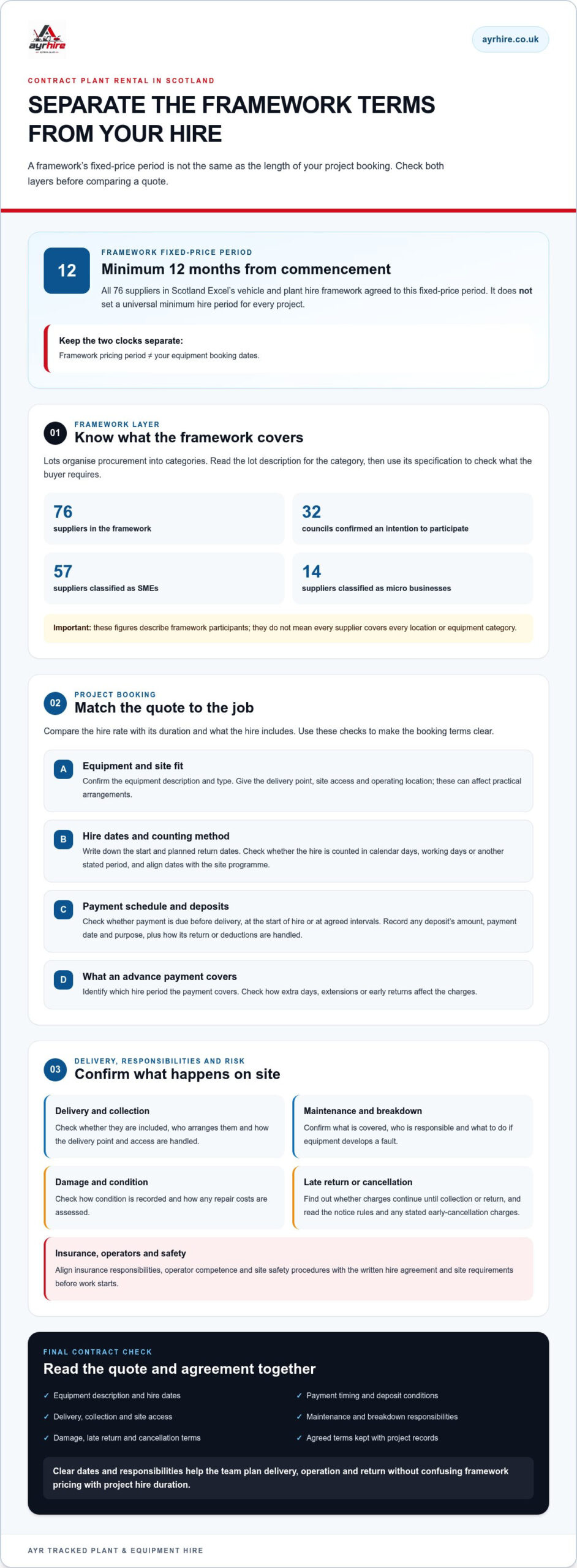
Framework pricing and project hire dates are separate terms. Scotland Excel’s vehicle and plant hire framework had 76 suppliers. All agreed to a minimum 12-month fixed-price period from the framework’s commencement. That framework period does not set the duration of every individual hire.
For a site booking, write down the start date and planned return date. Check whether the agreement counts hire by calendar days, working days or another stated period, then compare the return time with the site programme. A delay to groundworks, for example, may affect how long the plant is needed.
Are delivery, collection, maintenance and breakdown cover included in Scottish plant hire contracts? These services are not automatically included in every agreement. Check which are covered, who arranges them and what happens if equipment develops a fault.
Before signing, compare the quote and contract line by line. Confirm the equipment description, hire dates, payment schedule, delivery and collection arrangements, maintenance responsibilities and breakdown process. Keep a copy of the agreed terms with the project records, giving the site team a clear reference if dates or arrangements change.
- Damage: check how condition is recorded and how repair costs are assessed.
- Late return: identify whether hire charges continue until collection or return.
- Early cancellation: read the notice rules and any stated cancellation charges.
What are the risks and penalties for damage, late return or early cancellation? The contract sets the relevant charges and responsibilities. An unplanned extension may continue hire charges, for example, while damage may lead to repair costs under the agreement.
For a project using tracked plant hire equipment, align the hire dates with the programme and planned site access. Clear dates and responsibilities help the team plan delivery, operation and return without confusion.
Vehicle and plant hire lots
Scotland Excel’s vehicle and plant hire framework uses lots to organise procurement. Each lot groups requirements, helping buyers distinguish between vehicle, plant and associated hire categories. Read the lot description alongside its specification: the description shows the category, while the specification sets out what the buyer needs from suppliers.
According to Scotland Excel, 32 councils confirmed their intention to participate in the framework. It includes 76 suppliers, with 57 classified as SMEs and 14 as micro businesses. These figures describe the framework’s participants. They don’t show that every supplier covers every location or equipment category.
What insurance, operator training and safety requirements apply to hired plant in Scotland? The hire agreement and site requirements set out the relevant insurance responsibilities, operator competence requirements and safety procedures. Before work starts, align the equipment, operator and site arrangements with those written requirements.
Which Scottish regions and locations are covered by plant rental providers? Coverage depends on the supplier, equipment and delivery location. A council’s participation in Scotland Excel’s framework does not by itself define every supplier’s service area. A remote site, restricted access or specific delivery point can affect the practical arrangements.
- Identify the lot: match the procurement category to the equipment or hire need.
- Read the specification: compare required equipment and service details with the lot.
- Map the delivery point: include site address, access and operating location.
- Align responsibilities: record insurance, operator and safety requirements.
For example, a council seeking plant for a site with restricted access should describe that constraint in its requirements. The lot identifies the procurement route; the specification explains the job need. Keeping these distinct helps buyers assess whether a submission addresses both the requested category and practical site conditions.
Framework figures can provide useful context, but the lot and specification guide the decision. For a Scottish procurement, establish the equipment category first, then connect the delivery location, operator arrangements and site requirements to it.
Which plant hire companies offer contract rental in Scotland?
For public-sector buyers, Scotland Excel’s vehicle and plant hire framework provides a contract route. It includes 76 suppliers. The framework is not a single hire company, and its suppliers cover different requirements. Start by identifying the lot that matches your equipment or service need.
Of those 76 suppliers, 57 are classified as SMEs. Fourteen are classified as micro businesses. These figures show the framework includes suppliers of different sizes. They don’t identify which supplier handles a particular machine, site or contract requirement.
For a specific hire, compare the supplier’s response with the procurement specification. Check the equipment category, required hire period, delivery location and site access, then consider how the proposed terms fit the project schedule. A supplier may meet the equipment requirement but not the delivery arrangements.
Use this process to narrow the options:
- Define the requirement: name the plant type and intended work.
- Match the lot: connect the requirement to the relevant framework category.
- Set site details: include the delivery address and access constraints.
- Compare responses: assess whether each submission answers the specification.
For example, a project needing tracked plant for a restricted-access site should describe both requirements. The equipment category helps identify the relevant lot, while the access details help suppliers assess delivery and site requirements. Clear specifications make responses easier to compare.
Private contractors can assess plant hire companies by comparing the equipment and contract terms offered for their job. Set out the machine required, expected dates, location and operating conditions, then compare each response against the same points. This keeps the decision focused on project fit rather than supplier size alone.
Scotland Excel’s framework is one defined procurement route, with 76 participating suppliers. For any contract, use the lot or equipment category to create a shortlist, then compare each supplier’s response against the site requirements and written specification.
Ayr Tracked Plant & Equipment Hire: FORST TR8 8″ Tracked Wood Chipper
Ayr Tracked Plant & Equipment Hire offers the FORST TR8 8″ Tracked Wood Chipper for projects requiring tracked wood-chipping equipment. It’s a practical next step when your work calls for a chipper rather than a general plant hire contract.
For other defined site tasks, hire options include a KUBOTA Mini Excavator / Digger, ALMA Crawler Multi-Loader and Vacuum Lifter Hire. Match the equipment to the job, site access and planned hire period. Set out those details when arranging your rental so the equipment and contract terms suit the work.
To discuss equipment for your project, contact Ayr Tracked Plant & Equipment Hire.
Set up your next hire decision
Before arranging contract plant rental in Scotland, turn the project need into a concise equipment brief. Describe the task and the result the crew needs to achieve, then identify the machine role that supports it. Lifting, access and material movement are distinct requirements, so naming the job helps focus the equipment choice.
If the work involves lifting, Ayr Tracked Plant & Equipment Hire offers the TMC25/BG250 compact crawler crane. Include the intended use and site conditions in your request. This gives the hire discussion a practical starting point and connects the machine to the work ahead.
With the requirement set out, take the next step and discuss your project directly. Contact Ayr Tracked Plant & Equipment Hire to talk through the equipment needed. A clear brief helps you move forward with purpose and plan the next stage of work.
Frequently Asked Questions
What does contract plant rental mean in Scotland?
Contract plant rental in Scotland means hiring machinery under agreed terms for a project or ongoing work. The agreement sets out the equipment, hire dates, payment arrangements and responsibilities. For example, a contractor might hire a tracked carrier for a defined site task instead of acquiring equipment. “Contract” describes the agreed arrangement; it does not automatically mean a fixed minimum hire period.
What types of construction plant and machinery are available on contract hire in Scotland?
Options include wood chippers, mini excavators, tracked multi-loaders, spider cranes, vacuum lifters and trailer-mounted cherry pickers. Ayr Tracked Plant & Equipment Hire offers specialist equipment hire across South Ayrshire, North Ayrshire, East Ayrshire, Dumfries & Galloway and Glasgow. Match the equipment category to the task, such as chipping, digging, moving loads or lifting materials, then describe the site requirements.
What are typical minimum hire periods and contract terms for plant rental in Scotland?
There isn’t one minimum hire period for every Scottish plant rental. In Scotland Excel’s vehicle and plant hire framework, all suppliers agreed to a minimum 12-month fixed-price period from the framework’s commencement. That commitment concerns framework pricing, not the duration of each customer’s hire. For an individual booking, the agreed start and return dates and extension terms define the hire period.
How do contract plant rental, short-term hire and leasing compare in Scotland?
Contract plant rental is equipment hire governed by agreed terms. Short-term hire is arranged for a brief project need, with booking dates set out in the agreement. Leasing generally describes a longer-term arrangement with its own payment and end-of-term conditions. Compare the written obligations, duration and return arrangements rather than relying on the label alone to understand what each option involves.