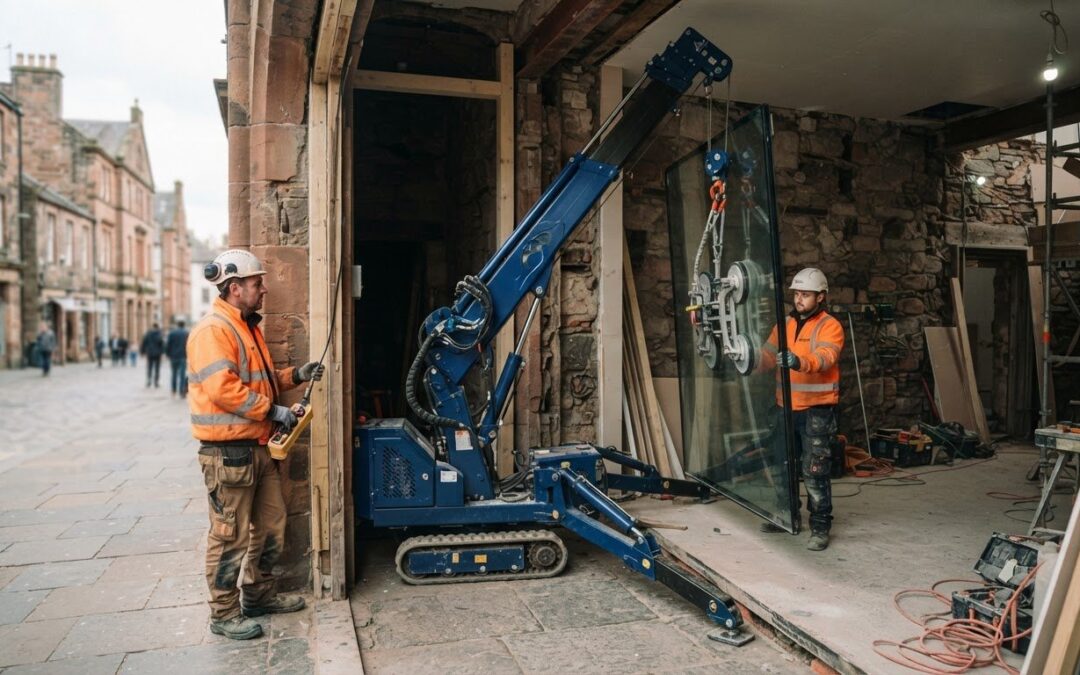
The tightest access point can determine which lift is possible. Choosing lifting equipment for restricted areas in Dumfries means matching the machine to the doorway, route, working space and load. For complex lifting, a compact crane may suit a site where a larger machine cannot reach or manoeuvre.
Restricted access can make a straightforward job harder to plan. You need equipment that can reach the work area and carry out the lift within the available space.
This guide explains the factors that shape the choice, from narrow aisles and doorways to construction, industrial and maintenance work. It also outlines crane hire and lifting responsibilities, helping you assess which options may suit your site and what to consider before arranging equipment.
Key Takeaways
- Match equipment to the full access route, including doorways, aisle width and room to manoeuvre.
- Compare compact lifting options by their working space, reach and load requirements before choosing a machine.
- Understand how the Lifting Operations and Lifting Equipment Regulations 1998 govern thorough examinations, according to The National Archives.
- See how tracked equipment and vacuum lifter hire from Ayr Tracked Plant & Equipment Hire can support demanding access and handling tasks.
Crane hire and contract lifting in Dumfries
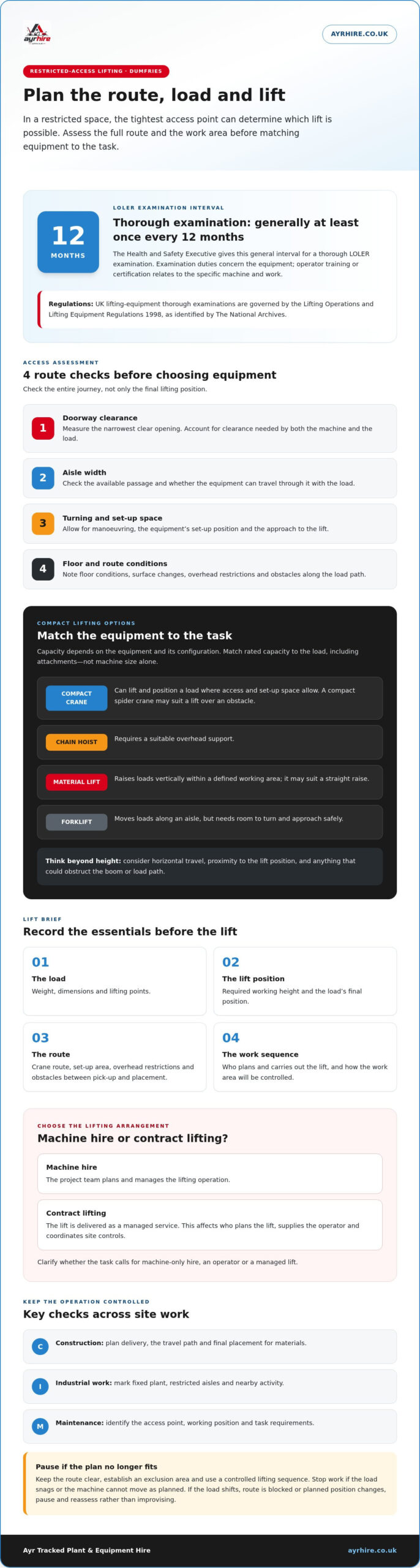
UK lifting-equipment thorough examinations are governed by the Lifting Operations and Lifting Equipment Regulations 1998, as identified by The National Archives. The Health and Safety Executive says that, in general, a thorough LOLER examination should be carried out at least once every 12 months. These examination duties concern equipment; operator training or certification relates to the specific machine and work being undertaken.
Crane hire and contract lifting are different ways to organise a lift. With machine hire, the project team plans and manages the operation. With contract lifting, the lift itself is delivered as a managed service. This affects who plans the lift, supplies the operator and coordinates site controls. For a Dumfries site, map the route from the delivery point to the set-up area, then identify overhead restrictions, ground conditions and the load’s final position.
Before choosing an arrangement, prepare a practical lift brief. Record the load’s weight and dimensions, lifting points, required working height and obstacles between pick-up and placement. For a load passing through a narrow doorway, account for the clearance needed by both the crane and the load. Site access, set-up space and the work sequence all affect which equipment and support are suitable.
- Define the load and where it must be placed.
- Mark the crane route, set-up area and overhead obstructions.
- Agree who will plan and carry out the lifting operation.
- Keep examination records available for the equipment being used.
For projects in Dumfries, consider whether the task calls for machine-only hire, an operator or a managed lift. Plan delivery around the site entrance, turning space and route to the lifting position. A clear brief helps match the service to the task, whether your team will operate the equipment or needs support coordinating the lift. Keep examination documentation with the site records and make the planned lift sequence clear to everyone involved.
Narrow-aisle access and doorway suitability
Assess equipment against the entire route, not just the final lifting position. Doorway clearance, aisle width, turning space and floor conditions all affect suitability.
Comparing compact lifting equipment
A compact crane can lift and position a load if access and set-up space allow. A chain hoist needs a suitable overhead support, while a material lift raises loads vertically within a defined working area. A forklift moves loads along an aisle but needs room to turn and approach safely. Compare the route, load and placement task together.
Equipment dimensions and capacities
Many narrow-aisle, low-level lift models are designed to pass through standard commercial doorways. In unusually tight spaces, check the exact machine width against the narrowest clear opening on site. Capacity also depends on the equipment and its configuration. Match the rated capacity to the load, including attachments, rather than judging suitability by machine size alone.
Reach for restricted sites
Reach involves more than maximum height. Consider how far the load must travel horizontally, whether the machine can set up near the lift, and what could obstruct the boom or load path. A compact spider crane may suit a lift over an obstacle, while a vertical material lift may work better for a straight raise. Confirm the full path before positioning equipment.
Delivery to access-limited sites
Delivery to restricted-access sites in Dumfries can be planned around the entrance, unloading point and route to the work area. Give the delivery team clear details of narrow gates, restricted turning space and any surface changes. These details help plan where equipment can be unloaded and moved. For a compact crane option, explore mini spider crane hire as part of your site planning.
Confined lifts bring practical risks, including collisions with walls, overhead obstructions, unstable loads and people entering the load path. Keep the route clear, establish an exclusion area and use a controlled lifting sequence. Stop work if the load snags or the machine cannot move as planned.
Equipment for construction, industrial and maintenance work
On a Dumfries construction site, equipment choice depends on the task, load and access route. Moving materials, positioning plant and reaching a maintenance point each call for a different set-up. Start by defining the work area and the item to be lifted or accessed.
For construction, map where materials arrive and where they need to go. A lift over an obstruction requires a clear path and a suitable equipment position. In an industrial building, columns, machinery and active work areas can restrict movement. For maintenance, identify the access point and required working height. These details help determine whether a lifting device or access platform is appropriate.
Distinguish between lifting loads and raising people. Equipment used to lift people or loads must be examined by a competent person. Keep the examination record with the site documents and ensure the equipment suits the operation. A glass panel, for example, needs secure handling and a planned route, while a pallet needs a stable position for lifting and placement.
- Construction: plan delivery, travel path and final placement for materials.
- Industrial work: mark fixed plant, restricted aisles and nearby activity.
- Maintenance: identify the access point, working position and task requirements.
- Every lift: confirm the load, equipment and examination arrangements before work begins.
Before work starts, brief everyone involved on the lift sequence and keep the work area clear. Moving a load through an active workshop, for example, requires coordination around nearby staff and equipment. If the load shifts, the route is blocked or the planned position changes, pause and reassess the set-up rather than improvising. A clear task plan connects the equipment choice to actual site conditions, from arrival to completed lift.
What are the dimensions, capacities and reach of compact lifting equipment available locally?
Compact equipment does not have one standard size, capacity or reach. Compare the machine’s transport dimensions with the doorway, aisle and turning area at your Dumfries site. Then assess its working configuration, as stabilisers or an extended boom may need more room than the machine in its travel position.
Record the narrowest clear opening and tightest turn along the route. Include ceiling height, floor transitions and the space needed for set-up. A machine that passes through a doorway may still need a wider working area once positioned. Sketch the route from delivery point to lift location, marking obstacles such as columns, pipework and stored materials.
Consider capacity alongside reach. A machine’s rated lifting capacity depends on its configuration and how far the load extends from its lifting point. Use the machine’s load chart for the planned position instead of relying on its headline maximum. For example, placing a load beyond an obstruction may require greater horizontal reach, which can reduce available capacity.
To compare options, list the load’s weight and dimensions, required lifting height, horizontal distance and available set-up space. Match these details against the equipment’s operating information. Include the attachment and lifting arrangement in the assessment, as these can affect usable capacity. For a narrow internal job, doorway clearance and floor space may determine suitability first. For an outdoor lift, ground and set-up conditions also shape the choice.
Keep the figures tied to the exact machine and lift configuration. A compact crane’s reach, for instance, is not a substitute for checking capacity at the intended working radius. Discuss your site access and lifting requirements to identify the equipment details relevant to your planned task.
Ayr Tracked Plant & Equipment Hire: FORST TR8 8″ Tracked Wood Chipper
Ayr Tracked Plant & Equipment Hire can help match specialist plant and handling equipment to the demands of a restricted site. The FORST TR8 8″ Tracked Wood Chipper is suited to vegetation work, whilst the ALMA Crawler Multi-Loader offers a tracked option for moving materials around challenging access routes.
For lifting and handling tasks, Ayr Hire’s Vacuum Lifter Hire can support the movement of suitable loads. A KUBOTA Mini Excavator / Digger may suit compact excavation work. The right choice depends on the task, load and access route, so share the site constraints and intended use when discussing your requirements.
If your Dumfries project needs specialist equipment for access, handling or vegetation work, contact Ayr Tracked Plant & Equipment Hire to discuss the task, or visit ayrhire.co.uk.
Plan the next lift with a clear site brief
Turn site constraints into a practical equipment brief. Note the access route, working area, load and intended placement. Include changes in floor level, overhead clearance or work activity that could affect the lift. This gives your project team a clear basis for planning, rather than relying on the machine’s compact size alone.
For lifting equipment for restricted areas in Dumfries, the best fit comes from matching the task to site conditions. Share the job details and the limitations that matter most. Ayr Tracked Plant & Equipment Hire can help you consider a suitable plant or handling option for the work.
Contact Ayr Tracked Plant & Equipment Hire to discuss your project and take the next step with confidence.
Frequently Asked Questions
What types of lifting equipment are suitable for restricted-access areas in Dumfries?
Suitable options include compact cranes and vacuum lifters, while tracked carriers move materials rather than raise them. For lifting equipment in restricted areas in Dumfries, the TMC25/BG250 Mini Spider Crane is suitable for rooftop or between-floor work. Vacuum lifters are used for stone and glass handling. Choose by separating the task into lifting, positioning or transporting, then matching the equipment type to that job.
Which Dumfries companies hire or supply compact lifting equipment?
Ayr Tracked Plant & Equipment Hire serves Dumfries & Galloway and hires compact plant and lifting equipment. Its relevant options include the TMC25/BG250 Mini Spider Crane, ALMA Crawler Multi-Loader and Vacuum Lifter Hire. These cover different tasks, from lifting to moving materials and handling stone or glass. Include the work location and the job’s main requirement when making an enquiry.
What lifting equipment is suitable for indoor work, narrow doorways or low headroom?
For indoor stone or glass handling, a vacuum lifter is a relevant option. The TMC25/BG250 Mini Spider Crane is suitable for rooftop or between-floor work. For a narrow doorway or low headroom, compare the machine’s dimensions and working configuration with the access route and overhead obstructions. The load’s path and required final position also affect which equipment can perform the task.
What site survey and access checks are needed before hiring lifting equipment?
Measure each doorway at its narrowest clear point, including handles or other projections, and note corridor turns and floor thresholds. Record overhead services and the space available for set-up. Photograph the route from the unloading point to the work area. Note the load’s shape, lifting points and final orientation so the planned movement accounts for the full journey, not just delivery access.