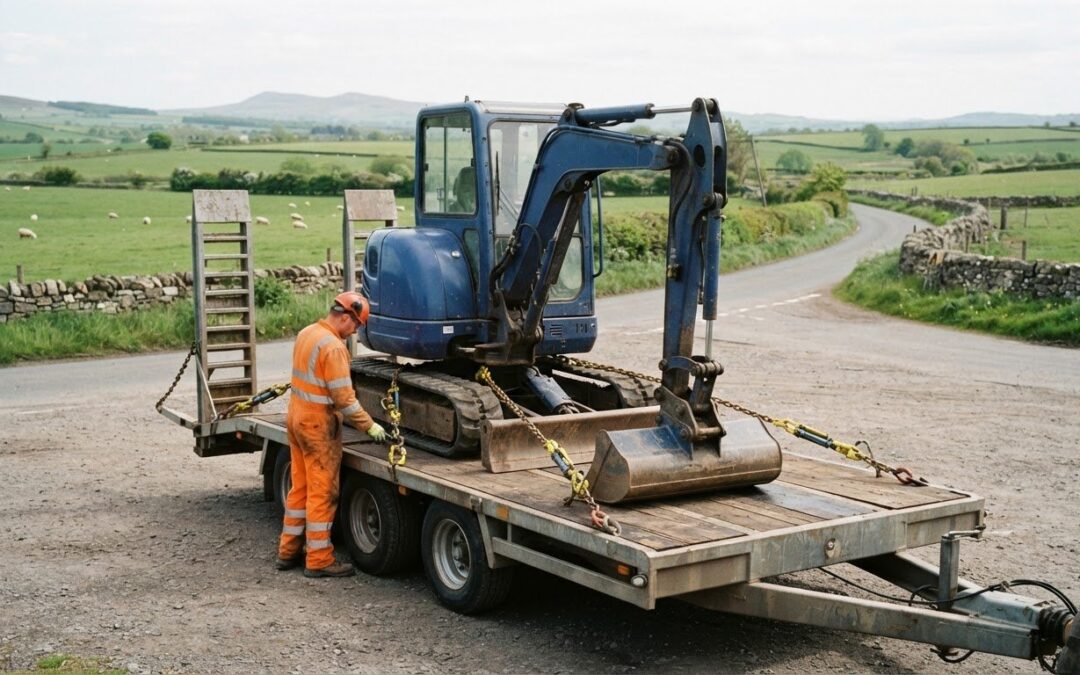
A secure journey starts before the excavator reaches the trailer. Knowing how to transport a mini excavator safely means matching its weight and dimensions to the trailer and towing vehicle, loading on firm, level ground, and securing it with suitable restraints. Stow the boom and attachments safely, then check the load before setting off.
It’s easy to focus on the drive, but the trailer, loading surface and excavator’s position matter just as much. A mismatch can make loading difficult or leave the machine poorly supported during the journey.
This guide explains how to prepare the excavator, choose a suitable trailer, load it carefully and secure it for travel. You’ll also learn what to inspect before departure and when specialist transport may be more practical. The aim is a clear, methodical process that helps you move the machine without overlooking the essentials.
Key Takeaways
- Match the trailer and towing vehicle to the excavator’s weight, dimensions and attachments before loading.
- Prepare the machine and loading area so it can be positioned steadily and safely.
- Secure the excavator against movement, then inspect the load and restraints before setting off.
- Plan the route and choose a transport method that suits the machine and the journey.
How to transport a mini excavator
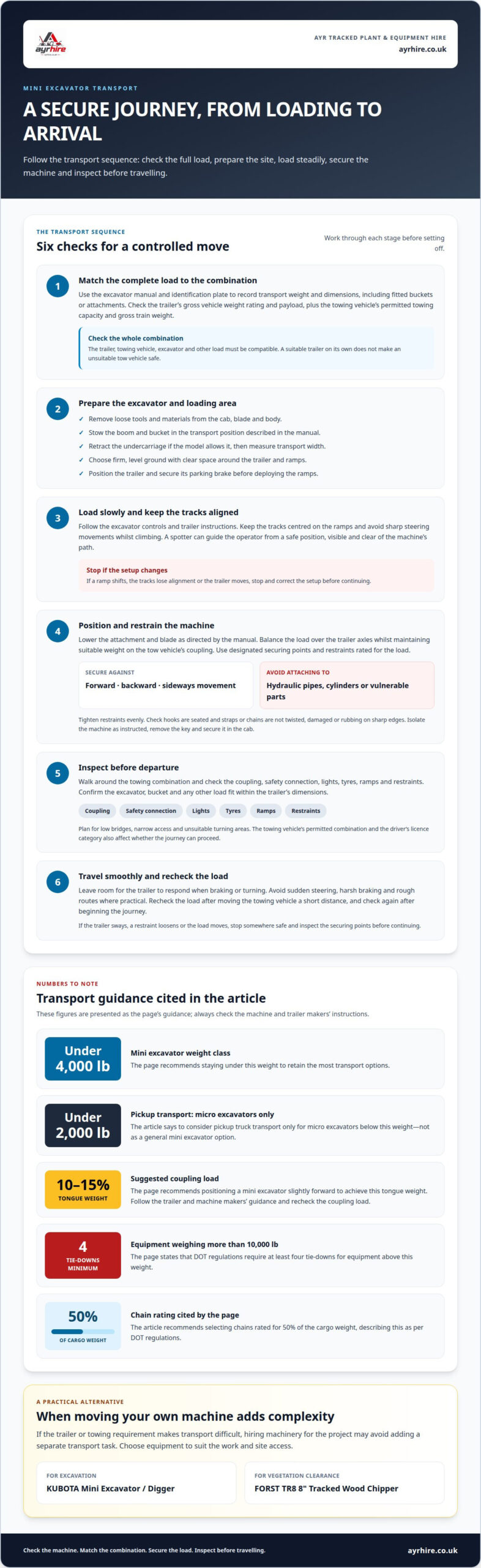
Start with the excavator’s operating manual and identification plate. Record its transport weight, width, height and length, including any fitted bucket or attachment. Transport weight can differ from the machine’s basic weight, so include the attachments and equipment travelling with it. These details determine whether the trailer and towing vehicle can carry the complete load, not just the excavator.
Check the trailer plate for its gross vehicle weight rating and payload. Payload is the weight the trailer can carry after accounting for the trailer itself. Check the towing vehicle’s limits too, including its permitted towing capacity and gross train weight. The excavator, trailer, towing vehicle and load must form a compatible combination. A suitable trailer alone does not make an unsuitable tow vehicle safe.
Before loading, prepare the machine and site:
- Remove loose tools and materials from the cab, blade and body.
- Lower the boom and bucket into the transport position described in the manual.
- Retract the undercarriage if the model allows it, then measure the transport width.
- Choose firm, level ground with clear space around the trailer and ramps.
- Position the trailer and secure its parking brake before deploying the ramps.
Load slowly, following the excavator’s controls and the trailer manufacturer’s instructions. Keep the tracks centred on the ramps and avoid sharp steering movements while climbing. A spotter can guide the operator from a safe position, remaining visible and clear of the machine’s path. Stop if a ramp shifts, the tracks lose alignment or the trailer moves. Correct the setup before continuing.
Once the excavator is on the deck, lower the attachment and blade as directed by its manual. Keep the load balanced over the trailer axles while maintaining suitable weight on the tow vehicle’s coupling. Too much weight at either end can affect stability and handling. Use the trailer’s designated securing points and restraints rated for the load. Attach restraints to suitable points on the excavator, not hydraulic pipes, cylinders or other vulnerable components.
Secure the machine against movement forwards, backwards and sideways, using the restraint arrangement specified by the excavator and trailer manufacturers. Tighten each restraint evenly, then check that hooks are seated and straps or chains are not twisted, damaged or rubbing against sharp edges. Isolate the machine as instructed, remove the key and secure it in the cab. In a safe area, move the towing vehicle a short distance and recheck the load.
Before setting off, walk around the combination. Check the coupling, safety connection, lights, tyres, ramps and restraints. Confirm that the excavator, bucket and any other load fit within the trailer’s dimensions. Plan a route that avoids low bridges, narrow access and unsuitable turning areas. The towing vehicle’s permitted combination and the driver’s licence category also affect whether the journey can proceed. Keep the load secure and visible throughout the trip.
Drive smoothly, leaving room for the trailer to respond when braking or turning. Avoid sudden steering, harsh braking and rough routes where practical. Stop in a safe place if the trailer begins to sway or a restraint appears loose, then recheck the securing points before continuing. A methodical process, from checking the machine plate to inspecting the loaded trailer, helps prevent avoidable problems on the road.
Before travelling, recheck the restraints and the excavator’s position, then confirm the combination remains within the trailer and towing vehicle limits. The page recommends staying under 4,000 pounds for the mini excavator’s weight class to retain the most transport options. Pickup truck transport should only be considered for micro excavators weighing under 2,000 pounds, rather than treated as a general option for mini excavators.
If repositioning the machine on the deck, follow the trailer and machine makers’ guidance and recheck the coupling load. The page recommends positioning a mini excavator slightly forward to achieve 10-15% tongue weight. Match every restraint to the cargo and its securing points. The page states that DOT regulations require at least four tie-downs for equipment weighing more than 10,000 pounds, and recommends selecting chains rated for 50% of the cargo weight per DOT regulations. Once the load is secured, pause to inspect the tie-downs and ensure the machine has not shifted. Recheck the setup after beginning the journey, and stop somewhere safe if any restraint loosens or the load moves.
Ayr Tracked Plant & Equipment Hire: FORST TR8 8" Tracked Wood Chipper
Ayr Tracked Plant & Equipment Hire offers the FORST TR8 8" Tracked Wood Chipper for site work where vegetation needs clearing before excavation begins. It’s a practical fit when branches and woody material are part of the job, alongside planning access for machinery. For the digging itself, Ayr Hire also offers a KUBOTA Mini Excavator / Digger. Hiring the machine for the project can be a useful alternative when transporting your own excavator would add a difficult trailer or towing requirement.
Choose equipment to suit the work, whether that involves vegetation clearance, excavation or both. The right match helps you plan site access and the sequence of tasks without treating transport as an afterthought. Contact Ayr Tracked Plant & Equipment Hire or visit ayrhire.co.uk to discuss your requirements.
Plan the next move with confidence
Before arranging a journey, consider whether transporting your own machine is the simplest option for the project. Knowing how to transport a mini excavator is only one part of the decision: the site work, access and equipment needed all shape the practical choice. Hiring machinery for the job may help avoid adding a separate transport task to your schedule.
Ayr Tracked Plant & Equipment Hire offers a KUBOTA Mini Excavator / Digger, as well as the FORST TR8 8" Tracked Wood Chipper and TMC25/BG250 Mini Spider Crane for other site requirements. Each serves a different task, so focus on the equipment that fits the work rather than moving machinery you may not need.
Discuss your project with Ayr Tracked Plant & Equipment Hire and take the next step with a clear plan. A well-matched choice can help you get on with the work ahead.