The fastest crawler multi-loader isn’t automatically the right choice. The benefits of using a crawler multi-loader depend on how its load capacity, controls and manoeuvrability suit the ground, access and pace of your job. Start with the site conditions, then consider how the machine will be operated and how quickly materials need to move.
It’s easy to focus on carrying capacity alone. But a machine that suits the load may still be a poor fit for a confined route, uneven ground or a work area where the operator needs to stand clear. The practical choice is one that suits both the task and the site conditions.
This guide explains how site conditions, remote control, manoeuvrability and operating speed shape your decision. You’ll learn which factors matter for different types of work and how to compare options without treating one specification as the whole answer. By the end, you’ll have a clearer way to choose a crawler multi-loader for the job, rather than simply picking the biggest or quickest machine.
Key Takeaways
- Start with the route, ground conditions and load, then narrow down the machine type that suits the work environment.
- Consider remote control and compact manoeuvrability where access is tight or the operator needs to work away from the carrier.
- Compare speed settings with the precision the task requires; the quickest option isn’t always the most practical.
- Use the decision guide to match your site requirements with Ayr Tracked Plant & Equipment Hire’s ALMA Crawler Multi-Loader.
Choosing a Multi-Loader for the work environment
Start with the route, ground and heaviest load. A tracked carrier is designed to transport materials; a skid steer handles different tasks, a mini excavator digs, and a dumper carries loose material. Choose the machine for its main role, rather than assuming it can do every job.
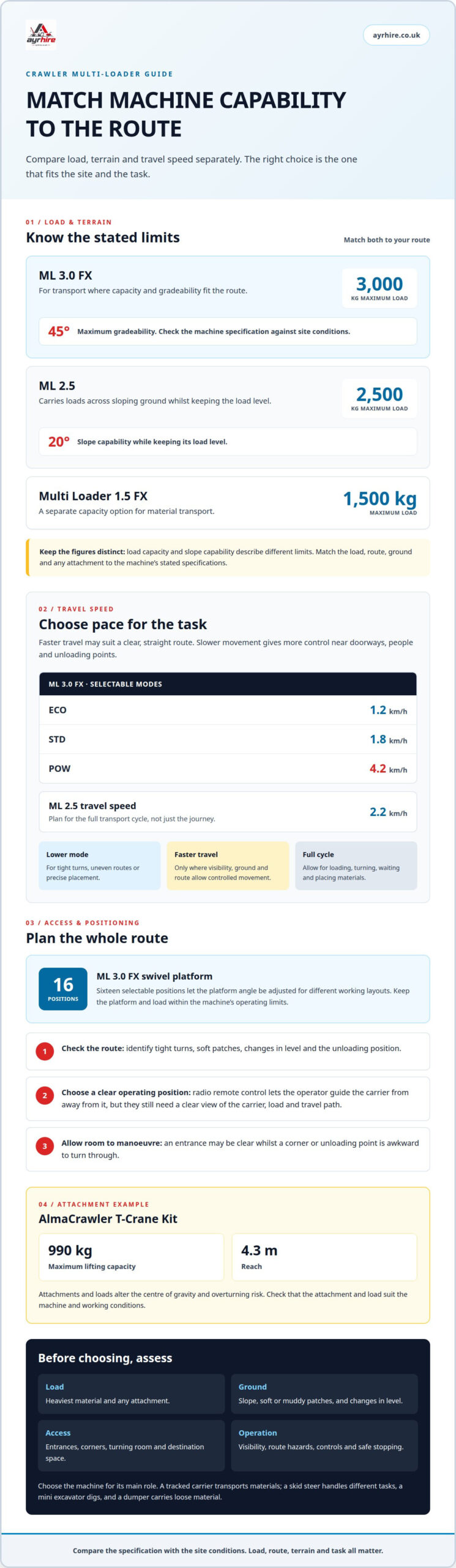
For loads and slopes, compare specifications carefully. The AlmaCrawler ML 3.0 FX is designed to carry loads and tackle gradients, but check its specifications against the site conditions. The ML 2.5 carries up to 2500 kg on slopes up to 20° while keeping its load level. These figures describe different capabilities, so match the load and terrain requirements separately.
Tracked carriers can move goods indoors and outdoors across construction sites. They suit materials that can be secured on a suitable platform. Attachments vary by machine: the AlmaCrawler T-Crane Kit, for example, has a maximum lifting capacity of 990 kg and reach of 4.3 m. Attachments and loads alter the centre of gravity and overturning risk, according to the UK Government.
Operating costs and energy use depend on the power source, load, travel distance, terrain and working time. Electric models use battery power, while diesel models consume fuel, so charging or refuelling arrangements affect running costs. Maintenance needs and service life also depend on operating conditions, maintenance and wear. Follow the manufacturer’s maintenance schedule.
| Option | Load capacity | Terrain consideration | Best suited to |
|---|---|---|---|
| ML 3.0 FX | Up to 3000 kg | Maximum gradeability 45° | Transport where its capacity and gradeability fit the route |
| ML 2.5 | Up to 2500 kg | Keeps load level on slopes up to 20° | Moving loads across sloping ground |
| Skid steer, mini excavator or dumper | Varies by machine | Select for the task and ground | Different work, such as handling, digging or carrying loose material |
Choose a machine by matching the load, route, ground and attachment to its stated limits.
The Multi Loader 1.5 FX offers a load capacity of up to 1,500 kg. AlmaCrawler tracked carriers have reinforced chassis, robust tracks and drive systems designed for demanding use.
Remote control and manoeuvrability in confined spaces
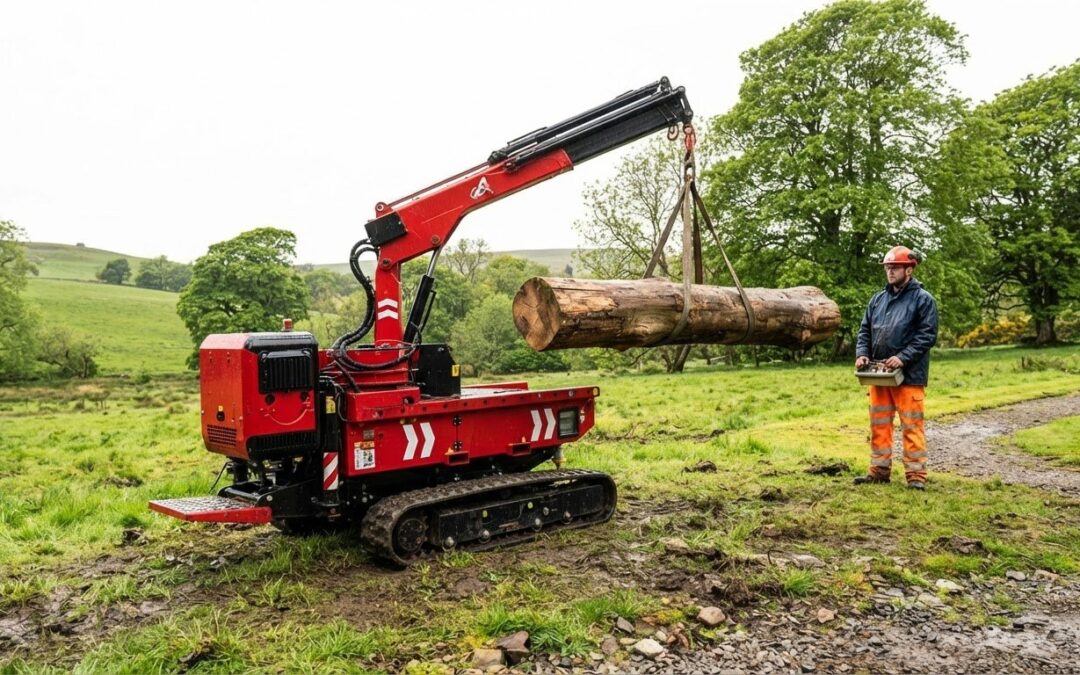
Radio remote control lets an operator guide a tracked carrier while standing away from it. This can help keep them clear of the immediate route, particularly where muddy ground may make footing difficult. The operator still needs a clear view of the carrier, load and travel path throughout each movement.
Remote operation can help where there is little room to walk beside a machine. For example, a narrow passage between buildings may leave limited space to turn or stand. Controlling the carrier from a suitable position can help guide a load through the route without placing the operator alongside the tracks.
Compact tracked carriers can move substantial loads through areas with limited space, but their usefulness depends on the whole route, not just its narrowest point. Consider entrances, corners, changes in level and the space needed to position the load at its destination. A route that allows forward travel may still be awkward if there is not enough room to turn at the unloading point.
Some designs add positioning options. The ML 3.0 FX swivel platform has 16 selectable positions, allowing the platform angle to be adjusted for different working layouts. This can help align the load with the route or destination, although the platform and load still need to remain within the machine’s operating limits.
Tracked carriers can also help move materials across soft or muddy areas. Tracks spread contact along the ground, which may reduce localised pressure compared with a wheeled machine. A tracked carrier can keep work moving without waiting for ground conditions to improve or laying temporary surfaces.
For a confined UK site, plan the route before moving materials:
- Identify tight turns, soft patches and the unloading position.
- Choose an operating position with a clear view of the carrier and load.
- Allow room to manoeuvre without forcing the machine against obstacles.
These checks help you assess whether remote control and compact manoeuvrability suit the site’s access constraints.
Operating speed
Travel speed affects how quickly a crawler multi-loader can move materials between collection and delivery points. The AlmaCrawler ML 2.5 travels at 2.2 km/h, while the ML 3.0 FX offers ECO, STD and POW modes. Its respective speeds are 1.2 km/h, 1.8 km/h and 4.2 km/h. These settings let the operator match movement to the route and task.
Speed alone doesn’t determine productivity. On a clear, straight path, a higher setting can shorten each journey. Near a doorway, work crew or unloading point, slower movement gives the operator more control. For example, using ECO mode on the ML 3.0 FX may suit careful positioning better than travelling at its maximum POW speed.
On UK sites, key risks include collisions, unstable loads and loss of control on uneven ground. Operators need practical instruction in the machine’s controls, load limits, route hazards and safe stopping, with training suited to the machine and task.
Plan for the full transport cycle, not just the carrier’s top speed. Allow for loading, turning, waiting and placing materials. A route with several tight corners may take longer than a clear run, so realistic planning helps avoid rushing near people or obstacles.
- Choose a lower mode for tight turns, uneven routes or precise placement.
- Use faster travel only where visibility, ground and route allow controlled movement.
- Allow time for loading and unloading, not only the journey between points.
The ML 3.0 FX’s 1.2 km/h ECO setting and 4.2 km/h maximum POW speed show why mode selection matters. Match travel pace to the route, load and operator’s view, then keep speed controlled throughout each movement.
The AlmaCrawler Multi-Loader EVO reaches a maximum speed of 3.7km/h, and the AlmaCrawler Multi-Loader ELC reaches a maximum speed of 2.6km/h. Maximum speeds for Multi Loaders on the page range from 2.2km/h to 4.2km/h. These figures add further options to consider when matching travel pace to the task. Compare each machine’s maximum with the planned route, while accounting for the load, turning and controlled placement.
What is a crawler multi-loader and how does it work?
A crawler multi-loader is a tracked carrier designed to move materials around a site. Tracks provide movement, while a flatbed or fitted attachment carries the load. Unlike a mini excavator, it transports materials rather than digging. Its role is similar to a dumper’s, although the platform design and available attachments affect the tasks it can handle.
The process is straightforward: place and secure the load on the platform, then steer the carrier along a planned route. At the destination, position the machine for unloading or placing the material. Some models have radio remote control, allowing the operator to direct movement from a suitable position. Beyond standalone mobile plant, facilities exploring wider robotic handling and industrial systems can look to automation specialists like EdNex Automation for integrated solutions.
Capacity and levelling features differ between machines. The AlmaCrawler Multi-Loader 6.0 can carry loads of up to six tonnes. Its self-levelling technology keeps loads level at 0° on slopes of up to 20°. That can help when transporting materials across sloping ground, but the load and route must still suit the machine’s operating limits.
Power systems also shape how a carrier works on site. The Multi-Loader 6.0 can use three different power-source configurations, allowing the machine type to be matched to the job’s working conditions. A carrier’s platform and attachments determine whether it transports a particular material or performs another handling task.
- Load: confirm the material can be carried securely on the platform or attachment.
- Route: account for slopes, turns, ground and the space needed at the destination.
- Configuration: match the carrier’s power source and fitted equipment to the work.
These features explain the practical benefits of using a crawler multi-loader: it combines tracked movement with material carrying, and selected models add levelling for sloped routes. Choose a machine whose capacity, configuration and equipment suit the transport task.
Ayr Tracked Plant & Equipment Hire: ALMA Crawler Multi-Loader
Ayr Tracked Plant & Equipment Hire offers the ALMA Crawler Multi-Loader for transporting materials where tracked access suits the site. It may be a practical option for construction work with confined routes or challenging ground, provided the load and conditions are suitable for the machine.
For a useful hire enquiry, outline the material to move, the route between loading and unloading points, and any access constraints. These details help connect the machine to the job, rather than choosing on carrying capacity alone. If the task is cutting and processing timber, the FORST TR8 8" Tracked Wood Chipper is a different offering for that specific work.
Contact Ayr Tracked Plant & Equipment Hire to discuss the ALMA Crawler Multi-Loader for your site and material-handling task.
Plan your next material move
Turn the site requirements into a clear equipment brief before work begins. Note the material to move, the route it must travel and any access constraints. This gives you a practical basis for deciding whether a crawler multi-loader suits the task. The benefits of using a crawler multi-loader are most relevant when its tracked movement and carrying role match your site’s needs.
Ayr Tracked Plant & Equipment Hire also offers a KUBOTA Mini Excavator / Digger for digging work, a TMC25/BG250 Mini Spider Crane for lifting tasks and the FORST TR8 8" Tracked Wood Chipper for wood processing. Each is suited to a different job, so define the work before choosing equipment.
Share your project requirements with Ayr Tracked Plant & Equipment Hire and discuss the ALMA Crawler Multi-Loader as an option for moving materials. Contact Ayr Tracked Plant & Equipment Hire to talk through your next job and take a clear next step.
Frequently Asked Questions
What are the main benefits of using a crawler multi-loader?
The main benefits are tracked material transport and features that can suit demanding site access. Ayr Tracked Plant & Equipment Hire’s ALMA Crawler Multi-Loader has an electric drive, Automatic Tensioning System, BI-Levelling system and remote controls. For projects in South Ayrshire, North Ayrshire, East Ayrshire, Dumfries & Galloway or Glasgow, consider how these features fit the work and site conditions.
What are the operating costs and fuel consumption of a crawler multi-loader?
Operating costs and energy use depend on the power source, load, travel distance, terrain and working time. Electric models use battery power, while diesel models consume fuel. Charging or refuelling arrangements also affect running costs.