
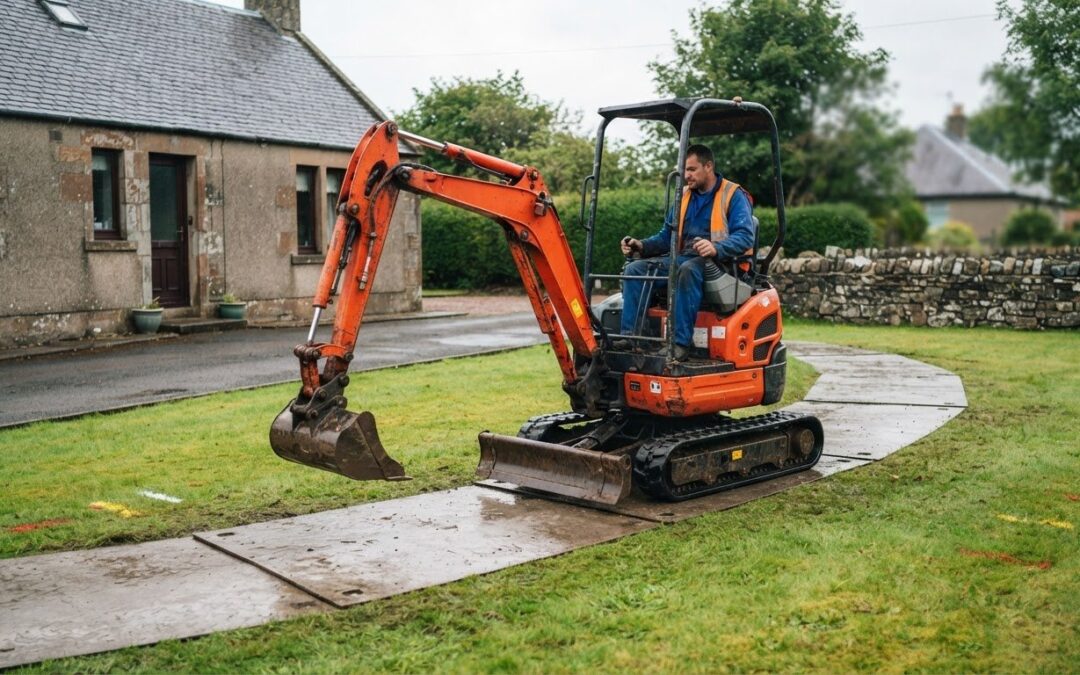
Ground damage often starts with an abrupt turn, while hidden services and overhead cables create other risks. To avoid property damage with a mini excavator, plan the route and digging area first, move steadily, and take care around utilities and cables. Use boards or mats to protect sensitive ground where needed.
Operating a mini digger safely means more than controlling the bucket. Understand the machine, keep the work area clear, and adjust your movements to the ground beneath the tracks. Small, deliberate choices can help prevent avoidable marks and damage.
This guide covers practical operating checks, precautions around overhead cables and buried utilities, and ways to reduce track scuffing on lawns, gardens and driveways. It also explains how to plan a route before work starts, so you can approach the job with a clear, steady method.
Key Takeaways
- Read the operating manual, inspect the machine and understand its controls before starting work.
- Identify overhead cables and buried services before digging, and keep the work area clear of bystanders.
- Reduce track scuffing with gradual movements, broad turns and boards or mats on vulnerable ground.
- Plan the route and digging area around ground conditions, obstacles and sensitive garden or driveway surfaces.
1. How to operate a mini digger?
Start with the operator’s manual and identify each control before starting the machine. Check the diagrams for travel, boom, bucket and blade functions, then practise small movements in a clear area. Keep the excavator within its stated load capacity and use only correctly sized, securely attached equipment. Avoid pushing the machine beyond its capabilities; steady inputs reduce strain and help keep the bucket under control.
Before operating, inspect for loose parts, visible damage, leaks and unusual sounds. Check fuel and oil pressure, then confirm there’s enough fuel for the task. Look over the tracks and attachment connections as well. UK employers have legal responsibilities under the Health and Safety at Work Act 1974 and associated PUWER and LOLER regulations to ensure excavator operators are trained and competent, according to the Health and Safety Executive.
Set up a safe work area before moving. Mark the operating zone with cones, barriers or signs, and keep bystanders outside it. Wear a hard hat, eye protection and suitable clothing. Know how to stop the machine in an emergency, and keep the work area clear of loose materials that could obstruct movement.
What UK rules apply near buried utilities and property boundaries? Stated employer duties cover training and competence. Around services, use a cautious locating process and hand-dig to expose them. Agree the excavation limit at the boundary, mark it clearly and keep the bucket within that line.
How do you locate underground pipes and cables? Review available service plans, scan the work area with a cable-avoidance tool, mark detected routes and hand-dig trial holes to establish the service position before machine excavation.
How much clearance and turning space does a mini excavator need? Allow for the machine’s full track width, boom reach and tail swing, using the dimensions in its manual. Keep turning space clear and avoid sharp turns near walls, fences or parked vehicles.
How can you protect foundations, retaining walls and drains? Mark their positions, keep excavation outside their immediate footprint and remove soil in controlled passes. What insurance covers accidental property damage? Review public liability wording for third-party property damage, including exclusions and excess. Hired-in plant cover concerns the machine itself.
2. Overhead cable and utility hazards
Mini diggers, including micro diggers, can still reach overhead cables with a raised boom, bucket or load. Before moving the machine, scan above the full work area and planned route. Allow for the space needed to slew and lift, not just the dig point. A low doorway, tree branch or cable crossing a driveway can restrict movement.
Mark overhead hazards clearly and keep the boom and attachment down while travelling beneath or near them. Plan digging positions so the boom cannot swing towards a cable. Uneven ground can affect the machine’s reach and stability, so assess slopes, ruts and soft patches before operating. Never assume a cable is safe because it looks insulated or runs above a familiar route.
Approach buried services just as carefully. Use available service plans and detection equipment to identify likely routes, then mark them on the ground. Treat those marks as guidance, not permission to dig directly over a pipe or cable. Carefully expose a service with hand tools before bringing the bucket closer. An unexpected duct, warning tape or change in soil is a reason to stop and reassess.
- Before starting: walk the route and identify overhead lines, service covers, poles and meter boxes.
- During digging: keep the bucket movement controlled and watch for exposed cables, pipes or ducts.
- If contact occurs: stop operating, keep others away and avoid touching the machine or service. Get appropriate emergency assistance.
Good planning keeps work efficient without letting speed dictate the approach. In confined spaces, reposition the machine rather than stretching the boom towards an obstacle. If you cannot maintain safe clearance from an overhead cable throughout the machine’s movement, do not proceed beneath it. That limit matters even when the digging itself seems straightforward.
3. Reducing track damage to ground
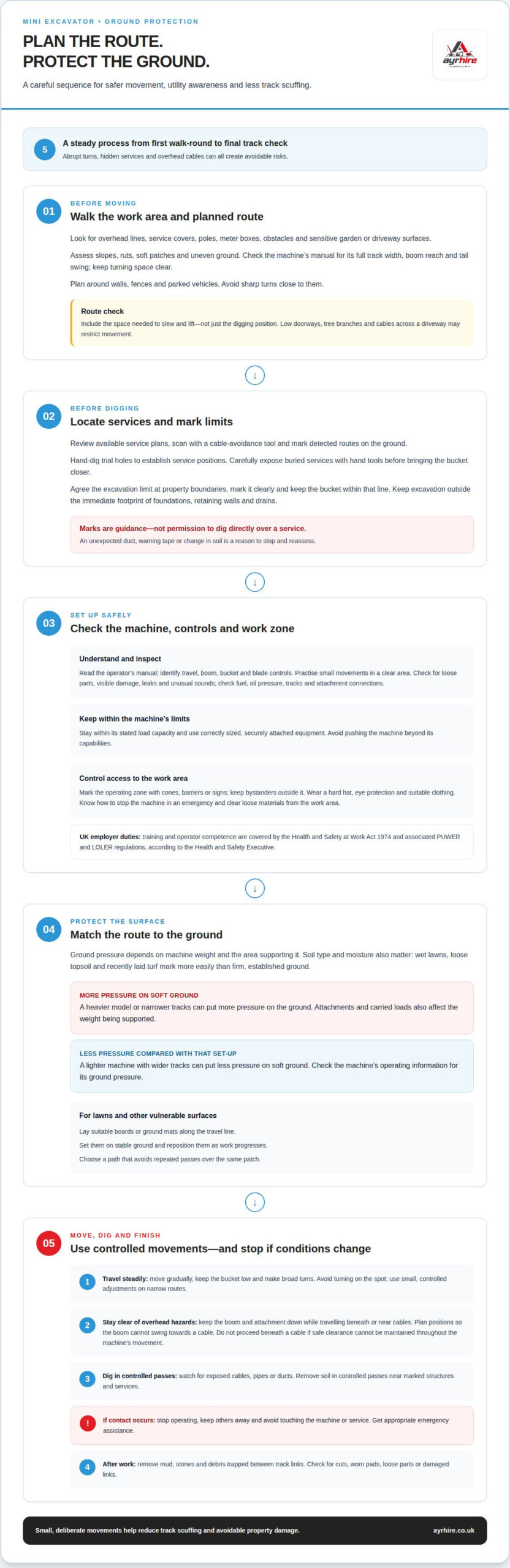
Ground pressure depends on the machine’s weight and the area supporting it. A heavier model or narrower tracks can put more pressure on soft ground than a lighter machine with wider tracks. Attachments and carried loads also affect the weight being supported. Check the machine’s operating information for its ground pressure, then consider soil type and moisture when choosing a route. Wet lawns, loose topsoil and recently laid turf mark more easily than firm, established ground.
Reduce track scrubbing by moving gradually and avoiding turns on the spot. A broad turn lets the tracks travel forwards instead of dragging across the surface. On a narrow route, make small, controlled adjustments rather than pivoting sharply. Keep the bucket low while travelling, and choose a path that avoids repeated passes over the same patch. To avoid property damage with a mini excavator, adapt the route to the surface rather than forcing tight turns.
For a well-kept lawn or other vulnerable surface, lay suitable boards or ground mats along the travel line. Set them on stable ground and reposition them as work progresses. Where a turn is unavoidable, a careful operator can use the bucket to lift the machine slightly while moving the track needed to turn. Do this only where the machine and ground conditions allow controlled movement. These small adjustments help avoid property damage with a mini excavator when access is restricted.
Ground conditions can vary across a single garden. Slow down on rough or soft sections, and avoid travelling across steep or uneven ground where the machine may slip or mark the surface. After work, remove mud, stones and debris trapped between track links. Check for cuts, worn pads, loose parts or damaged links, and follow the manufacturer’s recommended maintenance schedule. After heavy tracking, leave the engine idling for a few minutes to let hydraulic fluid circulate and cool.
What ground pressure do mini excavators exert, and how does it vary by model? There isn’t one figure that applies to every mini excavator. Ground pressure varies with the machine’s weight, track width, attachment and load, so compare the specific model’s stated pressure with the ground’s firmness and moisture before travelling.
4. How to plan a mini digger route to avoid garden damage
Walk the route before the machine arrives. Mark the digging area, spoil destination and any garden features that need protection. Note lawn edges, flowerbeds, drains, inspection covers, steps and driveway joints. A clear plan helps prevent last-minute turns that can scuff turf or push loose gravel across paving.
Choose the firmest practical route, avoiding saturated soil and newly laid turf. Check the full path for narrow gates, low branches and uneven thresholds. Compare the available width with the machine’s track width, then allow room to travel straight without brushing fences or walls. The boom and bucket also need clearance, even when folded for travel.
Plan each turn before setting off. Use a broad curve where space allows rather than pivoting on the spot. If a driveway requires a tight turn, reposition with controlled movements and avoid dragging the tracks repeatedly across the same edge. Place suitable boards or ground mats over vulnerable lawn sections, ensuring they sit flat and don’t rock under the tracks.
Separate travel from excavation where possible. Mark the route and spoil area so the machine doesn’t cross finished ground unnecessarily. Keep soil, stones and tools out of the travel line. If the route crosses a drain cover or paving edge, avoid placing a track directly on it. Check the surface as work progresses: rain or displaced boards can change conditions under the machine.
Before digging near a boundary, wall or garden structure, mark the limit and approach from the side with the clearest view. Work in controlled passes, keeping the bucket away from structures and watching for movement or cracking. Stop if the ground gives way or a hidden obstruction appears. A well-planned route protects access and leaves fewer marks to repair. Arrange mini digger hire for a job where machine access needs careful planning.
Ayr Tracked Plant & Equipment Hire: FORST TR8 8" Tracked Wood Chipper
Ayr Tracked Plant & Equipment Hire provides tracked equipment for projects where access and ground conditions need careful planning. For excavation work, its KUBOTA Mini Excavator / Digger is a relevant hire option; the FORST TR8 8" Tracked Wood Chipper suits jobs involving wood chipping. Matching the equipment to the task helps you plan routes, working space and ground protection before work starts.
For moving materials around restricted sites, the ALMA Crawler Multi-Loader may suit the job. Vacuum Lifter Hire is available for lifting tasks involving suitable materials. Consider the work, access route and ground surface when deciding which equipment supports your site plan.
Contact Ayr Tracked Plant & Equipment Hire or visit ayrhire.co.uk to discuss your equipment hire needs.
Turn your site plan into the right equipment choice
Before work begins, turn your site observations into a practical brief. Note the access route, surface type, overhead restrictions and task the machine must complete. This gives you a clear basis for choosing equipment and preparing the work area. To avoid property damage with a mini excavator, match the machine to the site rather than forcing the site to accommodate unsuitable equipment.
Ayr Tracked Plant & Equipment Hire offers a KUBOTA Mini Excavator / Digger for excavation work and a TMC25/BG250 Mini Spider Crane for lifting requirements. The right option depends on the job’s purpose and access constraints. A concise plan helps make that choice more straightforward.
For equipment hire that fits your project, contact Ayr Tracked Plant & Equipment Hire. Take your site plan into the next conversation and move ahead with a considered approach.
Frequently Asked Questions
How to operate a mini digger?
Begin by learning the travel and attachment controls, then practise moving the machine and bucket in a clear area. For example, test how the boom responds before digging beside a shed or fence. Keep movements deliberate, avoid carrying loads beyond the machine’s limits and stop if a control behaves unexpectedly. A trained operator who understands the manual can work more accurately and reduce avoidable strain.
How to protect paving, lawns and driveways from mini excavator tracks?
Protect surfaces by choosing a route that avoids fragile edges and repeated track passes. On paving, keep the machine away from unsupported corners and raised joints. On a lawn, spread the load with suitable ground-protection boards or mats. Clear stones from the route first, as they can become trapped under tracks and scratch hard surfaces. Reposition protection as the machine advances.
How to operate a mini excavator safely near fences, buildings and parked vehicles?
Keep the machine clear of fences, buildings and parked vehicles by planning where it will travel, slew and dig. Check the full movement range of the boom, bucket and rear of the machine, not just the track width. Move slowly in restricted spaces, keep the attachment low while travelling and stop to reposition if visibility is blocked. Remove vehicles from the working area where possible.
Are rubber tracks less likely to damage surfaces than steel tracks?
Rubber tracks are generally a better choice for finished surfaces because they’re less likely to scratch paving than steel tracks. They can still mark lawns, disturb loose gravel or damage weak surfaces under heavy pressure, especially during sharp turns. Ground condition, machine weight and driving technique matter too. Check the surface and track type before crossing delicate paving or newly laid turf.
What mats, boards or ground protection products work best for mini excavators?
Use ground-protection mats or sturdy boards to create a stable, continuous route across vulnerable areas. For a lawn, lay them flat along the planned track line. For a driveway, cover sections that could chip or scuff. The right choice depends on the surface, ground firmness and machine load. Avoid loose or rocking boards, which can shift as the tracks pass over them.