Will your indoor lifting project end with a precision installation or a cracked, expensive floor? It’s a question that keeps site managers awake, especially when navigating the tight corridors of a Glasgow warehouse or an Ayrshire factory. When hiring a spider crane for indoor projects Glasgow teams often discover that the biggest challenge isn’t the weight of the load. It’s the millimetres of clearance and the kilograms of pressure per square centimetre. You need a machine that’s powerful enough to work but small enough to fit through a standard doorway.
We understand the pressure of protecting high-value internal surfaces whilst meeting strict health and safety emission standards. This guide helps you master the technical requirements of indoor lifting, from calculating outrigger footprints to selecting zero-emission electric power. We’ll examine how compact machinery like the TMC25/BG250 can solve your access issues without compromising structural integrity. By the end, you’ll have the confidence to manage a safe, compliant, and efficient lift on your next local project.
Key Takeaways
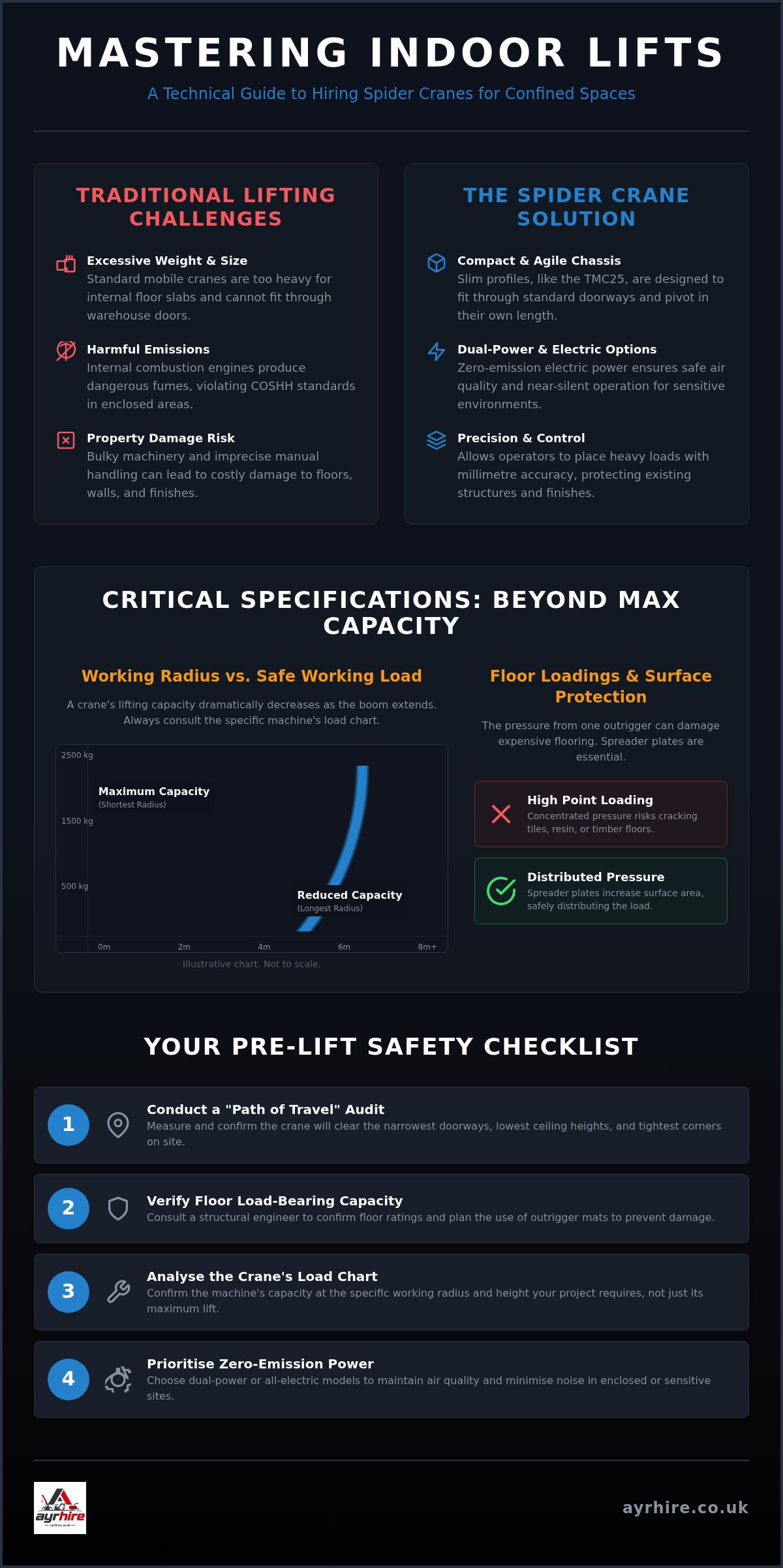
- Conduct a “Path of Travel” audit to ensure the compact crane clears the narrowest doorways and lowest ceiling heights on your site.
- Prioritise dual-power or electric machinery to eliminate harmful emissions and maintain air quality whilst working in enclosed environments.
- Verify floor load-bearing capacities and outrigger footprints with a structural engineer to prevent damage to expensive internal flooring.
- Understand the difference between maximum capacity and working radius to ensure your chosen crane can safely handle loads in tight corners.
- Streamline the process of hiring a spider crane for indoor projects Glasgow by partnering with a local specialist that offers versatile, narrow-access equipment.
The Unique Challenges of Indoor Lifting Projects
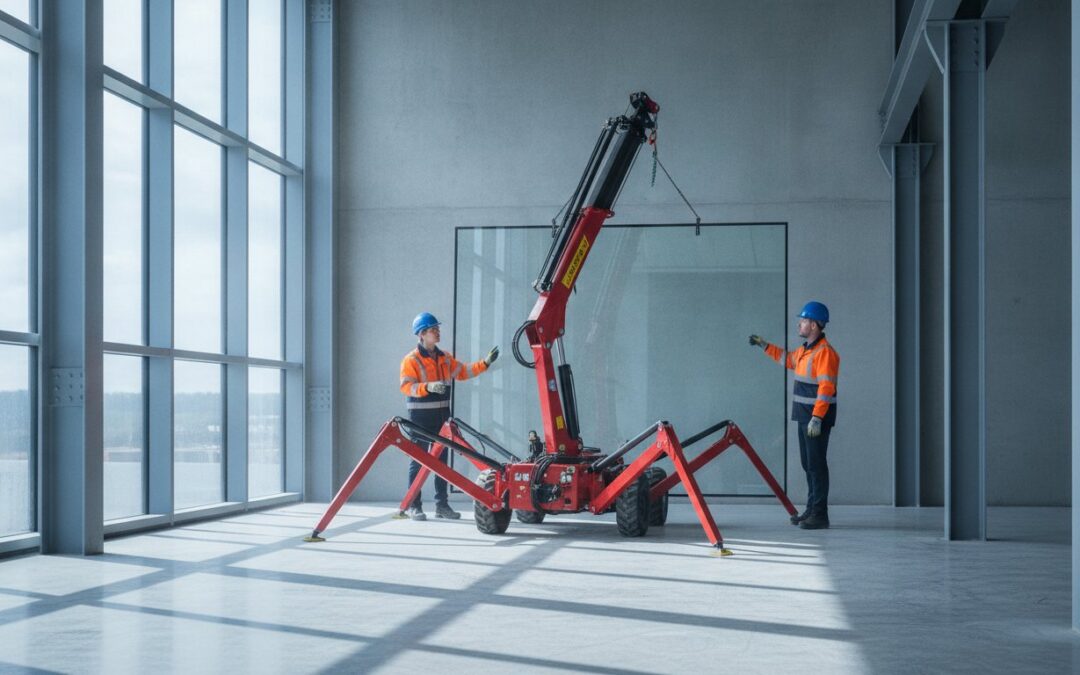
A spider crane is a specialised, compact lifting solution. It features a tracked chassis and four stabilising outriggers that distribute weight across a wide area. Unlike a traditional crane, these machines are engineered for accessibility. Traditional mobile cranes are usually unsuitable for internal works because they’re too heavy for floor slabs and produce high levels of exhaust. They simply won’t fit through a warehouse door or navigate a narrow corridor.
When hiring a spider crane for indoor projects Glasgow site managers often face unique hurdles. You aren’t just managing the lift; you’re managing the environment. Restricted entry points and low ceiling heights are the norm. Safety is the primary reason to choose these machines. They replace risky manual handling and bulky forklifts with a stable, controlled lifting platform. This protects your staff from injury and your site from accidental impact damage during the process.
Navigating Restricted Access and Entry Points
Chassis width is your most vital metric. Most indoor projects require a machine that passes the “Standard Doorway” test. The TMC25/BG250 is a prime example of this design, offering a slim profile that tracks through narrow openings. Its tracked manoeuvrability allows it to pivot in its own length. This makes it ideal for navigating around tight corners or internal pillars. If your project is on an upper floor, weight is the deciding factor. You’ll need to check the capacity of on-site goods lifts. Spider cranes are light enough to be moved between levels without exceeding structural limits.
Managing Internal Environmental Factors
Indoor work in Glasgow often involves sensitive sites like hospitals, schools, or occupied office blocks. Noise reduction is a high priority in these settings. Electric or dual-power cranes provide near-silent operation, which keeps disruption to a minimum. Ventilation is another major challenge. In enclosed rooms, internal combustion fumes are a serious health hazard. Using zero-emission electric power ensures you meet COSHH standards and maintain a safe atmosphere for everyone on site. Precision control is also essential. These machines allow operators to place loads with millimetre accuracy. This prevents expensive damage to existing internal structures, glass facades, or decorative finishes whilst the work is underway.
Critical Specifications: Beyond Maximum Lifting Capacity
Focusing purely on a machine’s maximum lifting capacity is a common mistake. In the reality of a confined site, that headline figure is rarely achievable. Manufacturers typically calculate maximum capacity at the shortest possible radius with the boom fully retracted. When hiring a spider crane for indoor projects Glasgow contractors must look deeper into the load chart. As the boom extends or the angle lowers to reach across a room, the safe working load drops significantly. You need to know exactly what the crane can lift at the specific distance required for your task.
The relationship between working radius and lift height determines your “sweet spot.” If you’re installing glass panels or HVAC units, you often need to reach over existing internal obstacles. This is where a fly jib becomes essential. It provides additional reach and allows for “up and over” positioning. This makes it possible to deliver materials onto mezzanine levels or over fixed production lines. Understanding these dimensions before the machine arrives prevents costly delays and ensures compliance with the Lifting Operations and Lifting Equipment Regulations 1998 (LOLER).
Calculating the Outrigger Footprint
Spider cranes get their name from their multi-position stabilising legs. These outriggers are designed to distribute weight across a wider area than the tracks alone. On uneven floors or stepped levels, they provide the necessary stability to keep the chassis level. Modern machines offer variable outrigger positions. This allows the crane to be set up in narrow aisles or tight corridors where a full symmetrical footprint isn’t possible. Always measure the clearance between the legs and surrounding walls. If the legs foul on fixed machinery, the crane cannot be safely levelled for the lift.
Floor Loadings and Surface Protection
Point loading is a critical concern for indoor projects. The total weight of the crane matters less than the pressure exerted through a single outrigger foot. On sensitive surfaces like resin, tiles, or timber, this pressure can cause immediate structural failure. Using spreader plates or heavy-duty outrigger mats is non-negotiable. These tools increase the surface area and reduce the pressure per square inch. For finished environments like showrooms or galleries, ensure the crane is equipped with non-marking tracks to avoid leaving permanent scuffs. If you’re unsure about the floor requirements for your site, consulting with a local hire specialist can help you select the right protection for your specific flooring.
Power Sources and Emission Standards for Enclosed Spaces
Using internal combustion engines in enclosed spaces is a major safety risk. Diesel exhaust contains carbon monoxide and nitrogen oxides. Without massive ventilation, these gases reach toxic levels quickly. When hiring a spider crane for indoor projects Glasgow site managers must prioritise the health of their team. Most modern spider cranes use Dual Power systems. This allows you to use the diesel engine for tracking the machine into position outdoors and then switch to an electric motor for the actual lifting operations inside. This combination ensures you have the torque needed for movement without polluting the internal environment.
Battery-powered spider cranes are becoming the standard for noise-sensitive sites. In hospitals or schools, the loud hum of a hydraulic pump can be as disruptive as exhaust fumes. Fully electric models offer near-silent operation. They are also compliant with the highest standards set by the Lifting Equipment Engineers Association (LEEA). You must match the crane’s power requirements to your site supply. Whilst 110V is the standard for most UK construction sites, some larger machines require a 415V three-phase supply to maintain full hydraulic pressure. Check your distribution boards before the equipment arrives to avoid downtime.
Zero-Emission Lifting Solutions
The rise of “Eco” models has changed the compact crane market. These machines use high-capacity lithium-ion batteries or direct mains connections. They are the ideal choice for specialised environments where hygiene is paramount. Using electric power eliminates the risk of oil mist or exhaust contamination. This is especially critical in food production facilities or clean rooms where air quality is strictly monitored. Electric motors also provide smoother power delivery for precision lifts. This reliability is essential for time-critical projects in occupied buildings.
- Food Production: Maintains strict hygiene standards near processing lines.
- Clean Rooms: Protects air quality whilst installing heavy laboratory equipment.
- Hospitals: Allows for silent operation in occupied wards or theatres.
Managing Power Cables and Site Safety
Working with mains-powered cranes introduces new logistical challenges. Cable management is vital to prevent trip hazards. Trailing leads must be clearly marked and protected from other site traffic, such as pallet trucks or foot traffic. Consistent voltage is also necessary for precision lifts. A drop in power can lead to hydraulic system lag, making it difficult to seat a delicate load accurately. For battery-operated cranes, plan your workflow around the charging cycle. Internal glazing projects often require continuous operation for a full shift. Ensure the battery capacity matches your work schedule or that the machine supports “plug and play” operation whilst charging.
Preparing Your Site: A Practical Access Checklist
A successful lift begins long before the machine arrives on site. You must conduct a thorough “Path of Travel” audit. This means measuring the absolute narrowest and lowest points between the unloading bay and the work zone. Hiring a spider crane for indoor projects Glasgow often involves navigating heritage buildings or modern office blocks with tight corridors. Don’t assume a machine that fits through the main entrance will clear every internal corner or service door. You need to account for the machine’s length and its turning circle whilst stowed.
For projects on upper storeys, verbal assurances from site plans aren’t enough. You must verify the floor’s load-bearing capacity with a structural engineer. They’ll confirm if the floor slab can handle the combined weight of the crane, the operator, and the load itself. Look up, too. Overhead hazards like sprinklers, low-hanging lighting, and HVAC ducting are easily overlooked during a quick walk-through. A site survey by a lifting specialist is the best way to identify these obstacles and plan a safe route before the hire period starts.
Measuring for Success
It’s easy to focus solely on the machine’s dimensions. However, you must also account for the operator. They need sufficient space for safe control and clear visibility of the load at all times. Outrigger “swing” is another critical factor. During the setup phase, the legs require clearance to rotate out from the chassis into their working position. If the aisle is too narrow for the legs to swing, the crane cannot be stabilised. Vertical clearance is equally vital. The boom angle changes as it extends; ensure the ceiling height accommodates the arc of the boom at the highest point of your lift.
Lifting Operations and Personnel
Competence is a legal requirement on any construction site. Operators must hold valid CPCS qualifications to ensure they understand the machine’s limits and safety protocols. When hiring a spider crane for indoor projects Glasgow teams must choose between a Contract Lift and standard Plant Hire. A Contract Lift is a fully managed service where the hire company provides the planning, supervision, and insurance. Standard hire leaves these responsibilities with you. For complex indoor environments with high-value flooring or tight clearances, the managed route is often the most reliable choice. For more information on choosing the right tools for your site, read our guide on Specialist Plant Hire Ayrshire: A Guide to Niche Equipment Solutions.
If you’re ready to plan your next internal lift and need a machine that fits your specific site constraints, contact our team for expert advice on compact crane hire.
Professional Spider Crane Hire in Ayrshire and Glasgow
Ayr Tracked Plant & Equipment Hire provides a specialised fleet designed for the toughest internal environments. Our TMC25/BG250 mini spider cranes are the core of our lifting service. These machines bridge the gap between manual handling and heavy plant. We serve Glasgow, Ayrshire, and Dumfries & Galloway with a deep understanding of local logistics. Our equipment is maintained to professional standards; it’s ready to work the moment it arrives on your site. When hiring a spider crane for indoor projects Glasgow firms need a partner who understands regional site constraints. We provide flexible hire terms, including daily and weekly options, to match your project’s specific timeline.
Our local expertise ensures that the equipment delivered is exactly what you need to get the job done safely. We don’t just supply machinery; we provide a reliable lifting solution. This includes technical support and advice on machine selection for restricted areas. Whether you’re working in a busy city centre or a remote industrial estate, our tracked machinery offers the stability you require. By hiring a spider crane for indoor projects Glasgow contractors can overcome the logistical hurdles of tight urban sites. We value long-term relationships and consistent performance above all else.
Specialised Solutions for Scottish Sites
Glasgow’s city centre is home to numerous heritage buildings undergoing refurbishment. These sites often feature weak floor slabs and narrow entry points that prohibit traditional plant. Our compact kit is the only viable way to execute heavy lifts in these environments. In Ayrshire’s manufacturing hubs, we support industrial maintenance projects using tracked plant that navigates around fixed production lines. For more details on our local support, see our guide on Mini Spider Crane Hire North Ayrshire: Professional Compact Lifting Solutions 2026.
The Complete Glazing Package
One of our most effective service combinations is the integration of spider cranes with vacuum lifters. This synergy is essential for modern glazing projects. It allows for the safe, precise installation of large glass panels in internal atriums and shopfronts. Our cranes provide the reach, whilst the vacuum lifters ensure a secure grip on delicate surfaces. You can learn more about this integrated approach in our article on Specialist Lifting Solutions Scotland: Professional Vacuum Lifter and Crane Hire 2026. Contact our team today to develop a tailored lifting plan for your next indoor project.
Secure Your Next Indoor Lift with Precision
Successful indoor lifting depends on the technical groundwork discussed throughout this guide. Managing floor pressure and emission standards allows you to execute complex tasks without structural risk. By following a site-specific access checklist, you ensure the machinery performs exactly as required. It’s about combining precision engineering with practical site preparation to avoid costly delays or damage to internal finishes.
When you’re ready to begin hiring a spider crane for indoor projects Glasgow teams at Ayr Tracked Plant & Equipment Hire offer the specialised support you need. Our fleet, including the TMC25/BG250, is maintained for reliability in narrow access environments across Ayrshire and Dumfries & Galloway. We bridge the gap between heavy lifting power and the delicate constraints of an internal workspace, providing a steady hand for your most challenging projects.
Don’t leave your project’s safety to chance. Enquire about Mini Spider Crane Hire today to access local expertise and high-performance compact plant. We’re ready to help you complete your next internal installation with confidence and professional efficiency.
Frequently Asked Questions
Will a spider crane fit through a standard single door?
Yes, many mini spider cranes are designed to fit through a standard single doorway. For example, some models have a stowed width of approximately 600mm to 750mm. This allows them to track through internal halls and office doors without removing the frame. When hiring a spider crane for indoor projects Glasgow contractors should always verify the exact width of their narrowest entry point to ensure the machine clears the opening safely.
Do I need a special licence to operate a spider crane indoors?
You must have a valid CPCS or NPORS operator card to use a spider crane on a UK site. Operating indoors doesn’t change the legal requirement for competence under the Provision and Use of Work Equipment Regulations 1998 (PUWER). If you don’t have a qualified operator, you should opt for a Contract Lift service. This ensures the lift is planned and executed by a certified professional in compliance with current LOLER standards.
Can spider cranes be used on mezzanine floors or upper levels?
Yes, spider cranes are frequently used on upper storeys and mezzanine levels because they are significantly lighter than traditional cranes. Their tracked chassis distributes weight during movement, whilst outriggers spread the load during the lift. You must always consult a structural engineer to confirm the floor’s load-bearing capacity before the machine arrives. They will calculate if the point loading from the outriggers is within the structural limits of the building.
How do I prevent a spider crane from marking or damaging internal floors?
You can protect sensitive internal surfaces by using non-marking rubber tracks and heavy-duty spreader plates. Non-marking tracks prevent scuffs on resin, tiles, or timber floors during transit. Once in position, outrigger mats or spreader plates are essential to distribute the pressure across a larger surface area. This prevents cracks or structural damage to the flooring. Always specify the floor type to your hire partner to ensure you receive the correct protection kit.
What is the difference between a mini spider crane and a mini crawler crane?
The primary difference is the presence of outriggers. A mini spider crane uses four stabilising legs to provide a wider footprint and level the machine on uneven surfaces. A mini crawler crane relies solely on its chassis weight and tracks for stability, often making it heavier and less versatile for indoor floors. Spider cranes are generally preferred for indoor work because their outriggers allow them to lift higher capacities relative to their compact stowed size.
Are electric spider cranes as powerful as diesel models?
Electric spider cranes provide the same lifting capacity and hydraulic speed as their diesel counterparts. The hydraulic pump performs identically regardless of whether it’s powered by a diesel engine or an electric motor. Dual-power machines are particularly useful for indoor work. They use diesel for tracking across a site and then switch to zero-emission electric power for the lift. This ensures you maintain full performance without compromising the air quality in enclosed rooms.
What happens if my site has no 415V power for the crane?
If your site lacks a 415V three-phase supply, you can use cranes that operate on 110V or battery power. Many compact models are designed to run off a standard 110V site transformer, though this may slightly reduce the speed of some hydraulic functions. Battery-powered “Eco” models are an excellent alternative, offering a full day of operation without any trailing cables. Always check the available amperage on your site to ensure consistent power delivery.
Can a spider crane lift glass panels in a tight internal atrium?
Yes, spider cranes are the preferred choice for lifting glass in atriums or tight spaces. When hiring a spider crane for indoor projects Glasgow teams often combine the crane with a specialised vacuum lifter. This combination allows for millimetre-perfect placement of glass panels in restricted areas where traditional methods would fail. The compact footprint of the crane allows it to sit close to the installation point, providing maximum control and safety during the lift.