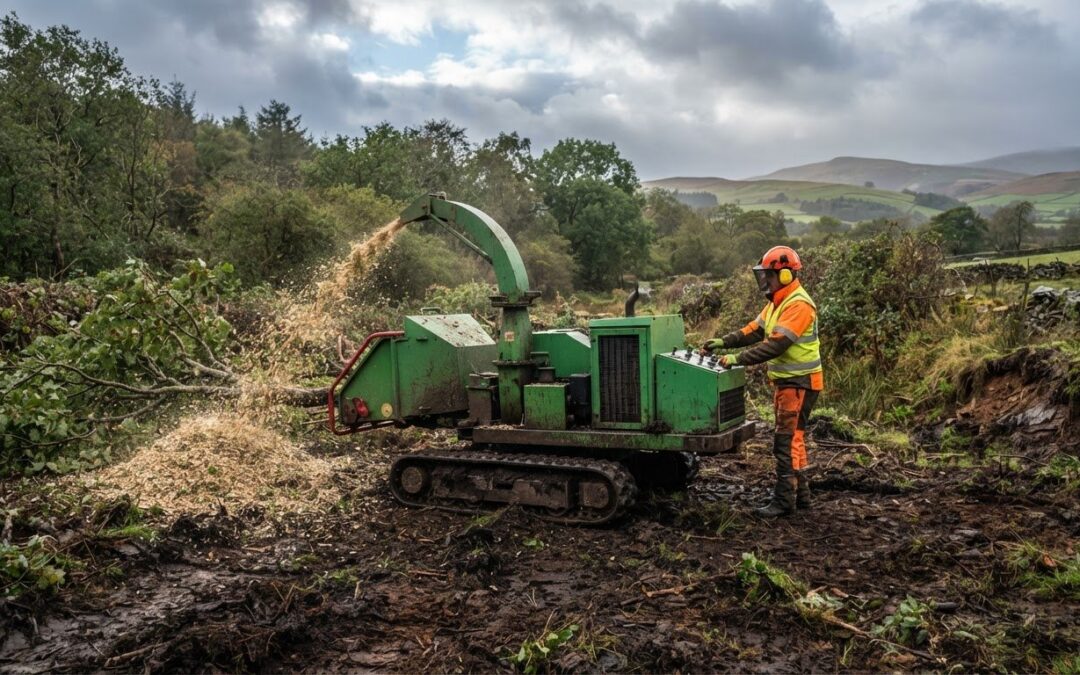
Dragging heavy timber across waterlogged ground is the fastest way to burn through labour hours and wreck job margins. Bringing the processing power directly to the fallen tree beats dragging brash every single time. For demanding rural and commercial projects, securing a high-performance tracked chipper for site clearance Dumfries contractors rely on is the simplest way to protect your timeline.
If you’ve ever watched a towed wheeled chipper bog down to its axles in wet clay, or lost half a shift waiting on delayed transport from distant national depots, you know how quickly site conditions turn against you. Saturated soils cause severe rutting, exhaust manual crews, and create avoidable logistical headaches.
Discover how hiring a heavy-duty tracked wood chipper streamlines challenging site clearance across Dumfries and Galloway. This contractor guide covers how to process up to 8-inch timber directly where it falls, minimise manual extraction on broken ground, and source dependable local equipment ready for immediate work.
Key Takeaways
- Navigate saturated peat and heavy clay soils without rutting client ground by utilising low ground-pressure rubber tracks.
- Reduce chainsaw labour and processing bottlenecks by matching machine intake specs to timber diameters up to 8 inches.
- Deploying a high-performance tracked chipper for site clearance Dumfries projects demand keeps extraction corridors short and ends timber drag fatigue.
- Protect site safety on steep embankments by applying correct track orientation and routine pre-start inspection protocols.
- Avoid distant depot haulage delays by sourcing the FORST TR8 on flexible hire from a dedicated regional specialist.
Why Tracked Wood Chippers Are Essential for Site Clearance in Dumfries
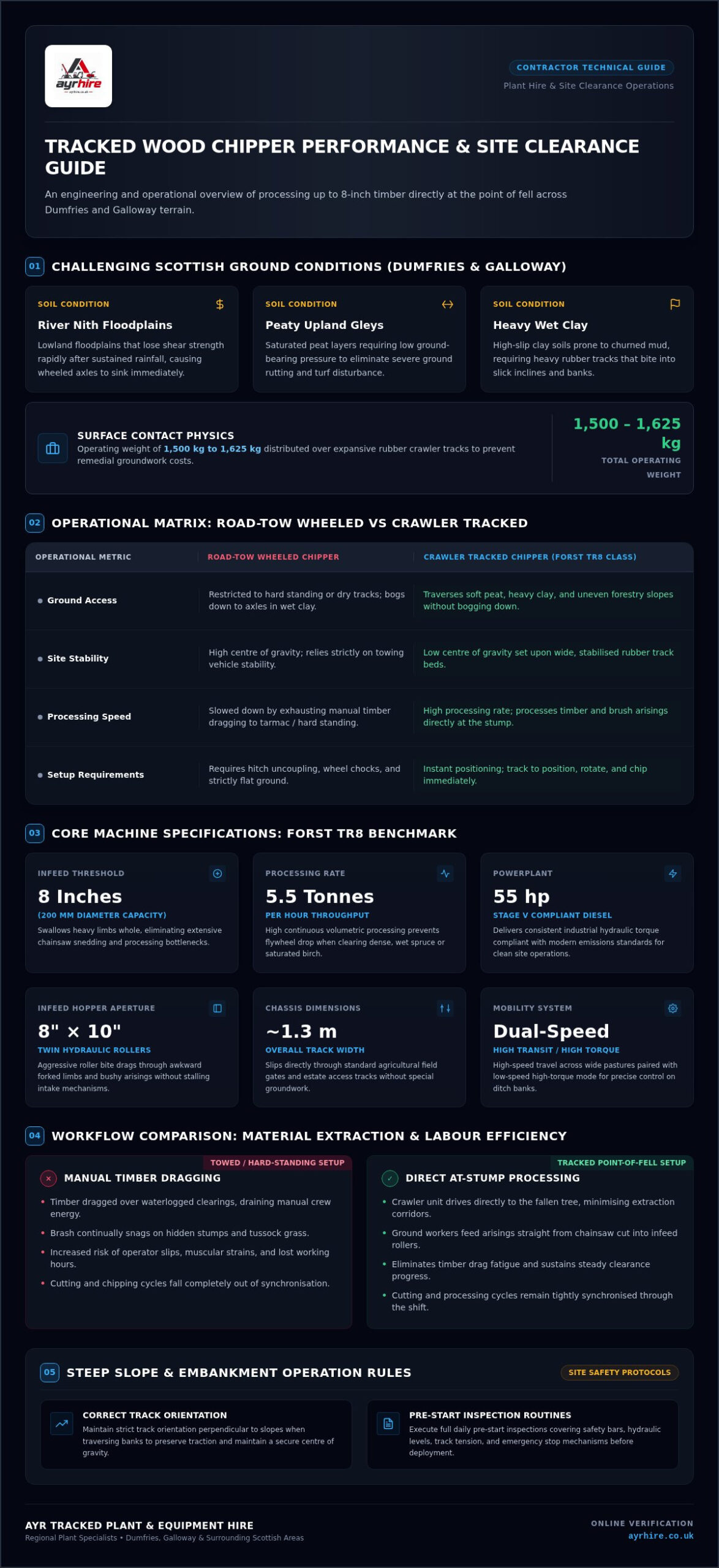
Dumfries and Galloway presents some of the most unforgiving terrain in Scotland. Lowland floodplains near the River Nith, peaty upland gleys, and wet clay soils lose shear strength rapidly after sustained rainfall. Standard wheeled, road-tow chippers hitched to 4x4s frequently sink to their axles, turning access tracks into churned mud. Choosing a dedicated tracked chipper for site clearance Dumfries contractors deploy eliminates these ground-access failures entirely.
Self-propelled crawler tracks spread operating weights between 1,500 kg and 1,625 kg across an expansive surface area. This dramatic reduction in ground-bearing pressure keeps your equipment floating over saturated turf instead of cutting destructive ruts. Processing brash straight at the felling point keeps the job moving forward.
Tackling Challenging Scottish Ground Conditions
Navigating boggy woodland fringes and waterlogged rural margins demands constant traction. Heavy rubber tracks bite into slick surfaces, giving you reliable stability on wet inclines and soft ground. This prevents expensive remedial groundwork on client property while ensuring steady production through wet winter clearance schedules.
Reducing Manual Handling and Labour Fatigue
Dragging timber across uneven, waterlogged clearings drains an arborist crew quickly. Heavy brash snags on hidden stumps and tussock grass, raising the risk of slips, strains, and lost working hours. When you drive the machine directly to the point of fell, manual handling drops sharply. Ground workers feed material straight from the chainsaw cut, keeping cutting and processing cycles tightly synchronised. Across the wider arboricultural sector, specialist contractors such as primetreeservices.co.nz demonstrate how pairing controlled tree felling with direct on-site clearance minimises manual timber handling and keeps crews safe.
Tracked vs Road-Tow Chippers: The Operational Comparison
Understanding traditional woodchipper mechanisms helps clarify why feed geometry and tracking drive systems matter in remote forestry work. The operational gap between towable road units and tracked platforms becomes obvious as soon as tarmac ends:
| Operational Metric | Road-Tow Wheeled Chipper | Crawler Tracked Chipper |
|---|---|---|
| Ground Access | Restricted to hard standing or dry tracks; bogs down easily. | Traverses soft peat, heavy clay, and uneven forestry slopes. |
| Site Stability | High centre of gravity; relies on towing vehicle stability. | Low centre of gravity on wide, stabilised rubber track beds. |
| Processing Speed | Slowed down by manual dragging to hard-standing areas. | High; processes timber and brush directly at the stump. |
| Setup Requirements | Needs hitch uncoupling, wheel chocks, and stable flat ground. | Instant positioning; drive, rotate, and chip immediately. |
Crawler tracks transform awkward, steep clearings into productive work zones by delivering industrial chipping capacity right to the stump.
Key Specifications to Check Before Hiring a Tracked Chipper
Selecting the right plant hire specification dictates how fast your clearance crew progresses through tough site conditions. Choosing an undersized machine leads to bottlenecks, constant chainsaw snedding, and blown deadlines. When sourcing a dependable tracked chipper for site clearance Dumfries contracts involve, verify three core operational areas: processing capacity, chassis dimensions, and operator safety controls.
Infeed Capacity and Timber Processing Power
Intake volume decides how much time operatives spend preparing limbs with chainsaws. A machine with an 8-inch (200 mm) chipping threshold and an 8″ x 10″ infeed aperture swallows heavy limbs and bushy arisings whole. Paired with twin aggressive hydraulic rollers, it drags through forked branches without stalling. Look for a 55 hp Stage V compliant diesel engine delivering continuous throughput up to 5.5 tonnes per hour. That steady torque prevents flywheel drop when chewing through dense, wet spruce or saturated birch.
Chassis Mobility, Track Width, and Slope Stability
Tracking gear must negotiate tight entrances while maintaining solid ground contact on banks. A machine with an overall track width around 1.3 metres slips through standard agricultural gateways and estate paths without track preparation. Check for dual-speed tracking: high-speed travel cuts repositioning time across wide fields, while low-speed high-torque mode gives precise control over ditch banks and rough mounds. Review your operational limits against official HSE steep ground working guidance before committing plant to steep Scottish inclines.
Safety Systems and Emergency Controls
High-capacity tree clearance demands reliable safety design compliant with HSE AIS38 and FISA 604 guidelines. Pre-hire checks should confirm:
- Hopper Perimeter Trip Bars: A responsive emergency stop bar wrapping cleanly around the infeed tray sides and base.
- Intelligent Feed Controls: Electronic no-stress systems that monitor flywheel speed, automatically halting feed rollers to clear blockages before the engine stalls.
- Weatherproof Controls: Sealed IP69-rated control touchpads on both sides of the hopper that withstand wet Scottish weather and intense vibration.
Securing equipment that satisfies these rigorous standards ensures smooth running throughout your contract. Trade arborists can review commercial machinery options with Ayr Tracked Plant & Equipment Hire to match exact job specifications across the southwest.
How to Organise Site Clearance with a Tracked Chipper in Dumfries
Efficient site clearance relies on methodical planning before plant tracks ever touch the turf. Establishing a structured site layout protects delicate ground, keeps chainsaws cutting, and prevents costly bottlenecks. Before felling starts, confirm you hold any required Scottish Forestry felling permissions and complete necessary bird nesting checks during active seasons. Deploying a tracked chipper for site clearance Dumfries jobs require works best when clear zones, paths, and handling tasks are established on day one.
Step 1: Survey Access Routes and Terrain Hazards
Walk the tracking route prior to unloading plant at the boundary. Check field gates against the machine width, verify the structural integrity of timber bridges or stone culverts, and watch for overhead telephone or power lines. Identify concealed hazards such as soft peat pockets, hidden tree stumps, and drainage ditches before tracking forward. Establishing a single, dedicated extraction corridor prevents widespread ground churn across vulnerable peat and wet clay.
Step 2: Establish the Felling and Chipping Progression
Work methodically across designated clearance zones. Clear timber systematically from front to back so operators never trap the tracked machine behind felled trunks or dense brushwood. Orient the infeed hopper directly toward the timber stockpile. This layout allows arborist crews to feed branches directly from the drop zone without dragging timber over rough ground. Enforce a strict working perimeter around the chipper, keeping non-essential personnel clear of the high-velocity discharge zone.
Step 3: Discharge Management and Chip Re-Use
Determine your chip strategy before powering up the rollers. Managing woodchip properly speeds up workflow and keeps projects compliant with local regulations:
- On-Site Mulching: Broadcast arisings across extraction tracks or cleared paths to create an instant weed-suppressing surface, ensuring deposits remain at least 10 metres away from watercourses to satisfy SEPA requirements.
- Off-Site Haulage: Aim the 360-degree rotating discharge chute directly into waiting haulage skips or high-sided transport bins.
- Mechanised Site Transport: Coordinate processing with an ALMA multi-loader hire to move heavy timber and chip bulk across steep inclines where conventional trailers cannot follow.
Executing these three preparation steps keeps your site organised, reduces idle machine hours, and maintains steady clearance progress across demanding southwest terrain. For projects requiring comprehensive felling support alongside site clearance, visit Ayrshire Tree Services to explore professional arboricultural solutions that help manage complex tree removals safely.
Safe Operation and Maintenance Tips for Tracked Chippers on Steep Ground
Working across Galloway hillsides, burn embankments, and uneven clear-fells presents real machinery hazards if gradients are ignored. Saturated turf reduces surface friction quickly. Operating a tracked chipper for site clearance Dumfries tree crews manage requires strict tracking discipline, daily machine inspections, and correct feeding technique.
Tracking Protocol on Gradients and Embankments
Drive tracked plant directly up or down the fall line of an incline. Tracking horizontally across steep contours invites catastrophic side-roll accidents. Keep the heavier engine compartment positioned uphill whether tracking up or down the bank. This orientation preserves ground pressure across the track cleats and keeps steering controls responsive. Avoid sharp pivot turns on slick grass or saturated peaty banks, which can peel a rubber track off its idlers or break ground grip.
Daily Pre-Start Checks and Maintenance Routine
A thorough fifteen-minute walkaround at the start of each shift prevents site delays and mechanical damage:
- Cutting Mechanism: Inspect chipping knives for blunt edges and check anvil clearances to prevent stringy wood wrapping around the drum.
- Track Undercarriage: Measure track tension and scrape out packed clay, brash, or gravel wedged between the track rollers and sprockets.
- Fluids and Air Flow: Check engine oil, hydraulic levels, and coolant, clearing any debris packed into the radiator air screen.
- Safety Devices: Test emergency trip bars and touchpad controls before loading wood to ensure feed rollers stop instantly when triggered.
Preventing Blockages and Managing Wet Brash
Fibrous vegetation, damp conifer limbs, and wet birch scrub present severe clogging risks if fed without care. Alternate bushy green arisings with solid branch wood to allow heavier chips to scour the exhaust chute clear. Keep engine revolutions at full operating speed throughout processing; reduced throttle diminishes centrifugal throw and leads to blocked flues. If material stalls in the throat, engage the hydraulic reverse controls immediately. Never insert manual poles or hands into the infeed chute while the cutting disc is active.
Need certified, thoroughly serviced equipment for your upcoming clearance schedule? Check equipment availability with Ayr Tracked Plant to hire robust site clearance machinery backed by responsive regional support.
Hiring the FORST TR8 Tracked Chipper from Ayr Tracked Plant
Securing a high-calibre tracked chipper for site clearance Dumfries tree surgeons and civil contractors depend on should never involve dealing with distant call centres. National hire desks often broker plant from remote hubs, leading to delivery delays and poorly serviced units. Ayr Tracked Plant provides direct, accountable hire across southwest Scotland. Every machine arrives site-ready, fully inspected, and fitted with razor-sharp blades.
The FORST TR8 8″ Heavy-Duty Advantage
The FORST TR8 delivers commercial chipping performance over unforgiving surfaces. Its 55hp Stage V engine pulls through dense spruce tops, fibrous gorse, and 8-inch hardwood trunks without stalling. Robust steel construction absorbs the physical punishment of heavy clear-fell operations. With a transport width around 1.3 metres, the machine tracks cleanly through standard field gates and tight estate tracks without widening access paths.
Direct Delivery Across Dumfries & Galloway and Ayrshire
We deliver plant directly to your working site across Dumfries, Thornhill, Annan, and the wider region. Direct transport eliminates the hassle of towing plant trailers through congested towns or wrestling heavy machinery onto local roads. If your job demands complementary tracked machinery, explore our specialist plant hire Ayrshire fleet, including compact diggers and multi-loaders designed for low-ground-pressure operation.
Flexible Hire Terms and Booking Your Plant
Project schedules change with weather and site demands. We support trade contractors with straightforward rental terms tailored to commercial workflows:
- Flexible Duration: Hire by the day for quick site interventions or arrange weekly terms for extensive commercial clearance phases.
- Direct Regional Knowledge: Speak directly with plant specialists who understand the ground conditions and logistics of southwest job sites.
- Consistent Machine Readiness: Receive equipment maintained to rigorous mechanical standards, ready to start chipping as soon as it leaves the trailer bed.
Organise your next project with confidence. Reserve your tracked chipper directly through Ayr Tracked Plant & Equipment Hire to secure dependable machinery delivered straight to your site boundary.
Streamline Your Next Dumfries Site Clearance Project
Demanding ground conditions don’t have to stall your clearance schedule. Choosing a self-propelled tracked chipper for site clearance Dumfries jobs demand protects fragile soils, slashes manual extraction time, and lets your crew process heavy timber right where it drops.
Bringing an 8-inch processing capacity directly to the fell site eliminates the exhausting brash-dragging cycles that wear out operatives and eat into profit margins. Ayr Tracked Plant delivers proven FORST TR8 commercial performance directly to sites across Dumfries & Galloway, Ayrshire, and Glasgow. Every machine arrives fully inspected, sharp, and ready for immediate work on flexible daily or weekly rental terms.
Don’t let waterlogged ground or distant depot logistics hold back your contract milestones. Hire the FORST TR8 Tracked Wood Chipper from Ayr Tracked Plant today and keep your rural clearance operations running safely, smoothly, and on schedule.
Frequently Asked Questions
Can a tracked chipper operate safely on steep slopes and wet ground in Dumfries?
Yes, provided proper tracking discipline and gradient limits are maintained. Wide rubber tracks spread machine weight across saturated peat and clay soils, keeping ground-bearing pressure minimal. When negotiating inclines, operators should always track directly up or down the fall line with the heavy engine facing uphill. Avoid side traverses and sharp pivot turns on slick grass to preserve traction and prevent losing directional bite.
What is the maximum diameter of timber the FORST TR8 tracked chipper can handle?
The FORST TR8 processes timber and brash up to 8 inches (200 mm) in diameter. Its rectangular 8-inch by 10-inch infeed aperture and aggressive twin hydraulic rollers crush bushy tops and pull branches through without continuous chainsaw snedding. Powered by a 55hp Stage V diesel engine, the machine delivers up to 5.5 tonnes of throughput per hour without stalling on heavy hardwood.
Do I need a commercial trade account to hire a tracked wood chipper?
No permanent trade account is strictly necessary, though hire arrangements are tailored directly for trade contractors, arborists, and groundcare professionals. Sourcing a tracked chipper for site clearance Dumfries teams require is straightforward. Equipment is supplied on flexible daily or weekly terms. You will just need standard business verification, valid hired-in plant insurance, and site contact details to arrange delivery without delay.
How does a tracked wood chipper compare to a road-towable wood chipper for site work?
A tracked chipper drives directly to the felling point, whereas a road-tow unit remains restricted to hard standing or paved access tracks. Wheeled chippers sink quickly into wet Scottish ground and demand exhausting manual dragging of brash. Tracked machines distribute weight across broad rubber tracks to prevent surface churn. This crawler mobility speeds up clearance cycles and keeps cutting and chipping workflows closely integrated.
Is the tracked wood chipper supplied with sharp blades and fully ready for site work?
Yes, every machine undergoes a full workshop inspection before dispatch to ensure immediate site readiness. Our workshop technicians check blade sharpness, set correct anvil tolerances, and test the electronic auto-feed systems. Hydraulic levels, track tension, and emergency stop trip bars are thoroughly inspected. You receive a fully fuelled, clean, and mechanically sound chipper ready to process material as soon as it leaves the trailer bed.
Can you deliver the tracked chipper directly to rural locations in Dumfries and Galloway?
Yes, we deliver plant directly to sites across Dumfries, Thornhill, Annan, and surrounding rural communities. Securing a dependable tracked chipper for site clearance Dumfries contractors rely on shouldn’t involve distant depots or freight brokers. We transport machinery directly from our Ayrshire depot to your site boundary. This local link ensures punctual delivery schedules so your clearance crew can start work without costly downtime.
What safety equipment is required when operating an 8-inch tracked wood chipper?
Operators must wear full arboricultural PPE in accordance with FISA 604 and HSE guidelines. Essential gear includes a safety helmet with EN 352 hearing protection and mesh eye or face protection. Operatives must wear snag-free work clothing without drawstrings, heavy-duty gloves with close-fitting cuffs, and protective chainsaw boots with high-traction soles. Operatives must also enforce strict exclusion zones around the high-velocity discharge chute.