A traditional mobile crane is often more of a liability than the narrow lanes of Glasgow. You likely already know the frustration of trying to squeeze heavy machinery into a West End lane or onto a fragile tenement site. The threat of expensive road closures and complex council permits can stall a project before the first lift even starts. It is a logistical bottleneck that demands a more surgical, reliable approach. This guide simplifies the process of spider crane hire Glasgow, providing the technical clarity you need to manage narrow-access lifting with confidence.
We will outline how to assess site access, calculate floor loading requirements, and choose the right capacity for your specific project. You will learn how to navigate LOLER regulations and BS 7121 standards while keeping your site efficient and safe. By the end, you will have a clear plan to bypass road closures and handle heavy materials safely, even in the city’s most restricted spaces. This is about finding a dependable local partner and the right tools to get the job done without unnecessary fuss.
Key Takeaways
- Identify why Glasgow’s architecture necessitates compact, outrigger-stabilised machinery to bypass the need for disruptive road closures.
- Learn to calculate the exact Safe Working Load and working radius required for your project before arranging your spider crane hire Glasgow.
- Compare the efficiency of tracked mini cranes against manual handling and HIAB methods to reduce site injury risks and logistical delays.
- Follow a practical site planning guide that covers everything from identifying overhead hazards to accounting for the weight of vacuum lifters.
- Understand the value of local expertise and well-maintained machinery when selecting a specialist plant hire partner for your next lift.
Understanding the Role of Mini Spider Cranes in Glasgow Projects
A mini spider crane is a compact, tracked lifting machine designed specifically for restricted spaces. It uses four stabilising outriggers that spread out from the chassis, resembling spider legs. This design is fundamental to Understanding the Role of Mini Spider Cranes in modern urban construction. These machines are utilitarian and robust. They provide an exceptional power-to-weight ratio. By travelling on rubber tracks, they distribute their weight evenly and can navigate finished floors without causing damage.
Glasgow’s urban landscape presents specific challenges for site managers. The city is famous for its dense red and blond sandstone tenements. These buildings often feature narrow back-courts, restricted lane access, or internal courtyards where space is at a premium. Traditional mobile cranes cannot reach these areas without massive reach or height, which isn’t always feasible. Choosing spider crane hire Glasgow allows contractors to position lifting equipment exactly where the work is happening. It bypasses the physical limits of larger machinery. It’s a surgical solution for a dense, historic city.
The “spider” nickname isn’t just for show. The folding outrigger system allows the crane to level itself on uneven ground or even across different floor levels. This is essential for stability on fragile surfaces or temporary platforms. Because the machines are lightweight compared to their lifting capacity, they exert very low ground pressure. This protects basement vaults or old pavement structures common in the Merchant City and other historic districts.
When to Choose a Spider Crane Over a Mobile Crane
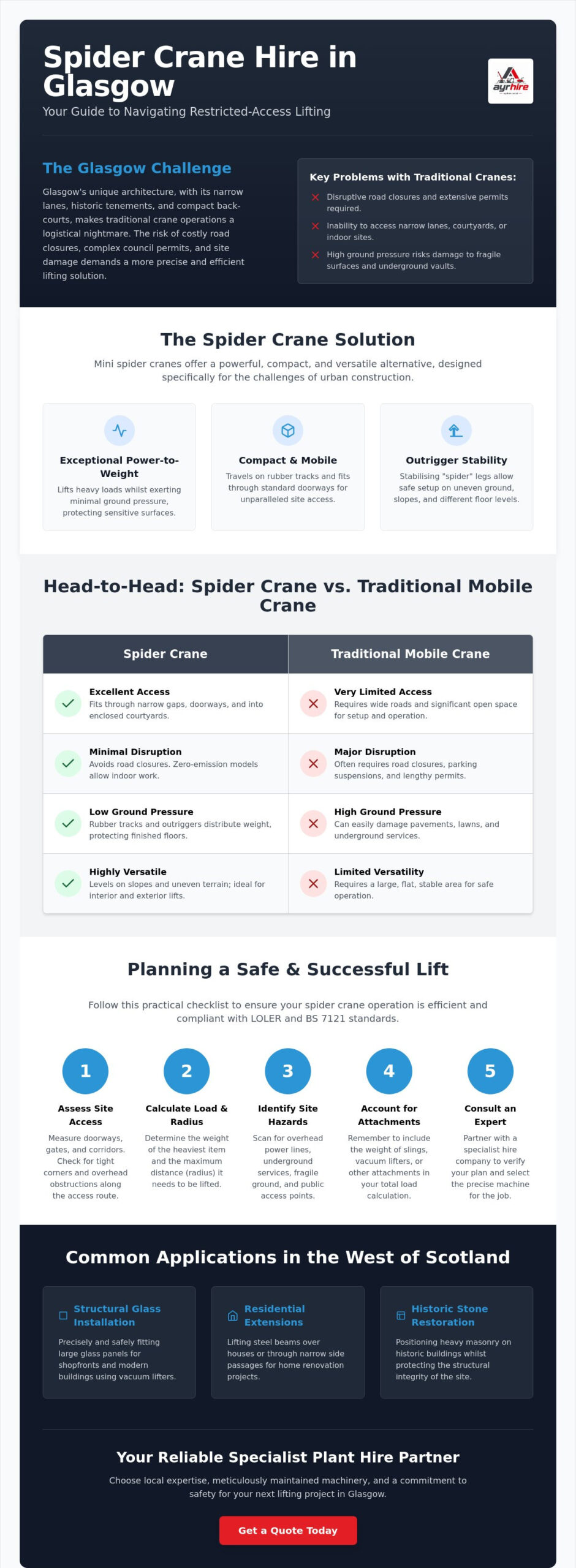
Mobile cranes usually require road closures and parking suspensions. Glasgow City Council permits are expensive and often take weeks to process. A mini crane avoids this logistical headache entirely. It can walk through a standard double door or navigate a tight site entrance on its own tracks. Work continues whilst the street remains open. This keeps the project on schedule and avoids public disruption. For internal projects, zero-emission electric models are vital. They allow for safe operation inside Glasgow shopping centres or office blocks without the risk of toxic exhaust fumes.
Common Applications in the West of Scotland
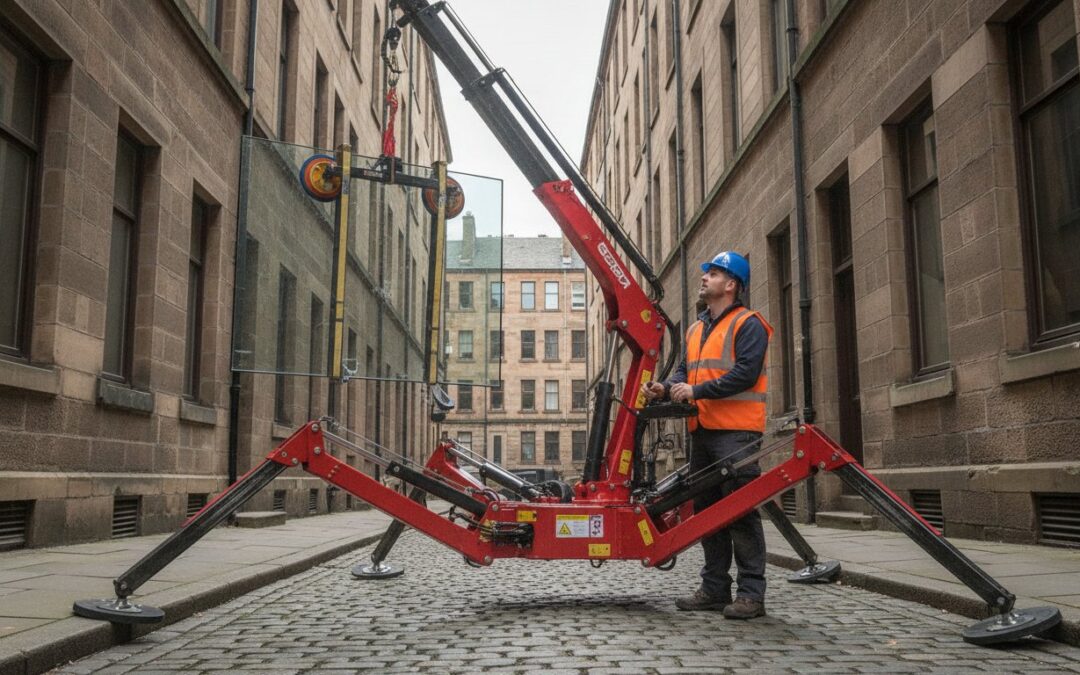
Contractors across the West of Scotland rely on these machines for precision tasks that manual handling cannot manage. Structural glass installation is a primary application. Using vacuum lifters paired with a TMC25/BG250 mini spider crane allows for seamless, safe shopfront fitting. In the West End, these cranes are frequently used for residential extensions. They lift steel beams over houses or through narrow side gaps with ease. They are also the preferred choice for historic stone restoration. Low ground pressure ensures the structural integrity of the site is maintained whilst heavy masonry is positioned; for more complex industrial relocation projects, you can explore Machinery Moving options to ensure all heavy plant is handled with professional care.
Selecting the Right Spider Crane for Your Lifting Requirements
Choosing the correct machine for spider crane hire Glasgow is a matter of physics and site geometry. You must first establish the Safe Working Load (SWL). This is the absolute maximum weight the crane can lift safely under ideal conditions. However, SWL is not a static figure. It fluctuates based on the working radius. The further the boom extends from the crane’s centre, the lower the capacity becomes. If you are lifting a 500kg steel beam but need to reach five metres across a tenement garden, a crane rated for one tonne at its base might be at its limit. Always plan for the heaviest load at the furthest reach. For contractors working across multiple Scottish locations, our comprehensive guide to spider crane hire Scotland covers the full range of site access and lifting challenges you may encounter beyond Glasgow.
Mobility is another critical factor. Glasgow is not a flat city. Sites in Garnethill or the steep streets of the West End require machinery that can handle inclines and rough terrain. Tracked spider cranes are built for these conditions. Their rubber tracks provide grip on wet, uneven ground and distribute weight to prevent the machine from sinking into soft soil. Once in position, the outriggers level the chassis, ensuring a stable platform even on a slope. This stability is what allows these compact machines to perform heavy-duty lifts in areas where a truck-mounted crane would simply tip.
Technical Specifications Decoded
Understanding stowed dimensions is vital for indoor or back-court access. Many Glasgow projects require a machine that can fit through a standard 900mm doorway or a narrow close. The TMC25/BG250 range is a staple for local projects because it balances a narrow footprint with a versatile reach. You must check the maximum lifting height against the maximum working radius. A crane might reach eight metres high, but if your lift is six metres away horizontally, the vertical capacity drops. Precise measurements of your site’s pinch points will ensure the machinery actually reaches the work area. Before your equipment arrives, reviewing a dedicated spider crane hire near me site readiness checklist can help you confirm that access routes, ground conditions, and load calculations are all accounted for in advance.
Fuel and Power Considerations
Power choice depends on the environment. Diesel engines are the standard for outdoor construction, providing consistent torque for heavy lifting. For indoor renovations or work near hospitals and schools, electric or battery-powered models are necessary. Bi-energy cranes offer the best of both worlds. They use diesel to travel to the site and then switch to a plug-in electric motor for zero-emission lifting. This is a practical way to meet Glasgow’s Low Emission Zone (LEZ) requirements whilst keeping noise levels low in residential neighbourhoods. If you are unsure which power source suits your site, you can view our range of specialist plant to compare specific model capabilities.
Comparing Spider Cranes with Traditional Lifting Methods
Manual handling remains a significant risk on small-scale Glasgow renovations. Carrying heavy RSJs or glass panels through a narrow tenement close is dangerous. It relies on brute strength and luck. Mechanical assistance is now the industry standard for reducing site injuries. By opting for spider crane hire Glasgow, you replace high-risk manual labour with controlled mechanical power. It is a safer, faster way to manage materials in restricted environments.
Compare this to a HIAB or truck-mounted crane. A HIAB is restricted by the vehicle’s position. If the lane is too narrow for the truck, the crane is useless. A spider crane travels on its own tracks. It can enter the site, navigate around obstacles, and set up exactly where the lift is needed. This independence from the delivery vehicle is a game-changer for land-locked sites in the city centre. You get the reach you need without needing a massive carrier vehicle.
For glazing projects, the efficiency increases when you combine the crane with vacuum lifter hire. This setup allows for the safe positioning of large glass units with minimal personnel. It is a precise, professional approach that traditional methods cannot match. When you look at the total cost, a mini crane is often more affordable than a 50-tonne mobile crane. For most urban projects in Glasgow, spider crane hire Glasgow provides a more efficient alternative. You avoid the high fees associated with road closures and council permits.
Safety and Risk Management
Modern H&S standards prioritise the elimination of manual handling wherever possible. Spider cranes provide precision controls for millimetre-perfect placement. This is vital when installing structural steel into existing masonry. Their outriggers provide excellent stability on made ground or suspended slabs. These surfaces are common in Glasgow’s brownfield developments and require careful load distribution to prevent structural damage.
Efficiency on Tight Sites
Time is money on a busy site. These machines offer rapid setup times. You can go from the trailer to the first lift in under 20 minutes. Certain tracked models even allow for pick and carry operations. This means you can move a load across the site whilst it is suspended. This versatility minimises disruption for other trades and keeps the project programme moving at a steady pace.
How to Plan a Safe Spider Crane Lift on a Glasgow Site
Safe lifting starts long before the machine arrives on site. A methodical approach ensures your project remains on schedule and compliant with UK safety regulations. To manage spider crane hire Glasgow effectively, you must follow a structured planning framework. This prevents avoidable delays and ensures the safety of everyone on the site. Use the following steps to prepare your lifting station.
Step 1: Conduct a site survey. Identify the specific access route and any overhead hazards. Glasgow’s urban sites often feature low-hanging power lines or narrow alleyways. Step 2: Calculate the total load. You must account for the weight of the material plus all lifting tackle. If you are using vacuum lifters for glass, include their weight in your final SWL calculation. Step 3: Specify outrigger mats. Glasgow’s historic pavements and back-courts can be fragile. Use appropriate mats to spread the load and protect underground services. Step 4: Verify LOLER certifications. Ensure the crane and all accessories have a valid Report of Thorough Examination. Step 5: Clear the path. Organise transport to ensure the crane has an unobstructed route to the lifting station.
Navigating Glasgow Access Challenges
Narrow entries are the most common hurdle. You must measure the narrowest point of your access route twice. A standard 900mm doorway might seem wide enough, but protruding pipes or uneven ground can stall the crane. In older districts like the Merchant City, you must also identify underground cellars or vaults. These voids can collapse under concentrated pressure. Clear communication between the operator and a trained banksman is essential during the move. This prevents accidental collisions in tight spaces where visibility is limited.
Lifting Accessories and Attachments
Choosing the right slings, shackles, and spreader beams is as important as the crane itself. For glazing projects, you can achieve exceptional precision by using specialised vacuum attachments. These allow for millimetre-perfect placement of expensive glass units. Weather is another factor to monitor. Glasgow is prone to sudden high winds, especially on exposed sites near the Clyde. Always use an anemometer to check wind speeds before a lift. If speeds exceed the manufacturer’s limits, you must suspend the operation immediately. For professional advice on site preparation, you can contact Ayr Tracked Plant & Equipment Hire to discuss your project requirements.
Reliable Specialist Plant Hire with Ayr Tracked Plant & Equipment
Execution is the final stage of any lifting plan. Choosing the right partner for spider crane hire Glasgow ensures your project starts with the right momentum. At Ayr Tracked Plant & Equipment Hire, we focus on the practical readiness of our fleet. We don’t just supply machinery; we provide tools that are maintained to professional standards and ready for immediate site integration. Our approach is grounded in reliability. We understand that a delay in lifting can stall an entire sequence of trades. We position ourselves as a dependable local ally for contractors who value efficiency and no-nonsense service.
Local expertise is our greatest asset. We understand the specific logistical needs of Glasgow and Ayrshire. From the tight corners of the West End to the industrial sites across the central belt, we know the terrain. This regional commitment means we are familiar with the access challenges discussed throughout this guide. We offer flexible hire terms, including daily and weekly rates, to suit your specific project timelines. This flexibility allows you to manage costs effectively without being tied to rigid, long-term contracts. Hiring from a specialist ensures you get equipment that is fit for purpose and supported by technical knowledge.
In addition to managing heavy equipment, coordinating the arrival of your site team in busy urban areas can be a challenge; for professional crew transport, you can visit Bucks Travel Ltd to explore their fleet of minibuses and coaches.
Our Tracked Lifting Fleet
Our fleet is built around versatility and narrow-access capability. The TMC25/BG250 mini spider cranes are the core of our lifting offering. These machines are chosen for their reliability in high-stakes environments. They provide the reach and capacity needed for most urban projects whilst maintaining a compact footprint. To support your site requirements, we also provide the ALMA Crawler Multi-Loader for moving materials across difficult ground. If your project involves site clearance alongside construction, we offer FORST wood chipper hire to manage debris efficiently. Every piece of equipment in our fleet is selected for its strength and ease of use.
Get a Quote for Your Glasgow Project
Securing the right machinery is a straightforward process. You can contact our team for expert advice on your specific lift requirements. We provide comprehensive coverage across Glasgow, Ayrshire, and Dumfries & Galloway. Whether you are lifting structural steel in a city centre or installing glazing in a residential extension, we have the machinery to support you. Our team is ready to discuss your site dimensions and load requirements to ensure the best fit. Secure your equipment hire today by reaching out for a transparent, professional quote. We focus on getting the job done right, every time.
Secure Your Narrow-Access Lifting Solution Today
Successful lifting in Glasgow depends on precise site planning and selecting machinery that respects the city’s unique architecture. By choosing tracked mini cranes, you bypass the logistical nightmare of road closures and council permits. These machines provide the stability required for fragile historic ground whilst delivering the power needed for structural steel and glazing. It’s about using the right tool for a specific, restricted environment.
Managing spider crane hire Glasgow is simplified when you work with a partner who understands local site constraints. Ayr Tracked Plant & Equipment has served Glasgow, Ayrshire, and Dumfries & Galloway since 2026. We are specialists in narrow-access tracked plant. Our fleet is maintained for practical readiness and immediate deployment. We offer flexible daily and weekly hire terms to keep your project on track and within budget.
Request a Specialist Hire Quote for Your Glasgow Project. Your next lift doesn’t have to be a logistical headache. With the right planning and a dependable machine, you can overcome any access challenge with confidence.
Frequently Asked Questions
Do I need a special licence for spider crane hire in Glasgow?
Yes, any operator on a commercial site must hold a valid CPCS or NPORS card. This ensures they’ve the technical training to manage lifting operations safely under LOLER regulations. For residential projects, you must ensure a competent person is responsible for the lift plan. If you don’t have a qualified operator, a managed contract lift is the safest option for your project.
How much weight can a mini spider crane actually lift?
Lifting capacities vary between models, but the TMC25/BG250 range typically handles up to 2.5 tonnes. It’s vital to remember that capacity decreases as the boom extends. When arranging spider crane hire Glasgow, always check the load chart for your specific working radius. A crane that lifts 2 tonnes at its base might only lift 500kg at a 5-metre reach.
Will a spider crane fit through a standard house door?
Yes, many compact models are designed with a stowed width of approximately 750mm to 900mm. This allows them to pass through a standard doorway or a narrow side gate with ease. The rubber tracks provide precision steering, making it possible to navigate through a tenement close or a garden path. Always measure the narrowest point of your access route before the machine arrives.
Can spider cranes be used on indoor flooring or mezzanine levels?
Yes, their lightweight design and low ground pressure make them ideal for internal use. We provide zero-emission electric or battery-powered models that are safe for indoor shopping centres and offices. To protect fragile surfaces, we use outrigger mats to distribute the weight. This prevents damage to tiles, raised floors, or mezzanine structures whilst providing a stable platform for heavy lifting tasks.
What is the difference between a spider crane and a mini crawler crane?
The main difference is the outrigger system. A spider crane uses four independent legs to provide stability on uneven ground. A mini crawler crane typically lifts whilst on its tracks and doesn’t always feature outriggers. Spider cranes are generally more versatile for Glasgow sites because they can level themselves on slopes or steps. This makes them the superior choice for restricted urban environments.
Do you provide an operator with the spider crane hire?
We offer both CPA Hire and managed Contract Lift services. With CPA Hire, you’re responsible for providing a qualified operator and insurance. A Contract Lift is a more comprehensive service where we provide the operator and take responsibility for the lift plan. The choice between these options is a key part of spider crane hire Glasgow logistics for most local contractors.
What happens if the ground is uneven on my Glasgow site?
The independent outriggers are designed to handle uneven terrain, inclines, and even stairs. Each leg can be positioned at different heights and angles to ensure the chassis remains perfectly level. This is essential for sites in the West End or Garnethill where flat ground is rare. The crane’s computer system will only allow the lift to proceed once the machine is stabilised.
How do I transport a spider crane to my site in Glasgow?
We handle the logistics of delivery and collection using our own plant trailers or beaver-tail lorries. Our transport team ensures the crane arrives on time and is positioned safely at your site entrance. We cover all areas across Glasgow and Ayrshire, providing a direct service to your lifting station. This removes the need for you to arrange third-party transport or complex towing equipment.